


I see a crowded market for skin analysis machine distribution. Competition centers on technological innovation, pricing strategies, and contractual relationships. North America led the skin analysis systems market in 2025. Consolidation continues through acquisitions.
| Metric | Value |
|---|---|
| Global AI skin analysis market size (2026) | USD 2.13 billion |
| Projected market size (2033) | USD 6.30 billion |
| CAGR (2026–2033) | 16.8% |
The global market size reached USD 1.2 billion in 2024, with projections of USD 3.08 billion by 2033 at a 12.5% CAGR. Distributors must align machine selection with varied customer types and geographic conditions. I propose a structured approach: segment your markets, match features to those segments, evaluate total cost of ownership, and use a step-by-step framework.
Key Takeaways
●Identify your target markets and customer segments first. This guides your machine selection.
●Match machine features to each segment’s needs. Dermatologists need precision; spas need speed and ease.
●Evaluate total cost of ownership over three years. Include training, support, and spare parts.
●Use a step-by-step framework: map demand, compare suppliers, pilot test, and negotiate terms.
●Carry multiple product lines to serve different segments effectively. One machine cannot fit all.
Identify Markets and Customer Segments
Geographic and Economic Market Variations
I start every distribution plan with a map of regional demand. North America leads with a market size of USD 5,963.8 million and a weighted CAGR of 13.8%. Europe follows at USD 4,486.4 million with a 12.9% CAGR. Asia Pacific shows the fastest growth at 15.2%, climbing from USD 1,973.3 million in 2026 to USD 4,003.1 million by 2031. Latin America sits at USD 2,509.1 million with a 13.3% CAGR, and the Middle East and Africa reach USD 763 million at 12%.
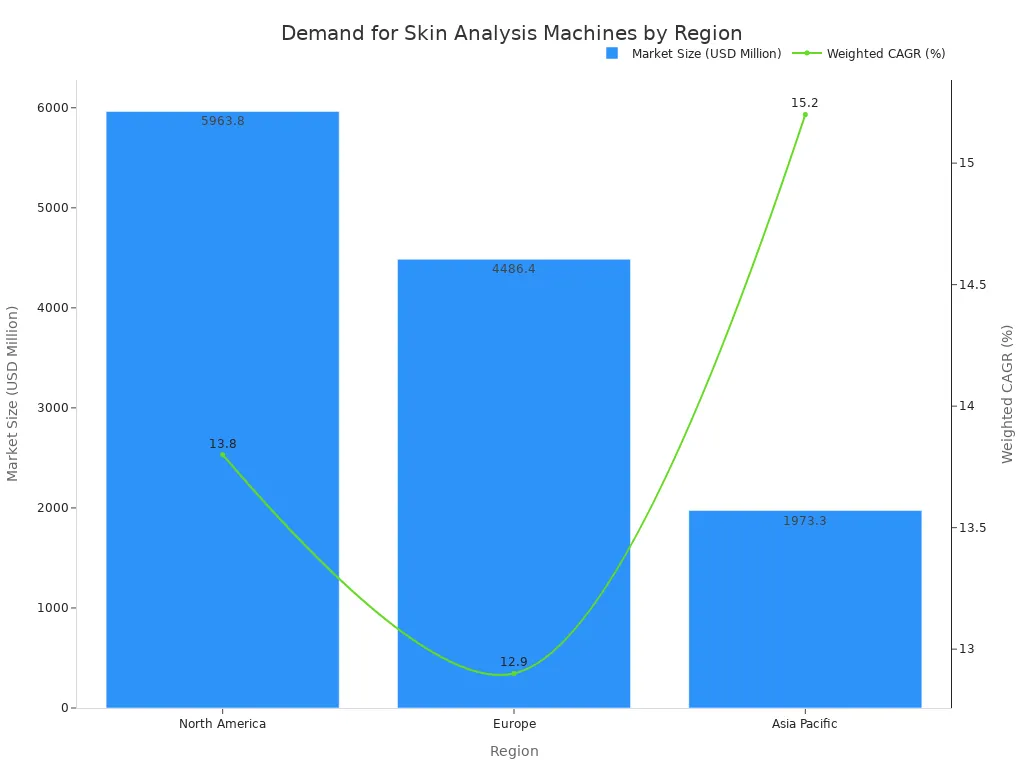
| Region | Market Size (USD Million) | Weighted CAGR |
|---|---|---|
| North America | 5,963.8 | 13.8% |
| Europe | 4,486.4 | 12.9% |
| Asia Pacific | 1,973.3 (2026) → 4,003.1 (2031) | 15.2% |
| Latin America | 2,509.1 | 13.3% |
| Middle East & Africa | 763 | 12% |
These numbers tell me where to place inventory and where to invest in training. North America rewards high-end clinical devices. Asia Pacific rewards affordable, portable units for salons and retail. Local competition and salon demand shift fast, so I track customer acceptance in each city before I commit to a skin analysis machine order.
Segment-Specific Needs: Dermatologists, Spas, and Retailers
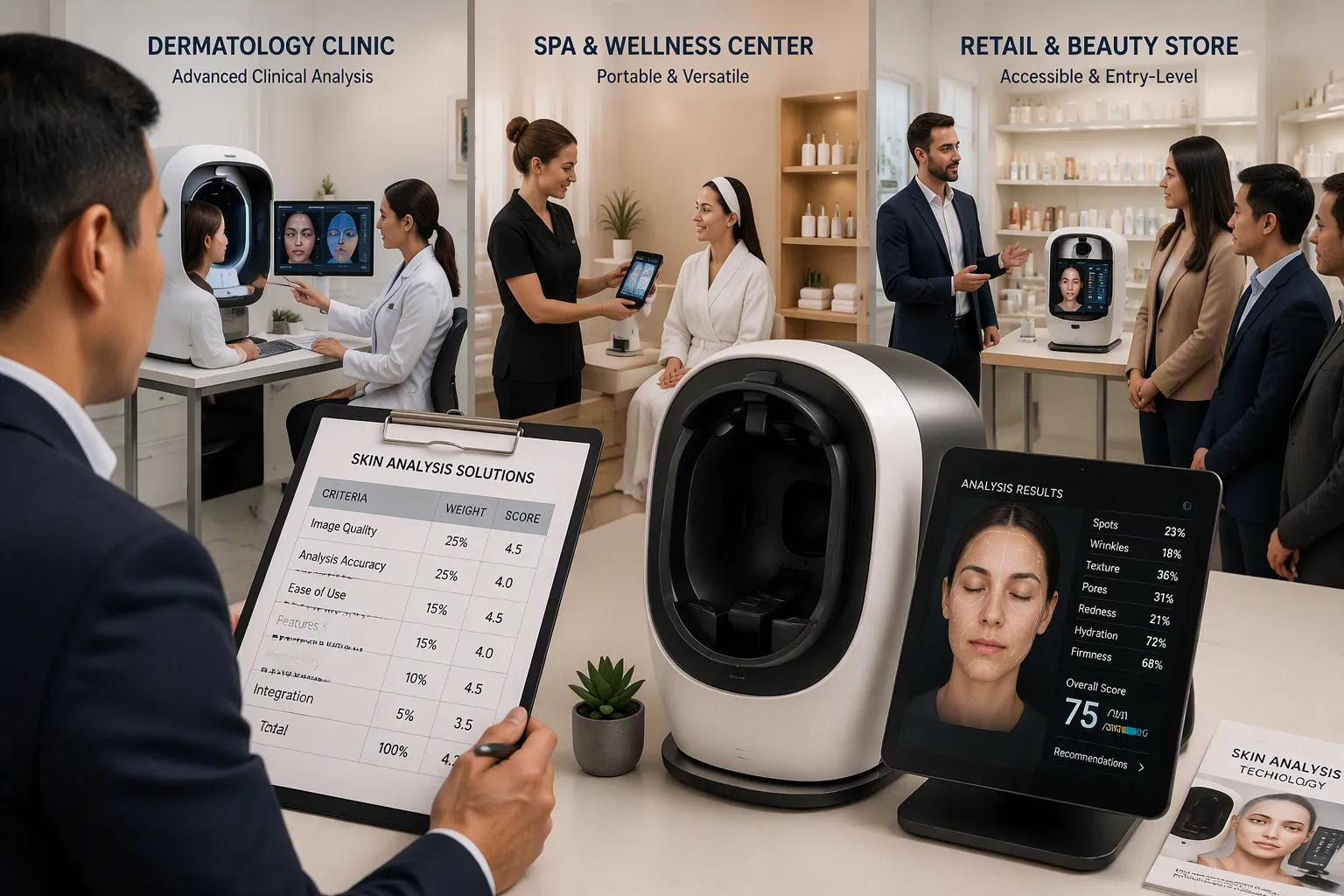
The US market splits by application into skincare, aesthetic treatments, cosmetics, and medical diagnosis. End users fall into healthcare, personal care, and other groups. Hospitals, beauty salons, and other buyers each want different features. A dermatologist needs clinical-grade accuracy and diagnostic depth. A spa needs speed and ease of use. A retailer needs a compact device with a friendly interface.
I treat these as separate product lines, not one machine for everyone. Dermatologists pay more for precision. Spas and retailers pay for throughput and low training time. This gap sets up my next step: matching machine features to each segment.
Match Skin Analysis Machine Features to Segment Needs
Imaging Technology and Analytical Depth
I match imaging specs to the buyer’s clinical ambition. Dermatologists need clinical-grade accuracy. Spas need speed and ease. The evidence supports this split clearly.
| Imaging Technique | Sensitivity (Se) | Specificity (Sp) | Accuracy (Acc) | Dimensionality |
|---|---|---|---|---|
| Multiphoton Tomography (MPT) | 71–95% | 69–97% | Similar to CLSM; 3D tumor depth estimation more accurate | 2D/3D |
| 3D Topography (Fringe Projection) | 80% | 76.7% | Increased specificity vs. similar studies | 2D/3D |
| Dermoscopy | 79–93% | 69–89% | 76.1% | 2D |
| Multispectral Imaging (MSI) | Higher than dermoscopy alone | Higher than dermoscopy alone | — | — |
Sensitivity and specificity were reported to be higher when a multispectral imaging system was used for making the decision to perform biopsy for a suspicious lesion than in the case of analyzing only dermoscopic images.
Accuracy of distinction between melanoma and benign lesions is improved by 50% when dermoscopy is used versus the standalone clinical evaluation.
Multispectral imaging systems represent the most technologically advanced segment of the dermatology imaging devices market. They capture skin data across multiple wavelengths. This provides enhanced visualization of subsurface structures, vascular patterns, and pigment distribution. Adoption concentrates in specialized centers and academic settings due to higher acquisition costs and training requirements. Despite narrower deployment, multispectral systems contribute disproportionately to market value through premium pricing and their role in complex diagnostic workflows, particularly in oncology-focused dermatology.
For dermatology clients, I prioritize high-resolution, multi-spectral, and 3D imaging. 3D volumetric analysis eliminates sampling bias. It captures entire nerve fiber lengths and epidermal volume. This avoids false density readings that occur in 2D when hyperplasia changes volume. 3D imaging also maps nerve–immune cell interactions that are ambiguous in 2D slides. 3D imaging captures volumetric data and maps tissue structures that 2D sections miss.
For spas, I look for speed and simplicity. High-resolution 3D technology with four wavelengths of visible light delivers accurate skin condition diagnosis without complex training. Systems that combine broad-spectrum LED and Xenon flash lamps achieve accurate color temperature and high-resolution images. They reveal hydration, hyperpigmentation, elasticity, and facial symmetry. These features suit spa consultations perfectly.
Software, Portability, and Brand Customization
Consumers now invest in home devices. This trend compels traditional aesthetic clinics to adopt at-home solutions. It democratizes access to professional-grade treatments. Distributors should note that dermatology clinics are a key end-user segment.
Spare parts availability and supplier reliability are non-negotiable. I verify that the supplier stocks replacement components and offers technical support. A skin analysis machine without reliable parts support becomes a liability. I also check that the software interface supports multiple languages for different regions.
Evaluate Skin Analysis Machine Cost and Supplier Support
Cost-Benefit Across Customer Tiers
I compare upfront price against expected returns for each buyer type. The gap between tiers is wide. Mid-range spa and clinic units are typically priced between $1,500 and $2,800, while premium medical systems like the VISIA range from $7,000 to $20,000.
Mid-range skin scanner units are typically priced at $1,500 to $2,800 per unit on Amazon, positioning them below VISIA-tier hardware. For reference, Canfield VISIA hardware units typically range from $7,000 to $20,000, while per-session costs at clinics generally run $50–$200.
Clinics recover costs through per-session fees. Spas recover costs through retail product sales and repeat visits. I calculate total cost over three years, not only purchase price. Ongoing expenses include calibration, software updates, disposable accessories, warranty, training fees, installation, and data storage charges. High-end imaging systems require calibration visits and may drift over time. Software-only options use automatic updates that prevent drift. I ask suppliers for written service procedures and realistic response times.
Training and After-Sales Support
Supplier support determines long-term satisfaction. I verify technical stability first. A skin analysis machine without reliable parts support becomes a liability. I check that the supplier stocks replacement components and responds to service requests quickly.
Training programs vary by manufacturer. Some companies offer training resources, manuals, and online support to help technicians understand the machine’s functions and interpret results correctly. Others provide specialized programs such as professor-led education and technical training. I request access to these materials before signing any distribution agreement. I also confirm that the software interface supports multiple languages for different regions. Strong after-sales support protects my reputation and keeps end users loyal.
Step-by-Step Selection Framework
Step 1: Map Market Demands to Feature Requirements
I build a weighted checklist before I contact any supplier. This checklist turns my market research into a scoring tool. I list every feature that matters to my target segments. Then I assign each feature a weight based on how much my buyers value it.
For a dermatology-focused territory, I weight clinical accuracy and 3D imaging highest. Multi-spectral capability earns a heavy weight because it improves melanoma detection. Software reporting depth also scores high. For a spa-heavy territory, I flip the weights. Speed, ease of use, and portability rise to the top. Price sensitivity pushes entry-level pricing into a prominent position.
I score each candidate machine against this checklist on a simple scale. A machine that scores well for dermatologists may fail for retailers. That outcome is useful. It tells me to carry two product lines instead of one. The weighted checklist also protects me from sales pressure. A supplier’s demo always looks impressive. My checklist keeps the decision tied to real buyer needs.
I also factor in regional conditions. Asia Pacific buyers reward affordable, portable units. North American buyers reward premium clinical systems. My checklist reflects those regional priorities from the start.
Step 2: Compare Suppliers, Pilot Test, and Negotiate
I narrow the field to three or four suppliers. Then I run a pilot test with a few end users. I place demo units in one dermatology clinic, one spa, and one retail location. I ask each user to run the machine for two weeks. I collect feedback on image quality, software speed, and training time. Real-world use reveals problems that a showroom demo hides.
Supplier reliability comes next. I verify that the supplier stocks spare parts and responds to service requests quickly. I check technical stability and software update schedules. I confirm that training materials exist in the languages my buyers speak. A skin analysis machine without reliable parts support becomes a liability, so this step is non-negotiable.
Negotiation covers terms that protect my margin. I ask for logo customization so I can build my own brand. I discuss minimum order quantities and push for flexible volumes during the first year. I request white-label documentation and marketing materials. I also negotiate warranty length and calibration service pricing. These terms matter as much as the unit price.
This framework answers my core question directly. I map demand, compare suppliers, pilot test, and negotiate. Each step reduces risk and improves my return on investment. I apply the same process in every new territory I enter.
Three pillars guide my machine selection process. I know my market first. I align features to each segment. I weigh cost alongside support. My structured framework—map demand, compare suppliers, pilot test, negotiate terms—protects my return across every territory. This framework removes guesswork from inventory decisions. It reduces risk and improves results. The process keeps my decisions grounded in facts. Apply these steps to your next purchase. Contact trusted suppliers for demos or sample units. Start with a weighted checklist. Build your product lines around real buyer needs and regional conditions. Let evidence drive your selection. A structured approach turns market data into profitable outcomes.
FAQ
How do I decide between a clinical-grade and spa-grade machine?
I prioritize clinical accuracy for dermatology buyers. Multispectral and 3D imaging matter more there. For spas, speed and ease win. I match features to the buyer’s specific workflow.
What customization options should I look for?
I look for logo branding and white-label documentation from suppliers. This helps me build my own brand without developing hardware from scratch.
How important is after-sales support?
Very important. I verify spare parts availability and training resources before signing agreements. A machine without reliable support becomes a liability for my reputation.
What regional factors affect my choice?
North America rewards premium clinical devices. Asia Pacific rewards affordable portable units. I adjust my inventory based on regional market size and growth rates from the data.
Should I carry multiple product lines?
Yes. I treat dermatologists, spas, and retailers as separate product lines. One machine cannot serve everyone well. My weighted checklist helps me decide which lines to stock.
Post time: Sep-18-2026


