


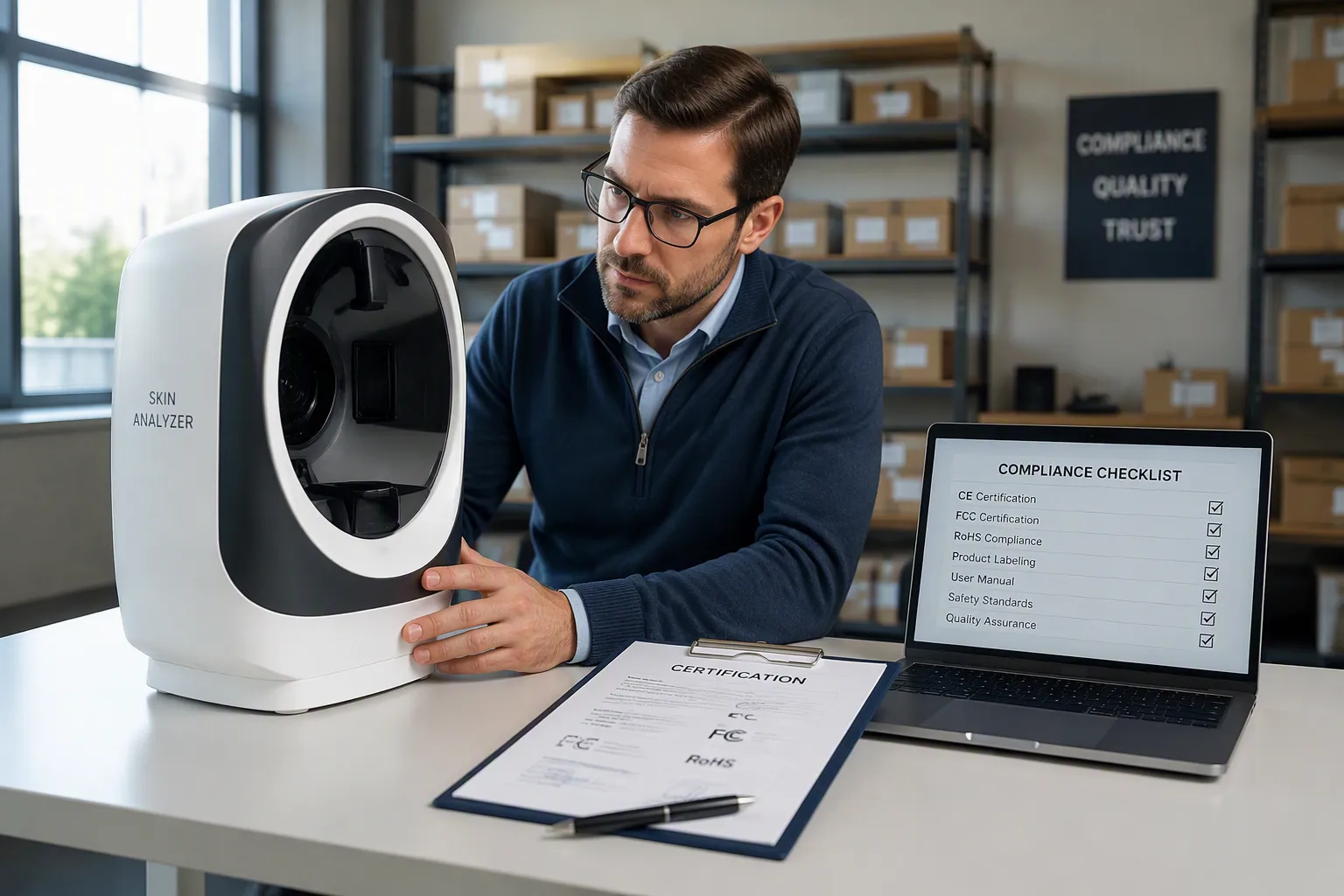
I see too many distributors lose shipments because they skip certification checks. Importing a skin analysis machine without verified FDA clearance, CE marking, RoHS compliance, FCC certification, ISO 13485, or regional marks like CCC, KCC, BIS, or SFDA risks customs seizure, legal liability, and forced market withdrawal. This article explains what each certification covers and how to verify it before purchase.
Key Takeaways
●Check FDA, CE, RoHS, FCC, and ISO 13485 certifications before you buy a skin analysis machine.
●Verify each certificate directly with the official database to avoid customs seizure and legal problems.
●Match every certificate to the exact model you plan to import, because a certificate for a different model does not protect your shipment.
FDA Status For Skin Analysis Machines
FDA Clearance Or Registration
I always start with one question: does this device need 510(k) clearance, or does registration alone cover it? The answer depends on the device’s intended use and risk class. A 510(k) clearance means the FDA reviewed the device and agreed it is substantially equivalent to a legally marketed predicate. Registration is different. It only means the manufacturer listed its establishment and device with the FDA. Exempt status means the device falls into a category the FDA does not require to go through 510(k) review.
| FDA Pathway | What It Means |
|---|---|
| 510(k) clearance | FDA reviewed and cleared the device before sale |
| Establishment registration | Manufacturer and device are listed with the FDA |
| Exempt status | The device category does not require 510(k) review |
One date matters here. Beginning July 8, 2026, importers of most regulated consumer products must electronically file (eFile) certificates of compliance with U.S. authorities. I tell distributors to plan for this now, not later.
How To Verify FDA Status
Verification takes three steps, and I never skip any of them. First, request the FDA establishment registration number from the supplier. Second, search the FDA 510(k) database for the device name and manufacturer. Third, confirm the device listing matches the model you plan to import.
I also check that the registration is active, not expired. A supplier who hesitates to share these numbers is a red flag. Before you commit to any skin analysis machine order, match every document to the exact model number on the label.
CE Marking For The EU
Which EU Rules Apply
I always ask suppliers which EU regulation their device falls under. The answer determines everything about the compliance path. A skin analysis machine may fall under the Medical Device Regulation (MDR), the older Medical Devices Directive (MDD), or the Low Voltage Directive and Electromagnetic Compatibility Directive for electrical safety.
The shift from MDD to MDR changed the landscape significantly. Under MDD, most medical software was Class I with no external review. Under MDR, many such products are upgraded to higher risk classes requiring notified body audits. The MDR mandates additional safety and performance data with 23 General Safety and Performance Requirements compared to 13 Essential Requirements under MDD. Post-market surveillance is also more rigorous. Manufacturers must report serious incidents within 15 days under MDR versus 30 days under MDD.
●Medical software reclassified from Class I to higher risk categories under MDR
●Products previously outside medical device scope now covered, including skin-related devices
●Unique Device Identification system introduced for traceability across the supply chain
How To Confirm A Valid CE Certificate
Verification requires three concrete steps. First, check the Notified Body number on the certificate. Second, request the EU Declaration of Conformity from the manufacturer. Third, cross-reference the Notified Body against the NANDO database.
I never accept a CE certificate at face value. The NANDO database tells me whether the Notified Body is actually authorized for the device category. A certificate from an unauthorized body means nothing. I also confirm the Declaration of Conformity lists the exact model I plan to import.
RoHS Compliance For Electrical Safety
What RoHS Restricts
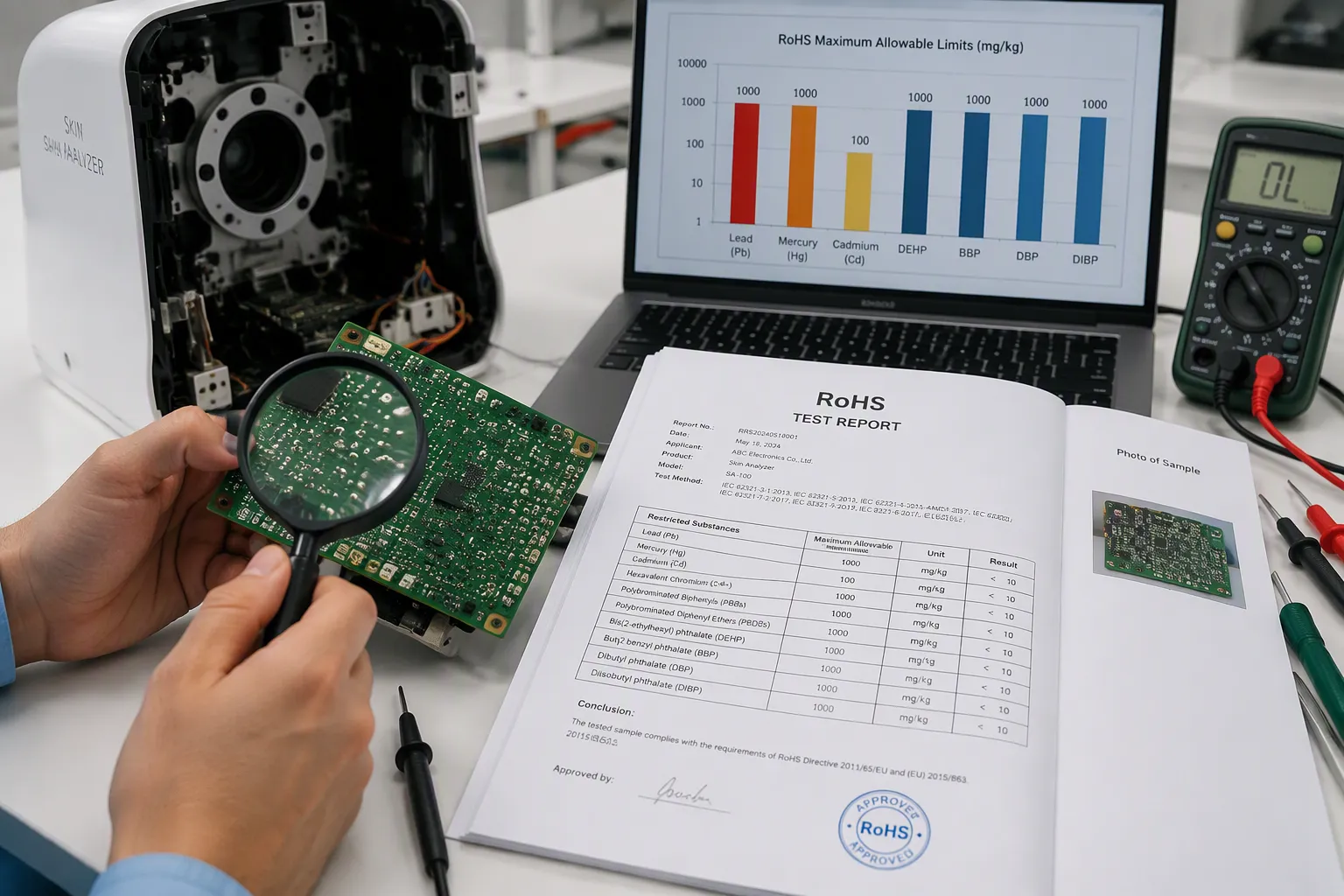
RoHS limits the hazardous substances inside the electronics of a skin analysis machine. The directive restricts ten substances in total. Lead, mercury, hexavalent chromium, polybrominated biphenyls, polybrominated diphenyl ethers, and four phthalates each carry a maximum limit of 0.1% (1000 ppm). Cadmium carries a tighter limit of 0.01% (100 ppm).
| Restricted Substance | Maximum Allowable Limit |
|---|---|
| Lead (Pb) | 0.1% (1000 ppm) |
| Mercury (Hg) | 0.1% (1000 ppm) |
| Cadmium (Cd) | 0.01% (100 ppm) |
| Hexavalent Chromium (Cr6+) | 0.1% (1000 ppm) |
| Polybrominated Biphenyls (PBBs) | 0.1% (1000 ppm) |
| Polybrominated Diphenyl Ethers (PBDEs) | 0.1% (1000 ppm) |
| Bis(2-ethylhexyl) phthalate (DEHP) | 0.1% (1000 ppm) |
| Benzyl butyl phthalate (BBP) | 0.1% (1000 ppm) |
| Dibutyl phthalate (DBP) | 0.1% (1000 ppm) |
| Diisobutyl phthalate (DIBP) | 0.1% (1000 ppm) |
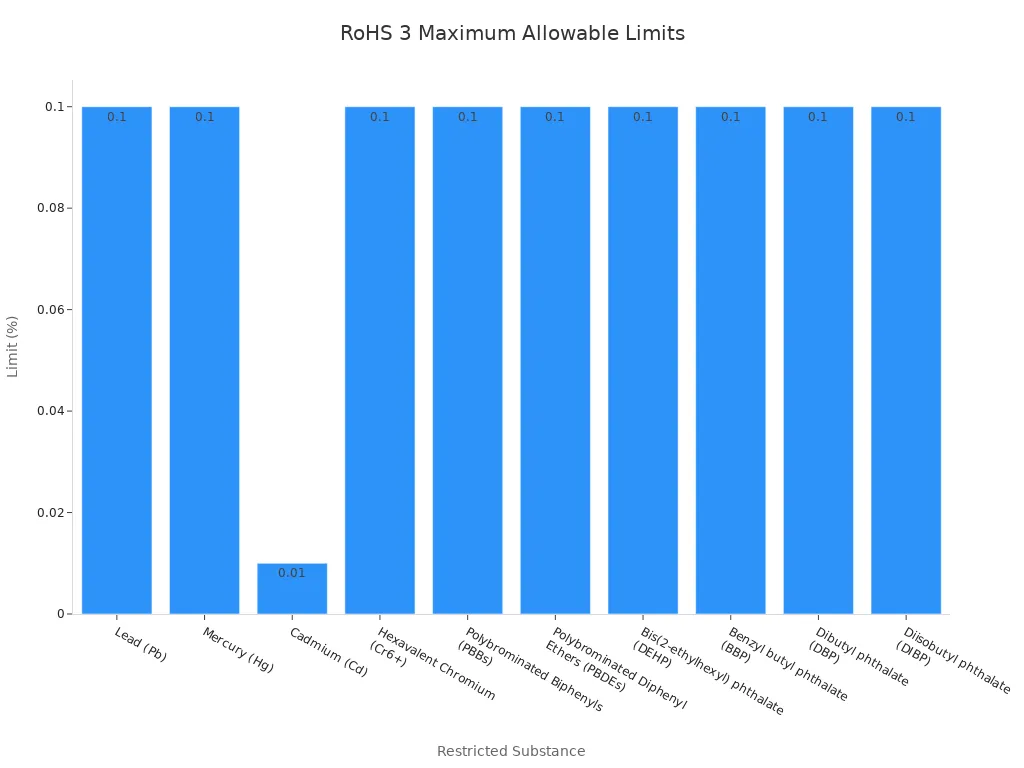
These limits matter for skin analysis machine electronics because the devices contain circuit boards, wiring, sensors, and power supplies. Solder, plating, and plastic housings are common places where restricted substances appear. The four phthalates joined the list in 2015 under RoHS 3, so older test reports may not cover them at all.
How To Check RoHS Reports
I never accept a one-page certificate that simply says “RoHS compliant.” I ask for the full test report from an ISO 17025-accredited laboratory. That accreditation tells me the lab meets an internationally recognized standard for testing competence.
A complete report contains several elements I check every time. It should include a product description and photos that identify the tested item, a bill of materials breaking down the components, and references to the IEC 62321 test method series. The report must show per-material results for all ten restricted substances, including the four phthalates added in 2015. It should end with a clear pass/fail determination, the lab’s ISO 17025 accreditation, and the issue date.
One detail trips up many distributors. The report scope must cover the actual device model you plan to import. A report for a different model, even from the same factory, does not protect your shipment. I match the model number on the report to the model number on the label and the purchase order. When those three match, I know the compliance claim is real.
FCC Rules For Skin Analysis Machines
When FCC Rules Apply
I ask one question first: does the device transmit any wireless signal? FCC rules apply to any skin analysis machine that includes Bluetooth, Wi-Fi, or any other intentional radiator. The rules also cover unintentional radiators. These are devices that generate radio frequency energy during normal operation without a dedicated transmitter. The internal clocks on circuit boards and the scanning mechanisms in imaging sensors both fall into this category. The FCC treats these emissions seriously. A device that exceeds the allowed limits can interfere with nearby electronics like medical monitors or Wi-Fi networks. The governing standard is FCC Part 15. That standard sets emission limits for both intentional and unintentional radiators. Manufacturers must test the device and verify compliance before sale.
I always confirm with the supplier whether the device has an FCC grant. A verbal “yes” does not satisfy me. I need documentation. I recommend checking the device type carefully. Devices with cameras, LED arrays, or processing units often contain oscillators that require unintentional radiator testing. Even a machine with no wireless module can require FCC compliance if it contains a microprocessor running above a certain clock speed.
How To Verify An FCC ID
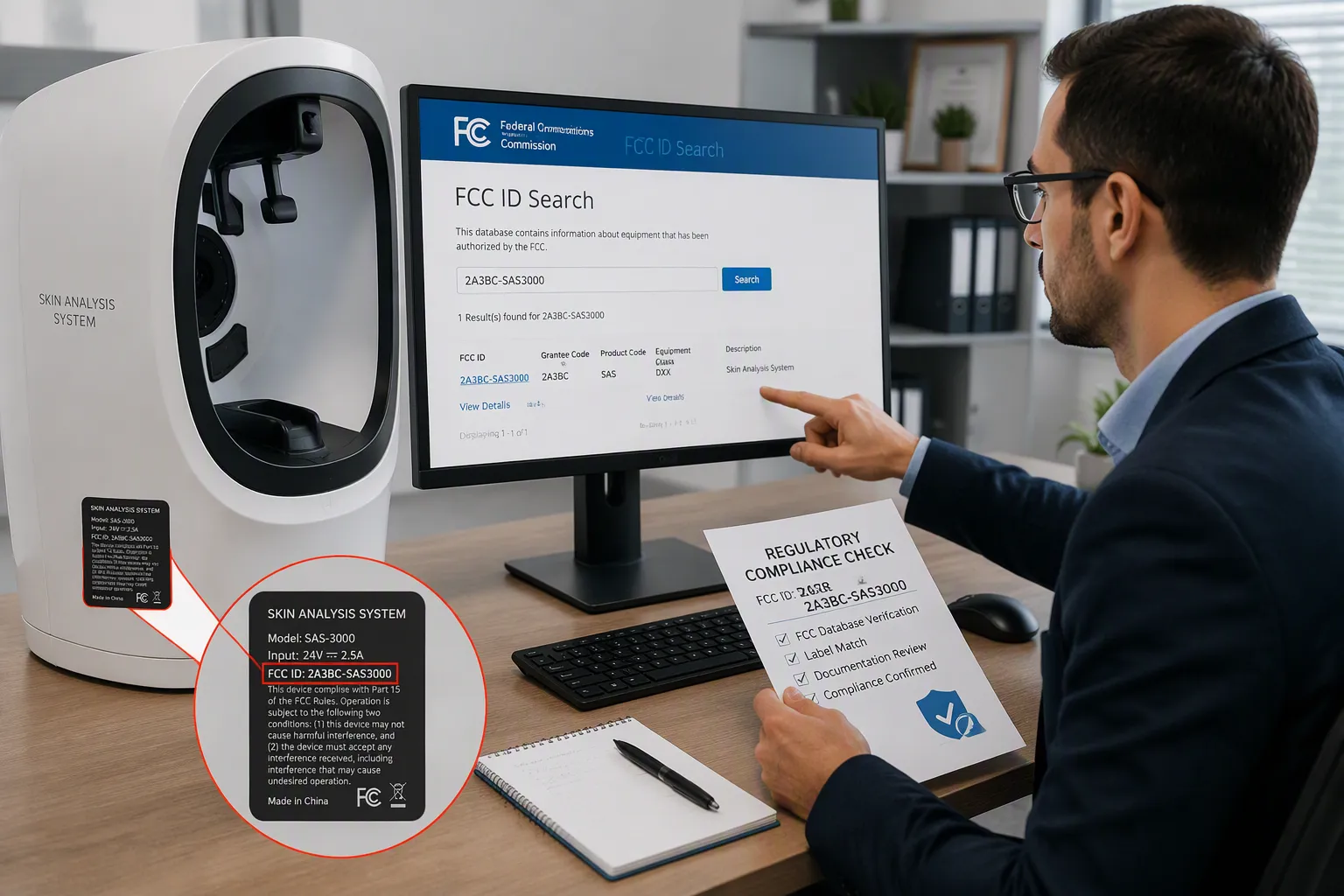
Verification follows three steps I never skip. First, I find the FCC ID on the device label. That ID contains a three-character grantee code followed by a product code. The grantee code identifies the manufacturer. The product code identifies the specific model. Second, I enter the complete ID into the FCC database on the FCC’s official website. The database shows the grantee name, the grant date, and links to the test report. Third, I confirm the grantee name matches the manufacturer I am buying from.
A mismatch between the grantee and the supplier is a clear red flag. It means the supplier is using another company’s certification without authorization. That violates FCC rules and voids the compliance claim. I also check that the model number in the database matches the model I plan to import. A different model number means the certification does not apply to my shipment. I never proceed until these checks pass. One final point: the device label must show the FCC logo and the complete ID before shipment. A missing label causes immediate customs delays.
ISO 13485 And Quality Standards
Why ISO 13485 Matters
ISO 13485 sets the quality management standard for medical devices. A manufacturer with this certification shows it controls design, production, and traceability. I treat it as a signal of manufacturing reliability. A factory that runs a certified quality system documents its processes and corrects defects. That discipline matters when you import a skin analysis machine and need consistent units across orders.
The standard also extends to related testing. ISO 17025-accredited labs test cosmetics and personal care products for microbiology, chemistry, and preservative efficacy. Some suppliers of skin analysis devices also sell topical products. A shared quality framework helps me judge whether the whole supply chain meets the same bar.
How To Validate ISO 13485
I never trust a scanned certificate alone. First, I check that the certificate shows both the Certification Body logo and the Accreditation Body logo. A missing AB logo means the certificate is unaccredited. Second, I confirm the AB is a member of the International Accreditation Forum by checking the IAF website. Third, I search the IAF certificate database at iafcertsearch.org. I also confirm the CB is authorized for the specific scope sector.
In India, the national accreditation body is NABCB. I visit its website and select MDQMS from the accredited CB list. Then I verify two facts: the CB covers my scope sector, and the issue date falls within the valid range. If the CB is not listed, I check the foreign AB’s website and repeat the check. When doubts remain, I refer the certificate to NABCB for verification.
Region-Specific Certifications To Check
China CCC, Korea KCC, India BIS
Every major market runs its own mandatory mark, and I treat each one as a separate gate. China requires CCC for many electrical products. Korea requires KCC for electromagnetic compatibility. India requires BIS registration for a long list of electronics. A skin analysis machine that carries a CE mark does not automatically satisfy any of these three authorities.
I map the destination country before I place any order. A distributor shipping to Shanghai needs CCC documentation. A distributor shipping to Seoul needs KCC. A distributor shipping to Mumbai needs BIS. The marks do not transfer between markets, and customs officers in each country check their own database first.
| Market | Mark | Governing Focus |
|---|---|---|
| China | CCC | Electrical safety and EMC |
| Korea | KCC | Electromagnetic compatibility |
| India | BIS | Product safety and quality |
Saudi Arabia SFDA And Other Marks
Saudi Arabia adds another layer. Importers must hold an active account with the SFDA. They also need the relevant commercial registration certificates on file before shipment clears. I confirm both documents are current before the goods leave the factory.
The intended use of the device shapes which marks apply. Manufacturers build these machines for professional and institutional buyers. Skincare clinics, medspas, estheticians, beauty schools, skincare retailers, distributors, and product brands all fall into that group. A clinic device may face stricter rules than a retail display unit in some markets.
Verification is the final step I never skip. I check each regional mark against the local regulatory authority database before shipment. A certificate that does not appear in the official database does not exist for customs purposes.
I follow one sequence before every order: verify FDA status, confirm CE marking, check RoHS reports, validate FCC IDs, review ISO 13485, then match regional marks. Skipping any step invites customs holds, liability exposure, and lost market access. Consult a compliance expert before finalizing any purchase.
FAQ
Can I import a skin analysis machine with only a CE mark?
No. A CE mark covers the EU market alone. China, Korea, India, Saudi Arabia, and the United States each require their own approval. I always match the mark to the destination country.
What happens if the FCC ID does not match the manufacturer?
I treat that as a serious red flag. It means the supplier uses another company’s certification without authorization. Customs can seize the shipment, and the compliance claim becomes void.
How often should I recheck a supplier’s certificates?
I recheck before every order. Certificates expire, scopes change, and Notified Body authorizations get withdrawn. A valid certificate last year does not guarantee a valid certificate today.
Post time: Sep-14-2026


