


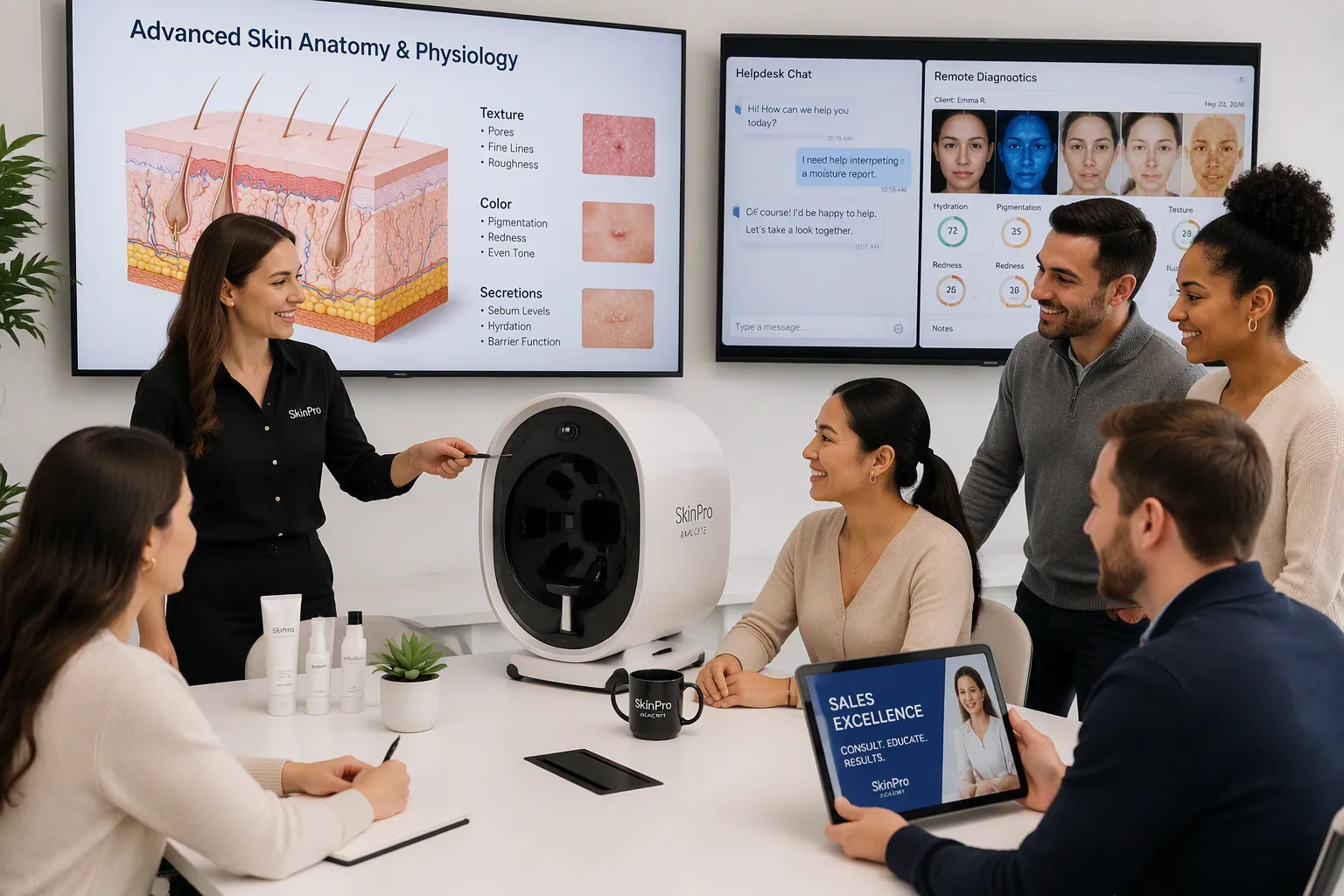
I believe the key to success in this business is simple. Partner with a manufacturer that delivers comprehensive training, reliable ongoing support, and robust after-sales services. These three pillars form the foundation of every profitable distribution operation.
Training equips your team to demonstrate a skin analysis machine with confidence. Ongoing support keeps your clients operational. Strong after-sales services protect your reputation and drive repeat orders.
The right manufacturer separates your business from competitors. They help you win clients and keep them satisfied for years. That partnership matters more than any discount or short-term deal.
Key Takeaways
●Choose a manufacturer that provides comprehensive training for your technical and sales teams.
●Ongoing support and after-sales services keep your clients happy and your business running smoothly.
●Evaluate manufacturers on technology, OEM/ODM options, and red flags to protect your investment.
●Software updates and cloud services can create recurring revenue for your distribution business.
●A strong manufacturer partnership is key to long-term success in skin analysis machine distribution.
Skin Analysis Machine Manufacturers: Training and Support as Pillars
Comprehensive Training Programs
I always tell new distributors the same thing. Your manufacturer’s training program determines how fast your team becomes productive. A strong program covers two areas. First, your technicians need deep technical knowledge. Second, your sales team needs the skills to communicate real value to clinic owners.
Technical training starts with skin science. I look for a curriculum that includes these modules:
1.Advanced Skin Anatomy & Physiology
2.Principles of a detailed skin analysis
3.Gathering important & relevant information
4.Skin conditions related to Texture
5.Skin conditions related to COLOR
6.Skin conditions related to secretions and the skin barrier
7.Summary and treatment planning
This foundation matters. Your technicians must understand what the skin analysis machine measures and why those measurements matter. They also need hands-on practice with hardware operation, calibration, and image capture. Without this, your team cannot troubleshoot effectively in the field.
Sales training is equally important. Your representatives must explain how the technology solves real problems for dermatologists, estheticians, and spa owners. They need to demonstrate ROI and address common objections. A manufacturer that provides both technical and sales training gives you a complete toolkit for market entry.
Reliable Ongoing Support
Training gets you started. Ongoing support keeps you running. I evaluate manufacturers on three support channels: helpdesk availability, remote diagnostics, and marketing assistance.
Helpdesk access matters most in the first year. Your technicians will encounter unfamiliar error codes and configuration issues. A responsive helpdesk resolves these problems before they damage client relationships. Top manufacturers offer direct and dealer channels. For example, Sylton provides dealer-led service with ongoing product support. Fotromed offers technical support through service coverage in Europe, the United States, and Australia. Zemits provides lifetime technical assistance. Canfield Scientific delivers service programs through a global distributor network.
Remote diagnostics transform your service capability. I require this feature from every supplier I work with.
Remote Diagnostics: Quickly identify and resolve issues with our self-diagnosis system, reducing downtime.
This capability lets your team solve problems without sending a technician to the client site. Faster resolution means happier clients and lower service costs.
I also recommend a structured service-level agreement. Distributors should require suppliers to provide technical training, spare parts kits, and remote diagnostic tools. A structured service-level agreement (SLA) with defined MTTR (mean time to repair) and RMA workflows reduces downtime for end customers and strengthens B2B relationships.
Marketing assistance completes the support picture. Manufacturers that supply brochures, demonstration videos, and lead-generation materials help you sell faster. This support builds distributor confidence. You know the manufacturer stands behind you when challenges arise.
After-Sales Services That Secure Client Loyalty
Warranty and Repair Logistics
I treat warranty terms as a direct reflection of manufacturer confidence. A strong warranty covers parts and labor for at least one year. It also defines clear repair turnaround times. I ask every supplier for their mean time to repair. A short MTTR keeps your clients running and protects your reputation.
Spare part availability separates professional manufacturers from the rest. I require suppliers to stock critical components locally or regionally. This reduces shipping delays and gets machines back online faster. A structured RMA workflow matters too. Your team needs a simple process for returning defective units. Clear RMA steps reduce confusion and speed up replacements.
I also negotiate spare part kits into my distribution agreement. These kits include common wear items and calibration tools. Your technicians can then handle routine repairs on-site. This capability lowers service costs and builds client trust.
Software Updates and Upgrades
Software updates turn a one-time sale into a lasting revenue stream. I look for manufacturers that release firmware and feature updates on a regular schedule. These updates improve diagnostic accuracy and add new capabilities. Your clients receive more value from their investment over time.
The business impact goes beyond customer satisfaction. AI-driven analytics and cloud-connected diagnostics contribute recurring revenue. This shifts the software and services share of value beyond the initial device sale. Ongoing updates become part of your recurring revenue stream as a distributor.
Manufacturers of multi-modal diagnostic stations (including skin analysis machines) earn capital income from device sales, but also generate consistent recurring revenue from several software-related streams: cloud storage expansion fees, facial analysis software updates, and licenses for proprietary AI-driven skin anomaly screening tools.
I always ask about update frequency and pricing models. Some manufacturers bundle updates into the original purchase. Others charge annual license fees. Both models work. The key is transparency. You must know the costs before you sign. This knowledge lets you price your skin analysis machine packages accurately and protect your margins.
How to Evaluate the Right Skin Analysis Machine Partner
Technology and OEM/ODM Fit
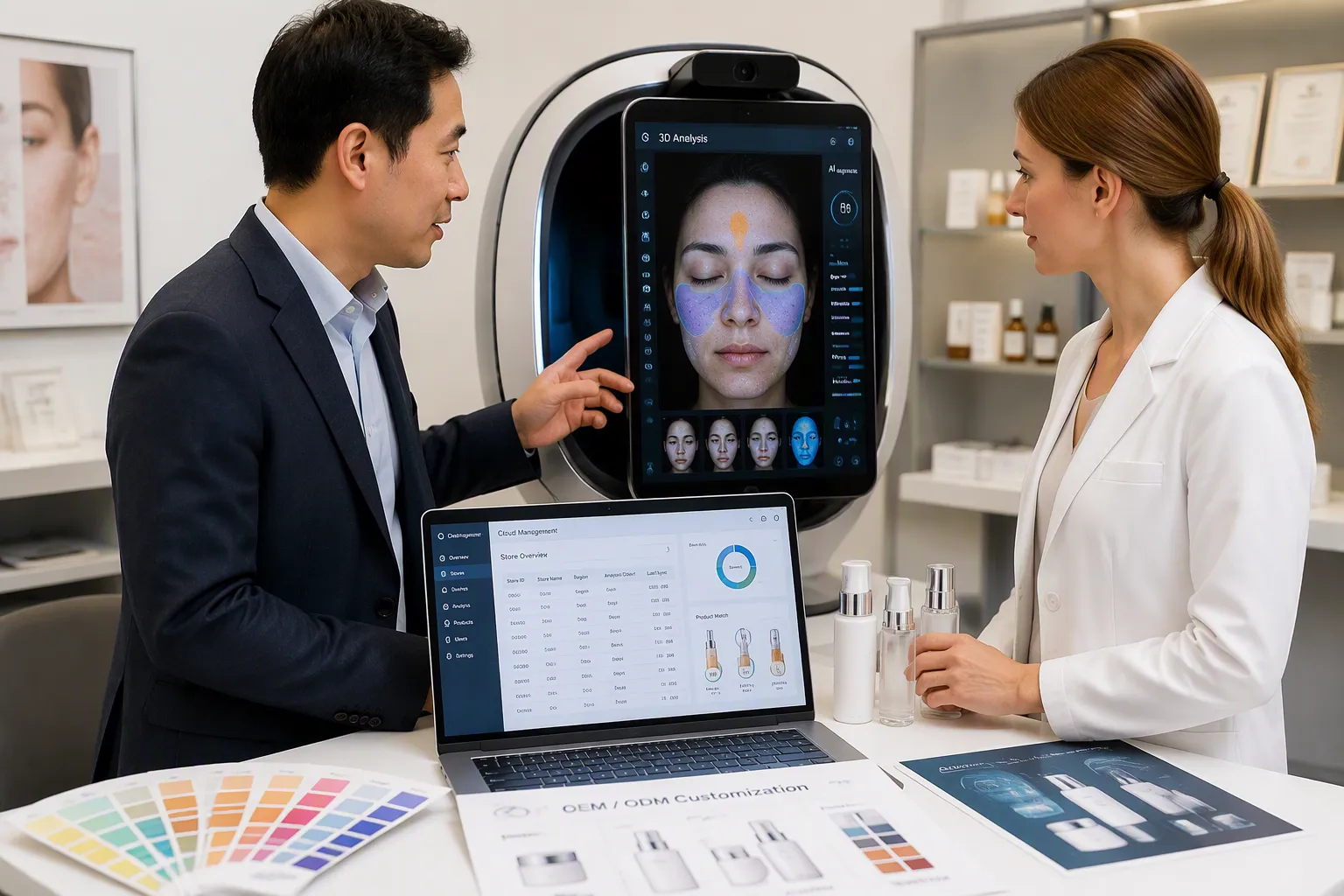
I compare technology platforms before I sign anything. Three features separate premium manufacturers from average ones: 3D imaging, AI, and cloud integration.
3D imaging captures real skin conditions and supports simulation. Canfield VISIA uses cross-polarization and UV illumination with RBX technology to isolate red and brown skin components. Miravex Antera 3D reconstructs full 3D images for topographical analysis of wrinkles, texture, pores, and volume. Its instrumental error stays under 2%, which demonstrates high measurement reproducibility.
AI drives diagnostic power. AI face recognition now detects 14 skin health indicators and generates online reports with improvement methods. A 2025 systematic review found AI diagnostic models in dermatology achieve sensitivity rates of 90–98% and specificity rates of 45–99%. AI outperformed dermatologists in 63% of studies. Research presented at the American Academy of Dermatology 2025 meeting reinforced this. Dr. Dilraj Kalsi of Skin Analytics showed the DERM AI tool performs “at least as well as dermatologists” in ruling out melanoma.
Cloud integration changes your business model. Distributors upload products once, and the system matches them to 18 skin indices. A single cloud sync pushes branding to every analyzer. Each store receives its own cloud ID for standardized multi-store rollouts. The cloud backend is free for life, so you avoid recurring software costs.
OEM/ODM support is the real differentiator. OEM service starts from a single unit. Logo and software customization takes 3–5 days. Color customization takes 7–14 days. New-design molding takes 40–60 days. Unit prices for OEM/ODM skin analysis machines range from $650 to $1,150.
Red Flags and Buyer Alignment
I watch for warning signs that predict failure. On-time delivery rates below 97% signal supply disruptions. Supplier response times over 2 hours suggest weak communication. Reorder rates below 25% may indicate poor client satisfaction. Missing ISO 13485 or FDA compliance is a major quality and market-entry red flag.
A supplier that merely resells devices instead of manufacturing them introduces additional risk. Manufacturers who build their own machines control quality and shipping timelines better.
Training commitment matters too. Overly complex interfaces impede staff training and lead to inconsistent operation. Poor customer support for updates and troubleshooting creates ongoing operational risk.
Buyer alignment completes the evaluation. I check whether the manufacturer’s target market matches mine. A partner focused on clinical dermatology may not serve spa clients well. I also verify that their product roadmap aligns with my growth plans. This alignment ensures long-term success.
I built this guide around three critical areas. First, manufacturer-driven training and support prepare your team for technical and sales success. Second, strong after-sales services, including warranty logistics and software updates, secure client loyalty and create recurring revenue. Third, careful evaluation of technology, OEM/ODM fit, and red flags protects your investment.
The right manufacturer is a strategic partner for long-term success. They do not just sell you a skin analysis machine. They stand beside you as your business grows.
I urge you to create a vetting checklist today. Start assessing manufacturers against the criteria in this guide. Your future clients will thank you.
FAQ
How much capital do I need to start distributing these machines?
I cannot give you a fixed number. Your costs depend on order volume, OEM customization, and shipping terms. The article notes OEM/ODM unit prices range from $650 to $1,150. I recommend starting with a small order to test your market before scaling up.
What training should I expect from a manufacturer?
I expect two tracks. Technical training covers skin science, hardware operation, calibration, and troubleshooting. Sales training teaches your team to demonstrate ROI and handle objections. A manufacturer that offers both gives you a complete toolkit for market entry.
How do software updates create recurring revenue?
Manufacturers release firmware and feature updates that improve diagnostic accuracy. Some bundle updates into the purchase price. Others charge annual license fees. Cloud storage expansion and AI screening licenses also generate recurring income. I always confirm the pricing model before signing.
What is the biggest red flag when evaluating a supplier?
I watch for suppliers who merely resell devices instead of manufacturing them. They control quality and shipping timelines poorly. I also flag on-time delivery rates below 97%, response times over 2 hours, and missing ISO 13485 or FDA compliance.
How do I know if a manufacturer fits my target market?
I check whether their product roadmap aligns with my growth plans. A partner focused on clinical dermatology may not serve spa clients well. I also verify their OEM/ODM support matches my branding needs. Alignment here ensures long-term success.
Post time: Sep-18-2026


