


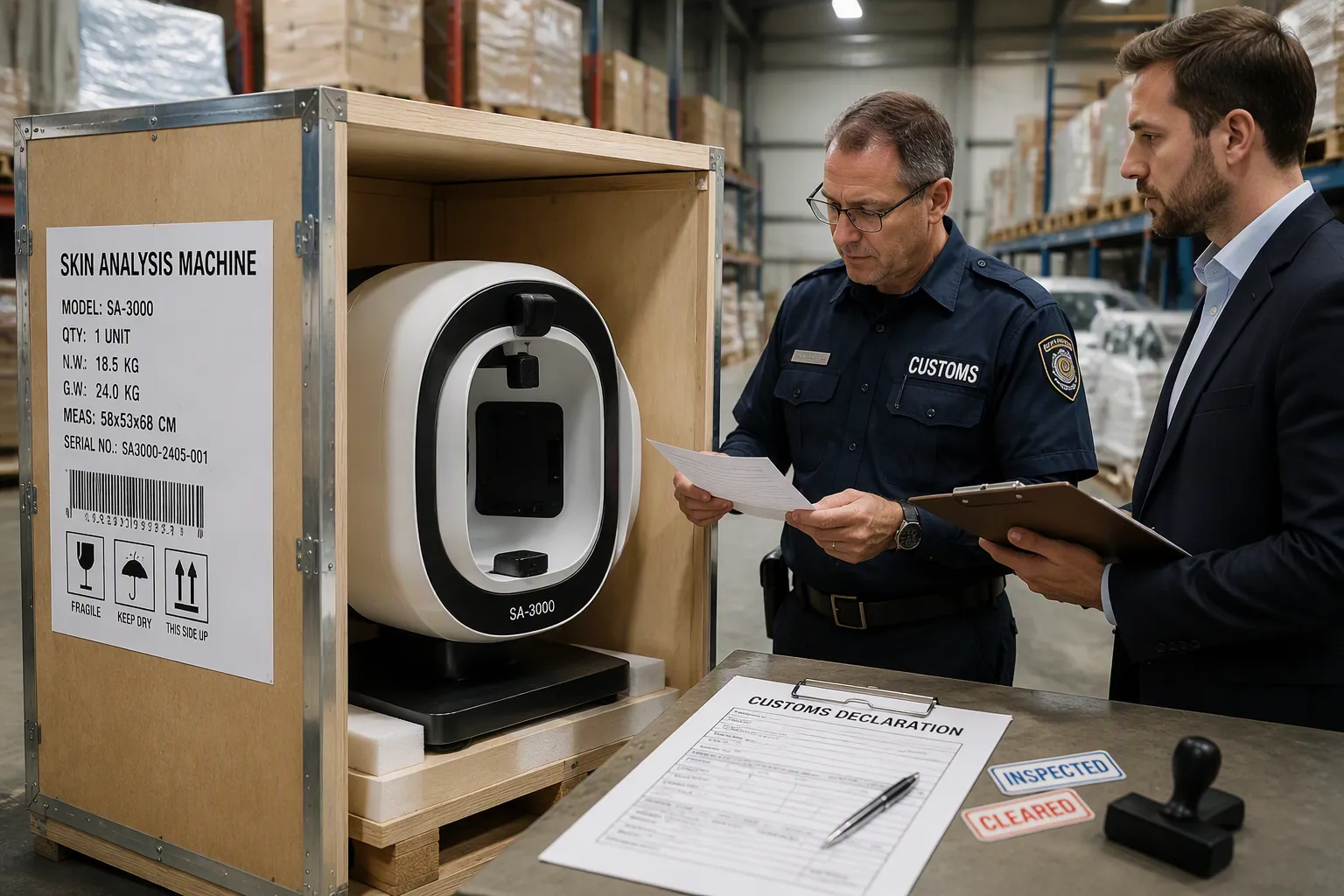
Your first order of skin analysis machines should go by air freight. I recommend it. Air balances speed, cost, and risk better than sea freight or courier. First orders differ from later ones: smaller volume, quality verification, and a faster cash cycle. These factors make air freight the practical choice for most new distributors.
Key Takeaways
●Choose air freight for your first order. It takes 5–7 days. This speed helps you check quality fast and keep your cash flow healthy.
●Find the correct HS code for your machine. A wrong code causes delays and fines. Use a customs broker to confirm the code before you buy.
●Calculate the full landed cost per unit. Add freight, duties, and fees to the unit price. This total shows your real cost and protects your profit.
Shipping Methods for Skin Analysis Machine Imports
Air, Sea, or Courier
You have three main options for moving a skin analysis machine across borders. Each one trades cost against speed and risk in a different way. Air freight gets your goods from the factory door to your warehouse in about 5–7 days. Sea freight takes 25–40 days for the same route. Courier service moves small units in 3–5 days, but it charges premium rates and caps weight and dimensions.
| Method | Door-to-Door Time | Cost Level | Best For |
|---|---|---|---|
| Air freight | 5–7 days | Medium | First orders, mid-size batches |
| Sea freight | 25–40 days | Low | Large repeat orders |
| Courier | 3–5 days | High | Single units, samples |
Shipping cost ranks among the top risks distributors face when importing beauty machines. A surprise freight bill can wipe out your margin on the whole order. I always price freight before I commit to a purchase.
Best Choice for a First Order
Air freight wins for your first order, and I recommend it without hesitation. You need to inspect the units fast. A 5–7 day transit lets you verify quality, test the software, and confirm the build before you pay the balance. Sea freight locks your capital in transit for over a month. That delay hurts your cash cycle and stretches your exposure to damage or loss.
High-value electronics also carry more risk on a slow boat. Every extra day in transit adds handling, humidity, and theft exposure. Air freight shortens that window. You pay more per kilogram, but you protect a much larger investment. For a first order, that trade-off favors speed every time.
Customs Rules and HS Code Classification
HS Codes and Duty Rates
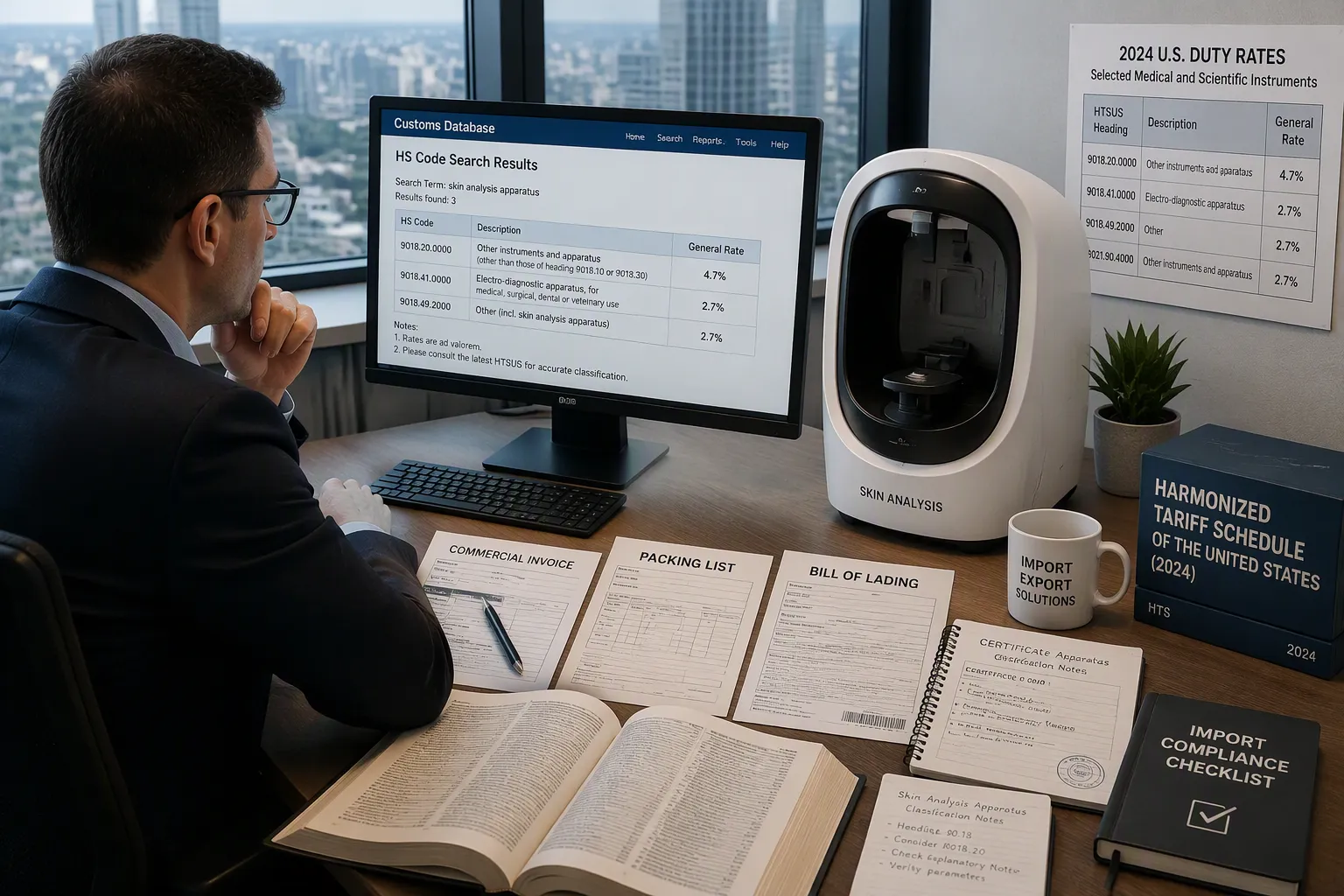
Finding the correct HS code for your skin analysis machine matters more than most new importers realize. The Harmonized System assigns a six-to-ten-digit number to every product crossing a border. A skin analysis machine typically falls under HS Chapter 90, which covers optical, medical, and measuring instruments. I search my destination country’s customs database using keywords like “skin analysis apparatus” or “dermatological imaging device.” A wrong code triggers overpayment or underpayment of duties. Customs officers flag misclassified shipments for inspection. Those inspections delay delivery by weeks and often carry fines. I have seen shipments held for a month over a single wrong digit. That delay costs more than the duty difference itself.
I expect duty rates to land between 3% and 8% for most destinations. This range applies when the machine clears as a medical or measuring instrument. Rates shift by country. The European Union, the United States, and Southeast Asian nations each apply different tariff schedules. I always confirm the rate with a licensed customs broker before I finalize my purchase order.
Never undervalue your invoice to cut duties. I state this plainly because it tempts every new distributor. Customs authorities compare shipment values against database benchmarks. When your declared value falls too low, they hold the goods, issue a penalty, or seize the entire shipment. The cost of a fine far exceeds any duty you save.
Documents and Compliance
Standard shipping documents include a commercial invoice, packing list, and bill of lading or airway bill. A certificate of origin helps you claim preferential duty rates under free trade agreements. Beyond these basics, your machine may require import permits tied to its intended use. The U.S. Food and Drug Administration works closely with U.S. Customs and Border Protection. If your device requires oversight or operation by another person, customs treats it as a commercial import and demands additional review.
I find the European Union’s requirements the most demanding. Under the Medical Device Regulation (MDR), your machine needs CE marking before legal sale in any EU member state. The CE mark confirms compliance with safety, performance, and regulatory standards. Essential MDR compliance documents include:
●Quality Management System — ISO 13485 certification
●Technical Documentation — device description, design, risk analysis, clinical evaluation, labeling, and Instructions for Use
●Clinical Evaluation — clinical literature reviews, investigations, or equivalence studies
●Risk Management — ISO 14971 compliance with hazard identification and risk control
●Post-Market Surveillance — complaint monitoring, vigilance reporting, and Periodic Safety Update Reports
For most Class IIa and higher devices, you must work with a Notified Body authorized under MDR. I factor this step into my timeline. Preparing these documents before shipment clears customs faster. Without them, customs holds the goods at the border.
Landed Cost and Avoiding Delays
True Landed Cost Per Unit
Your unit price is not your real cost. I calculate landed cost by adding every expense between the factory and my warehouse. The full formula looks like this: unit price + freight + insurance + duties + customs broker fees + airport handling + final delivery + overhead. Each line item matters. Freight alone can add hundreds of dollars per unit on a small order. Broker fees and airport handling often surprise new importers because they arrive after the goods land.
Here is a worked example. Suppose I import 10 skin analysis machines at $800 each. Air freight costs $1,200 total. Insurance runs $150. Duties at 5% add $400. My customs broker charges $250. Airport handling and final delivery total $300. Overhead for paperwork and administration adds $200. The total landed cost is $10,500, or $1,050 per unit. That is $250 above the unit price — a 31% increase. I price my resale around this number, not the factory quote.
Common Pitfalls and Pre-Shipment Checklist
I have seen distributors lose margin to the same mistakes again and again. A wrong HS code tops the list. Medical-grade analyzers with regulatory approval typically fall under HS heading 9018 with duty rates of 3%–8%. Cosmetic analyzers without a medical designation often fall under heading 9031 with rates of 1%–5%. AI-powered analysis and 3D imaging features may trigger extra regulatory scrutiny. Incorrect codes lead to delays, fines, or seizure.
Missing documents rank second. Undervalued invoices, no customs broker, and ignored local compliance standards all cause holds. Electrical safety certifications trip up many importers. I learned this lesson from a case that still stings:
A standard automation machine shipped to Australia was CE-marked and UL-listed, yet customs held the shipment because it was missing RCM certification. The delay was 2–3 weeks, and a third-party local inspection cost $7,200. CE is not a passport, and UL is not a global license.
Each region demands its own mark:
●Australia: RCM certification is required; CE and UL alone are insufficient.
●USA: UL listing is a key electrical safety certification for machinery imports.
●EU: CE marking is mandatory for market access.
●China: RoHS standard GB 26572-2025 restricts 10 hazardous chemicals and takes effect on 1 August 2027.
Before goods leave the factory, I confirm five things: airport handling arrangements, a licensed customs broker, all import documents, cargo insurance, and final delivery to my warehouse. I also evaluate the manufacturer’s after-sales and warranty plan. Meicet (https://www.meicet.com/) is one example of a manufacturer distributors may evaluate when sourcing.
I ship my first skin analysis machine order by air. I classify the device under the correct HS code. I calculate the full landed cost before I commit. I prepare documents before shipment.
Mistakes bring delays, fines, and lost profit. Correct preparation brings predictable delivery and protected margin. I treat shipping and customs as a repeatable process.
FAQ
Which shipping method should I pick for my first skin analysis machine order?
I pick air freight. It takes 5–7 days door-to-door. That speed lets me verify quality fast and keep my cash cycle short.
How do I find the right HS code for a skin analysis machine?
I search my destination country’s customs database with keywords like “skin analysis apparatus.” A licensed customs broker confirms the code before I place my order.
What happens if customs holds my shipment?
A hold means delays, fines, or seizure. I prevent holds by using the correct HS code, declaring full value, and preparing every document before the goods leave the factory.
Post time: Sep-15-2026


