



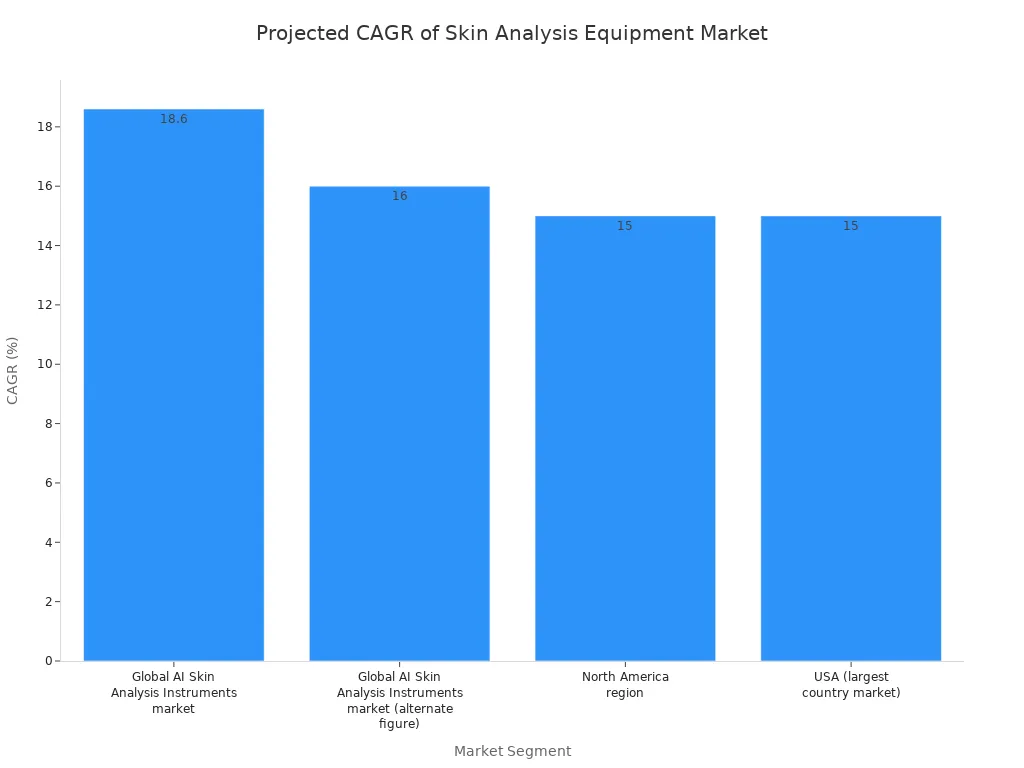
Importing skin analysis machines from China for wholesale distribution follows a clear path: vet suppliers, verify quality, arrange logistics, clear customs, and secure payments. I see demand across dermatology, spas, and clinics. Global market expands from USD 1.79 billion in 2025 to a forecast USD 8.02 billion by 2035, a 16.18% CAGR. Due diligence makes it profitable.
| Metric | Value |
|---|---|
| Market Size (2025) | USD 1.79 billion |
| Market Size (2026) | USD 2.09 billion |
| Forecast Market Size (2035) | USD 8.02 billion |
| CAGR (2026–2035) | 16.18% |
| Base Year | 2025 |
| Forecast Period | 2026–2035 |
Key Takeaways
●Research suppliers on B2B platforms and check their patents and certifications to ensure quality.
●Calculate all costs including freight, duties, and insurance to set a profitable wholesale price.
●Split payments into stages and inspect goods before final payment to protect your investment.
Sourcing Skin Analysis Machine Suppliers and
Ensuring Quality
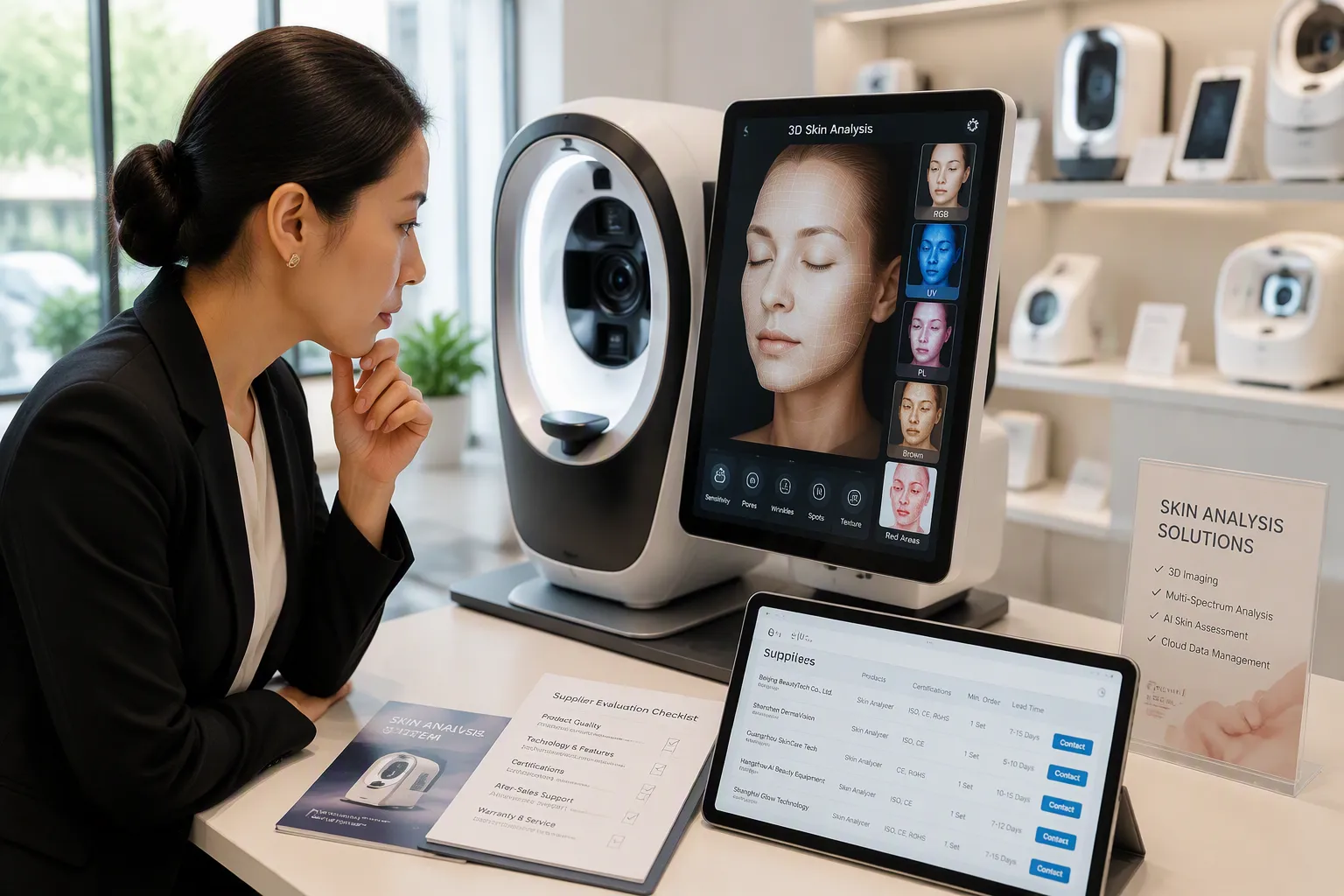
Finding the right supplier sets the foundation for your entire wholesale business. I always start by researching manufacturers on B2B platforms before committing to any purchase.
Finding Manufacturers on B2B Platforms
Tradewheel and Alibaba list hundreds of suppliers. Alibaba alone hosts 508 suppliers offering OEM services and 451 providing ODM services. This gives you strong customization options. I look for manufacturers holding self-owned patents because patents signal real research investment. Guangzhou markets deserve special attention. They offer complete skin analysis and beauty machine systems at accessible price points for clinics and retailers. Many suppliers there provide AI-powered 3D face analyzer machines and other advanced skincare devices. When I evaluate a manufacturer, I check three things: production capacity, patent ownership, and OEM/ODM flexibility. These factors determine whether you can build a unique product line or must sell generic units.
Evaluating Skin Analysis Machine Specifications
Specifications vary widely across product tiers. Basic skin analyzers handle simple visual checks. Professional skin analysis systems deliver higher-resolution imaging and multiple analysis functions. AI 3D skin analysis systems add intelligent features for professional consultation services. I pay close attention to imaging technology. RGB imaging captures visible skin conditions. UV and polarized light reveal concerns that normal lighting cannot detect. Higher-level models with multiple imaging modes provide deeper assessment. Look for these features: Predict Mode showing skin condition after 5–7 years, wireless Bluetooth connectivity, backup and restore functions, and 5 Spectra modes including Daylight, Cross Polarization, Parallel Polarization, UV Light, and Wood’s Light. Detectable conditions include skin tone and pigmentation, texture and wrinkles, sensitivity and inflammation, pore and sebum formation, and UV damage. Certifications matter enormously. I request CE Marking for EU markets, FDA 510(k) clearance for the US, ISO 13485:2016 for quality management, and IEC 60601 series for electrical safety. Software validation records prove the AI algorithms work correctly. Ask vendors about training data diversity across Fitzpatrick scale categories. Models trained mainly on lighter complexions show documented limitations on darker skin tones.
Navigating Logistics, Customs, and Total Costs
Freight is only one line on your final invoice. I treat importing as a chain of cost events. Product classification, cargo insurance, and compliance paperwork all shape your true cost. A cheap unit price means little when customs delays or rejected certifications eat your margin.
Choosing Shipping Methods and Incoterms
Air freight moves fast and suits small trial orders. Sea freight costs less per unit and fits full container loads. I match the method to order size and urgency. Express couriers work well for single samples.
Incoterms decide where your responsibility starts and ends. FOB means the supplier handles goods until they reach the port. DDP means the supplier delivers to your door with duties paid. I prefer FOB for larger orders. It gives me control over the freight forwarder and insurance. New importers often choose DDP for simplicity. Just confirm the supplier quotes the real duty rate.
Calculating Landed Costs and Regulations
Landed cost includes the unit price, freight, insurance, duties, and customs clearance fees. I build this number before I set any wholesale price. Import fees vary by region. Some markets charge higher duties on medical devices. Others add value-added tax at the border. These fees directly change your resale price.
A beginner should treat a skin analysis machine as regulated equipment. Confirm the supplier holds CE Marking, FDA 510(k) clearance, ISO 13485:2016, and IEC 60601 safety reports. Request a pre-shipment inspection. Verify the voltage rating matches your market. Arrange marine cargo insurance for the full shipment value. These steps protect your investment before the goods leave China.
Managing Payments and Supplier Relationships
Selecting Secure Payment Methods
I treat payment as one of the highest-risk steps when importing a skin analysis machine. Wire transfers remain the most common method, but they offer no buyer protection once money leaves your account. I reduce this risk by splitting payments into three stages. I send a 30% deposit to secure production. I pay 40% after I receive a pre-shipment inspection video of the completed units. I send the final 30% after the goods pass inspection and the supplier provides the bill of lading. For orders exceeding ten thousand dollars, I consider a confirmed irrevocable letter of credit. The issuing bank guarantees payment when I present the required shipping documents. Smaller orders work well with escrow services offered by some B2B platforms. The platform holds my payment until I confirm receipt and inspection. I always place a separate sample order before any bulk purchase. A supplier who delivers quality samples will likely deliver quality production units.
Negotiating Wholesale Terms
I begin every negotiation by understanding the supplier’s minimum order quantity and price breaks. Most manufacturers in Guangzhou offer better per-unit pricing at 50, 100, and 500 units. I ask for a tiered price sheet before I mention my target quantity. This shows me exactly where I need to order to reach my desired margin. I also negotiate payment terms beyond the standard 30% deposit. Experienced suppliers may agree to a 20% deposit after a few successful orders. Building a long-term relationship matters more than squeezing the lowest price on a single transaction. I visit the factory when possible. A face-to-face meeting builds trust and shows I treat the business seriously. I keep communication consistent and pay invoices on time. Suppliers offer better pricing and priority production slots to reliable partners. Over time, I negotiate exclusive distribution rights for my region in exchange for larger consistent orders. This approach protects my investment and grows my wholesale business sustainably.
I follow four steps: research suppliers on B2B platforms, verify certifications, plan logistics, and secure payments. Transparent relationships with Chinese manufacturers drive consistent supply and better pricing. Start by requesting samples and certifications from online marketplaces. The global AI skin analysis machine market grows at 18.6% CAGR from 2025–2030, so your wholesale business has strong potential.
FAQ
How do I protect my payment when buying from a new supplier?
I split payments into three stages. A 30% deposit starts production. I pay the balance only after a pre-shipment inspection confirms quality.
How can I verify a supplier’s certifications are real?
I ask for the certification number and contact the issuing body directly. Request test reports from accredited laboratories before any production.
What if I cannot meet the minimum order quantity?
Many manufacturers lower MOQs for first-time buyers. I start with a sample order. Building trust opens better terms for later bulk purchases.
Post time: Sep-15-2026


