


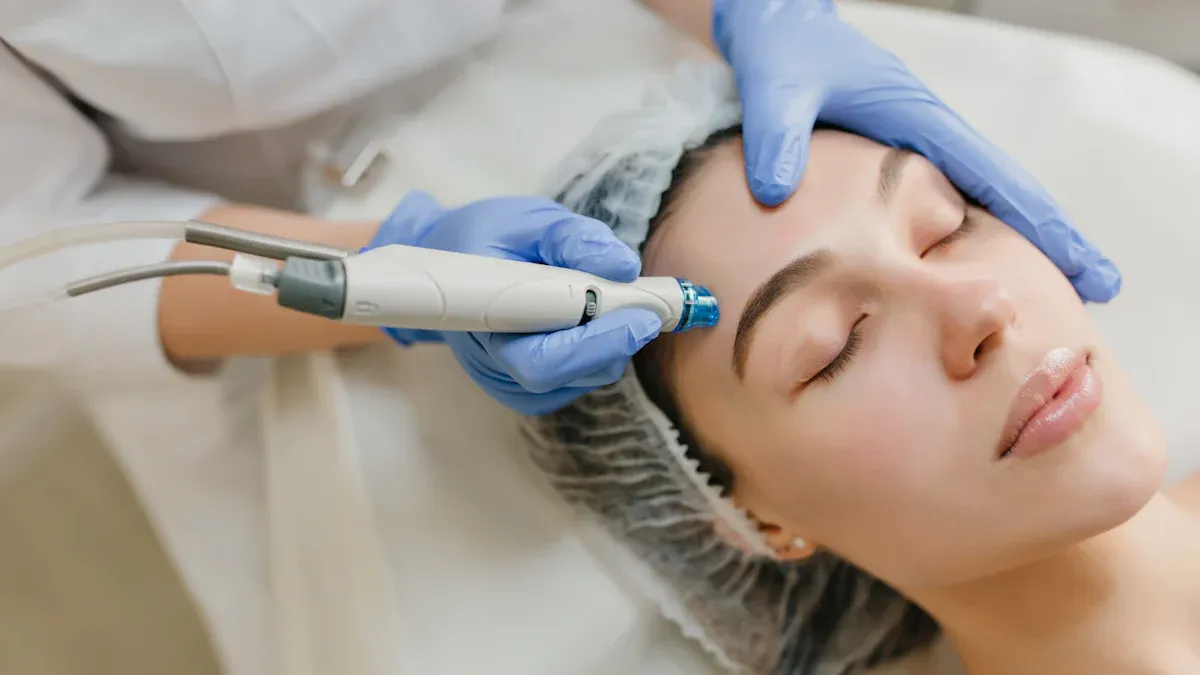
I always look for companies with strong certifications, a proven track record, and great customer reviews when I search for the best Skin Analyzer manufacturers in China. I focus on suppliers who offer OEM or ODM services and use the latest technology, like AI-powered analysis. I also pay close attention to after-sales support and request product demonstrations. These steps help me make confident decisions and find reliable partners.
Key Takeaways
●Always check for certifications like ISO and CE to ensure product safety and quality.
●Look for manufacturers that offer OEM and ODM services for customized products that fit your brand.
●Evaluate the technology used by manufacturers, such as AI and 3D imaging, for better skin analysis results.
●Prioritize suppliers with strong customer service and after-sales support to ensure a reliable partnership.
●Request product demonstrations and samples to assess quality before making a purchase decision.
Key Criteria for Reliable Skin Analyzer Manufacturers
Certifications and Compliance Standards
When I look for a reliable Skin Analyzer manufacturer in China, I always check their certifications first. Certifications show that a company meets strict safety and quality standards. Most trustworthy manufacturers hold several important certifications:
●Verified Manufacturer status
●Compliance with ISO standards
●CE certification for international safety and quality
These certifications give me confidence that the products are safe and meet global requirements. I also pay attention to how manufacturers follow international compliance standards. For example, some companies use advanced testing methods to ensure product safety and effectiveness. Here is a table that explains some of these methods:
| Method | Description |
|---|---|
| BrdU-FCM Method | Uses flow cytometry for objective data on skin sensitization. |
| Toxicokinetic Testing Method | Evaluates how cosmetic ingredients behave in the body, improving safety assessments. |
| Revised Human Skin Patch Test Method | Refines study design and reduces variability in results. |
| Revised Human Safety in Use Test | Optimizes safety assessments under real-use conditions to reflect actual consumer exposure. |
I always choose manufacturers who can show these certifications and use advanced testing methods.
OEM/ODM Capabilities and Customization
Customization is very important to me when I select a Skin Analyzer supplier. Many Chinese manufacturers offer OEM (Original Equipment Manufacturer) and ODM (Original Design Manufacturer) services. This means they can create products that match my brand and specific needs. I have found that China accounts for about 60% of the Asia-Pacific region’s OEM/ODM manufacturing capacity. This large share shows that Chinese companies have strong experience in customization.
●Many professional beauty equipment manufacturers in China provide flexible OEM/ODM services.
●They can adjust product features, design, and packaging to fit my requirements.
I always ask about customization options before making a decision. This helps me get a product that stands out in the market.
Technology and Product Innovation
Technology plays a big role in the quality and effectiveness of a Skin Analyzer. I look for manufacturers who use the latest innovations. Many leading companies in China integrate advanced technologies such as:
●AI-powered analysis
●3D facial recognition
●Multi-spectral imaging
These features help the Skin Analyzer deliver accurate and personalized skin assessments. Some devices, like the MNLT AI Skin & Hair Analyzer, use up to nine advanced spectral imaging technologies. They can capture both surface and subdermal skin conditions. AI algorithms then provide detailed diagnostic insights and structured reports.
Chinese manufacturers like Shanghai May Skin Information Technology Co., Ltd. and Shenzhen Langdai Industrial Development Co., Ltd. lead in product innovation. They combine research and development with production. This approach helps them respond quickly to market changes and keep their products competitive worldwide.
●The M5 Professional Facial Skin Analyzer generates detailed reports with high-definition visuals.
●It uses a magnifying handle to capture micro-details for precise diagnostics.
●The device supports personalized skincare suggestions.
Customer Service and After-Sales Support
Customer service is a top priority for me. I always check how quickly a manufacturer responds to questions and how they handle after-sales support. Leading companies often reply to inquiries within 24 hours. For example, the New Bitmoji AI Skin Analyzer A6 has a response time of less than one day.
I also look at customer satisfaction ratings. High reorder rates and positive reviews show that a manufacturer values long-term relationships. Here is a chart that compares reorder rates among top Chinese skin analyzer manufacturers:
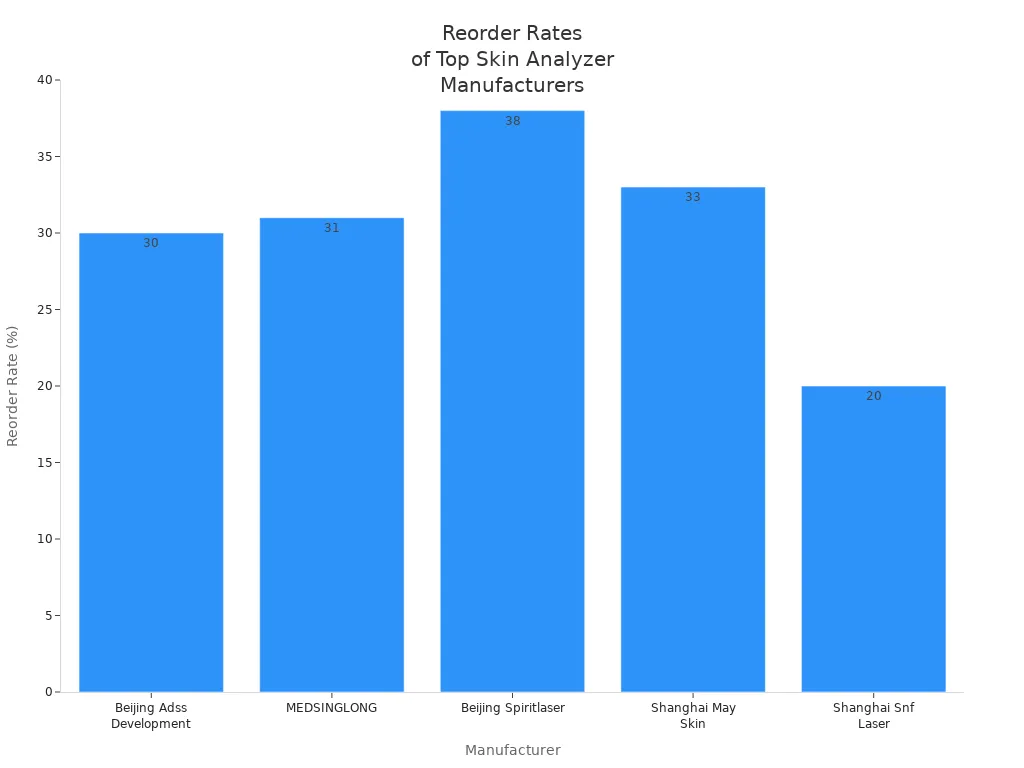
Manufacturers like Beijing Adss Development Co., Ltd. and Shanghai May Skin have high client retention and strong review scores. I always choose suppliers with proven customer service and reliable after-sales support. This ensures I get help when I need it and builds trust for future orders.
Top Skin Analyzer Manufacturers in China
Leading Brands and Locations
When I search for the best Skin Analyzer manufacturers in China, I focus on companies with strong reputations and advanced technology. Many of these brands have their headquarters in major cities like Shanghai, Shenzhen, and especially Guangdong province. I have found that Guangdong is a hub for high-tech beauty equipment. Here are some of the leading brands and what makes them stand out:
| Brand | Distinguishing Features |
|---|---|
| MEICET | 3D imaging, AI-powered analytics, high-definition imaging, deep learning for skin issue detection |
| ISEMECO | High-end 3D imaging, aesthetic analysis, anti-aging assessment, custom 3D camera with high precision |
| Meiji 3D | Optical imaging, ultrasonic depth detection, digital diagnostics for aesthetic procedures |
| Think View | Medical-grade imaging, high-resolution output, spectral detection for skin inflammation |
| OBSERV 520X | 360light aging assessment, emotional aesthetics evaluation, standardized imaging for precise diagnosis |
Tip: I always check if the manufacturer has international certifications and a strong presence in the beauty technology industry.
Product Range and Specialties
I look for manufacturers who offer a wide range of Skin Analyzer products and related devices. This helps me find solutions for different needs, from facial analysis to hair diagnostics. Here are some popular products from top manufacturers:
| Product Name | Link |
|---|---|
| MC-A8 | MC-A8 |
| MC88 | MC88 |
| ISEMECO 2D S7 | ISEMECO 2D S7 |
| M-18S | M-18S |
Manufacturers in China also specialize in different types of beauty and diagnostic equipment. I see that many companies offer not only Skin Analyzer devices but also machines for hair analysis, slimming, and non-invasive treatments. Here is a quick overview of their specialties:
| Product Type | Specialty Focus |
|---|---|
| Skin Care Machine | Effectiveness in skin analysis |
| Facial Skin Analyzer | High ratings for beauty treatment results |
| RF Cavitation Machine | Advanced technology for non-invasive treatments |
| 808 Hair Removal Machine | Non-invasive treatment options |
| HIFU Skin Care Machine | Enhances capabilities of beauty professionals |
| Slimming Device | Addresses diverse client needs |
| Hair Analysis Devices | Comprehensive solutions for hair care |
I always choose manufacturers who offer a complete product line and focus on innovation. This gives me confidence that I can find the right Skin Analyzer and related devices for my business.
How to Verify a Skin Analyzer Manufacturer
Checking Certifications and Licenses
I always start by checking certifications and licenses when I want to verify a manufacturer. These documents prove the company follows strict safety and quality standards. I request copies of their GMPC and ISO 22716 certificates. I also ask for photos and videos of their production area, including cleanroom environments and quality control labs. I obtain product samples of their most recent export formulas. I seek references from past export clients if available. I assess the quality of communication regarding technical questions.
Here is a table that shows the most common certifications and what to look for:
| Certificate | What it proves | What to check |
|---|---|---|
| CE (Medical Device Directive) | Compliance with EU safety and performance standards | Is it issued by a notified body? Does it list your specific model? MDR or MDD is required. |
| FDA 510(k) clearance | Device is equivalent to a legally marketed device in the US | Search the FDA database for the manufacturer’s name. Check for a valid 510(k) number. |
| ISO 13485 | Quality management for medical device design and manufacturing | Check if the scope covers “design and manufacturing.” Full scope is best. |
| IEC 60825 | Safety of laser products | This is for laser machines. If missing, the device is not safe. |
Tip: I always verify certificates with the issuing bodies. This helps me avoid fake or expired documents.
Assessing Factory Audits and Quality Control
I believe factory audits are essential for confirming a manufacturer’s reliability. I conduct on-site visits to verify the supplier’s registered address and factory authenticity. When I cannot visit in person, I use third-party audits to confirm operational status. I request detailed photos, videos, or documents.
Third-party organizations help me check company registration, ownership, production systems, and ethical labor conditions. Here is a table that explains different audit types:
| Audit Type | Purpose | Covers |
|---|---|---|
| Basic Factory Audit | Confirms company registration and ownership | Licenses, location, employee records |
| Quality System Audit | Checks production and QC systems | Equipment, inspection process, traceability |
| Social Compliance Audit | Ensures ethical labor conditions | Safety, wages, working environment |
I follow standard procedures for factory audits. I verify the testing of raw materials and certificates of analysis for every ingredient. I check hourly production line parameters like viscosity, pH, and color consistency. I perform drop tests for packaging and stability tests at elevated temperatures before shipping.
●I inspect manufacturing areas, quality control laboratories, storage facilities, and administrative offices.
●I observe cleanliness standards, equipment maintenance, employee training levels, and adherence to documented procedures.
●Specialized auditing firms evaluate technical capabilities and regulatory compliance.
Manufacturers like Newangie operate under strict quality control supervision. They adhere to international manufacturing practices. All products undergo CE and ISO international certifications.
Evaluating Online Presence and Reviews
I always check a manufacturer’s online presence and reviews. A strong website and active social media profiles show professionalism. I look for detailed product information, clear contact details, and regular updates. I read customer reviews on platforms like Alibaba, Made-in-China, and Global Sources. Positive feedback and high reorder rates signal reliability.
●I search for independent reviews and testimonials from past clients.
●I pay attention to how the company responds to negative feedback.
●I check for transparency in business practices and product claims.
Note: I trust manufacturers who provide real photos, videos, and customer stories. This helps me confirm their credibility.
I use these steps to verify a Skin Analyzer manufacturer. I feel confident when I see strong certifications, thorough factory audits, and positive online reviews.
Tips for Contacting and Evaluating Suppliers
Effective Communication Strategies
I always start by preparing clear questions before reaching out to a supplier. I introduce myself and explain my business needs. I ask about their experience with international clients and request details about their production capacity. I use email for formal communication and instant messaging apps for quick follow-ups. I pay attention to how quickly they respond and how well they answer my questions. If a supplier replies within 24 hours and provides detailed answers, I feel more confident about their professionalism.
Tip: I keep all communication records. This helps me track agreements and compare responses from different suppliers.
Requesting Samples and Demos
I believe that seeing a product in action is essential. I always request demo videos and product samples before making a decision. Leading manufacturers in China usually provide operation demo videos that show how the device works. They also explain system compatibility, such as support for Windows Vista, 7, 8, or 10, and whether the device works on computers, laptops, or tablets. I check if the Skin Analyzer can measure skin texture, oil, moisture, pore size, acne, and wrinkle depth. I also ask about language options and the types of reports provided. Most suppliers offer a one-year warranty, 24-hour software support, and free lifetime upgrades.
| Feature/Support | Details |
|---|---|
| Operation Demo Video | Yes |
| System Compatibility | Windows Vista/7/8/10; computers, laptops, tablets |
| Detection Functions | Texture, oil, moisture, pores, acne, wrinkles |
| Language Versions | Spanish, English, Chinese, Malay |
| Reports Provided | Moisture, oil, texture, collagen, wrinkles, pigment, sensitivity, pores |
| Warranty and Support | 1-year warranty, 24-hour response, free lifetime upgrades |
Negotiating Terms and Support
I always negotiate terms to protect my investment. I discuss the warranty period and try to secure at least 24 months. I ask for a spare parts kit that includes O-rings, sample tubes, and filters. I negotiate logistics terms, such as CIF or DAP, to reduce my shipping burden. I request OEM or ODM customization, like special software interfaces or sample holders. If I plan to order regularly, I mention a long-term procurement plan. This often helps me get a 5-10% discount on the unit price.
| Negotiated Term | Description |
|---|---|
| Warranty Period | Aim for 24 months |
| Spare Parts Kit | O-rings, sample tubes, filters |
| Logistics Terms | Incoterms 2020: CIF or DAP |
| OEM/ODM Customization | Software interfaces, sample holders |
| Long-term Procurement Plan | 5-10% discount on unit price |
I always confirm all terms in writing and ask for a signed contract before placing an order.
I always follow a clear process when I search for a reliable skin analyzer manufacturer in China. Here are the steps I use:
●Check the manufacturer’s experience and certifications.
●Evaluate their technical support and software updates.
●Look for OEM and private label options.
●Review training materials and after-sales service.
●Confirm spare parts and system compatibility.
Using these criteria helps me choose trustworthy suppliers. The table below shows why each factor matters:
| Criteria | Importance |
|---|---|
| Experience | Shows reliability and a strong track record. |
| Certification | Confirms compliance with health and safety standards. |
| Quality Control | Ensures high product quality and supplier reliability. |
| Customer Feedback | Reveals strengths and weaknesses from real clients. |
I recommend reaching out to your top choices and asking for product demonstrations. This approach gives you confidence and helps you make the best decision for your business.
FAQ
How do I know if a Chinese skin analyzer manufacturer is trustworthy?
I always check for certifications like ISO and CE. I read customer reviews and request product demos. I also verify their business license and factory address. These steps help me confirm their credibility.
What should I ask before placing an order?
I ask about warranty terms, after-sales support, and software updates. I request demo videos and sample reports. I also confirm customization options and delivery timelines. This helps me avoid surprises.
Can I visit the factory before buying?
Yes, I often arrange a factory visit or request a third-party audit. This lets me see their production process and quality control. I feel more confident when I see the factory in person.
What is the typical lead time for a skin analyzer order?
Most manufacturers tell me the lead time is 2 to 4 weeks for standard models. Custom orders may take longer. I always confirm the timeline before I place my order.
Post time: Jul-29-2026


