


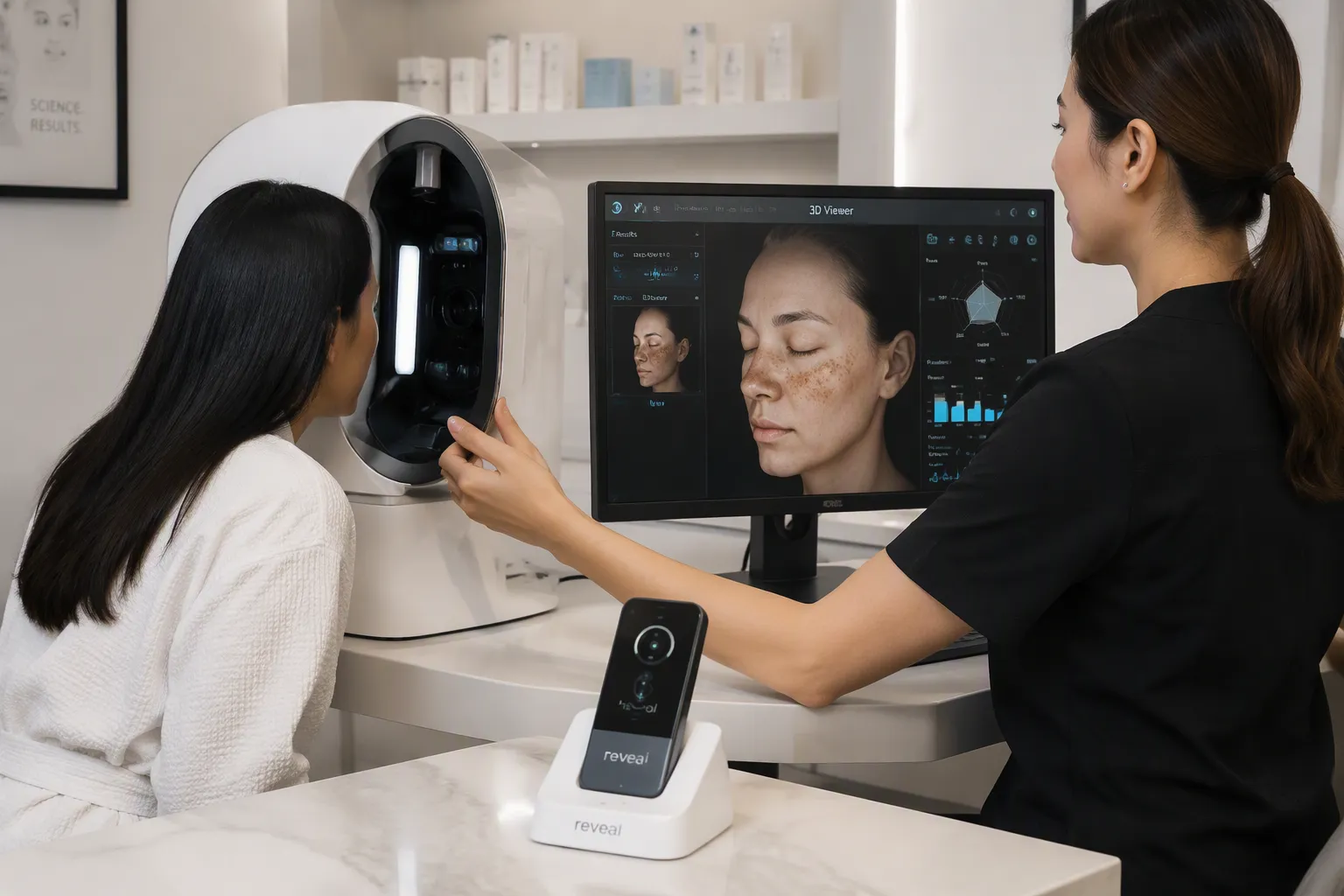
I have evaluated many 3D skin analysis machines over the years. The best machine sits at the intersection of high-quality hardware, intelligent software, seamless integration, and reliable support. I treat this purchase as a strategic business investment, not just a tech upgrade. According to the International Society of Aesthetic Plastic Surgery, the average ROI period for mid-range 3D skin analysis devices is 5.2 months. That number shows how quickly a smart choice can pay for itself. I will share a practical guide to help you navigate the options. My goal is to help you make a confident decision for your beauty business.
Key Takeaways
●A 3D skin analysis machine builds client trust and increases revenue.
●Choose a machine with high-quality hardware and intelligent software.
●Ensure the machine meets data privacy and security standards.
●Calculate total cost of ownership and expect a return on investment.
●Test the machine with a pilot before you buy.
The Business Case for 3D Skin Analysis
Building Client Trust and Standardizing Consultations
I have watched clients hesitate when a technician gives a vague skin assessment. A 3D skin analysis machine changes that dynamic completely. The device captures detailed images of pores, pigmentation, and texture. Clients see their own skin on a screen with clear visual proof. This transparency builds immediate trust. They stop questioning the recommendation and start asking how to fix the problem.
Standardized consultations also protect your business. Every client receives the same objective evaluation, regardless of which staff member performs the scan. This consistency removes guesswork from treatment planning. New team members can deliver professional consultations faster because the machine guides the process. The objective, data-driven nature of the analysis also lowers legal risk associated with subjective treatment recommendations.
Increasing Treatment Uptake and Revenue
Visual proof sells. When a client sees sun damage or dehydration mapped on their face, they understand the need for treatment. This clarity drives revenue growth. Beauty businesses report a 25–40% increase in treatment package sales after adding this technology. Client return visits also rise by 15–20%. One study found treatment package sales increased by 42% after implementing AI-based 3D skin analysis. Repeat visits grew by 60%, and average client spend rose from $180 to $280.
| Financial Benefit | Reported Figure |
|---|---|
| Return on investment achieved within | 12–18 months |
| Increase in treatment package sales | 25–40% |
| Increase in client return visits | 15–20% |
| Monthly maintenance/software cost | $50–$150 |
| Initial equipment investment | $3,000–$15,000 |
Beyond direct revenue gains, these machines reduce operational costs. Shorter consultation times and more accurate diagnoses lower labor and service costs. Fewer misdiagnoses mean fewer refund requests and less customer dissatisfaction. Consistent results also reduce the need for extensive ongoing staff training.
Evaluating Hardware and Software
Hardware Essentials: Imaging Sensors and Lighting
I always separate clinical-grade imaging from low-end, gimmick-heavy devices. Verifiable optical technologies like multispectral imaging and true 3D scanning produce reliable data. Cheap alternatives often rely on standard webcams with colored filters. Those devices generate attractive graphics, but the underlying measurements lack consistency.
Resolution matters for detecting fine lines, pores, and pigmentation. Lighting control matters even more. Inconsistent lighting shifts pixel distributions and confuses AI models trained on studio-style images. Makeup and sunscreen also interfere with readings. They inflate redness and texture scores. A serious machine uses controlled, reproducible illumination.
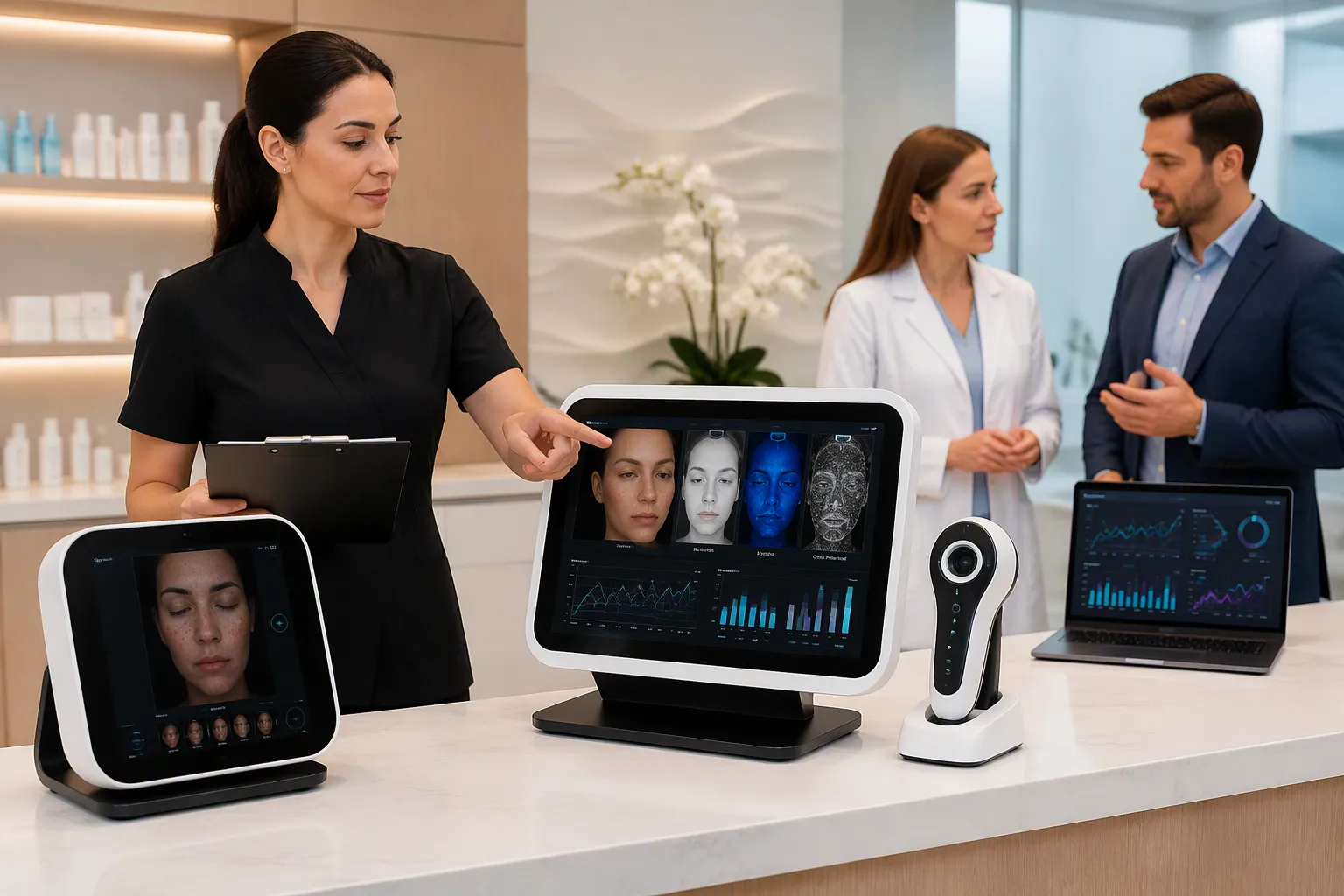
Portability is a real trade-off. A portable smartphone-based analyzer saves space and suits mobile consultants, small salons, and field sales teams. However, results vary with smartphone model, ambient light, focus, angle, and user technique. A stationary 3D facial imaging analyzer supports repeatable visual documentation and three-dimensional comparison when capture conditions are standardized. It suits aesthetic clinics and treatment-planning teams. Hair, movement, facial expression, and positioning can still affect results. Buyers should examine depth accuracy, capture speed, positioning aids, cleaning requirements, warranty coverage, and technical service response times.
A compact analyzer may suit mobile consultants, while a larger unit can provide steadier positioning. Accuracy should not be judged from attractive graphics alone, since some readings still vary with makeup, recent exercise, or room temperature.
Software Capabilities: AI Accuracy and Reporting
Software determines whether the hardware data becomes useful. I check AI analysis capabilities first. Dataset bias is a documented problem. Several studies show underrepresentation of darker skin tones and certain geographies in dermatology datasets. This can depress sensitivity and specificity for skin of color. Domain shift is another gap. Models trained on dermoscopy do not always translate to clinical or smartphone photos.
To determine whether an AI tool is authorized and for what indication (triage, decision support, diagnosis), check the FDA’s AI-Enabled Medical Device List; as of 2025, AI dermatology tools are primarily positioned as clinical decision support rather than autonomous smartphone diagnostics.
I look for published validation data with skin of color representation. I also check clear labeling on intended use. A 2025 systematic review found AI outperformed dermatologists in 63% of studies analyzed. Sensitivity ranged from 90–98%, and specificity ranged from 45–99%. Those wide ranges reflect variation across conditions and study designs.
Report clarity drives client trust. The best reports include oil production, moisture levels, skin elasticity, UV damage detection, fine lines and wrinkle depth, and vascular conditions. They link findings directly to personalized treatment plans. Clients value objective measurable data, transparency, personalization, and detection of invisible skin details like hydration and pigmentation. Visual progress reports turn consultations into data-driven conversations.
Treatment compatibility matters too. The software should export raw metrics and support interoperability options like DICOM, HL7, or FHIR. Vendor SLAs for uptime and updates protect your investment. I recommend running a 6–8 week pilot on 30–50 patients before purchase. Compare AI-guided plans against standard of care for adherence and satisfaction. Audit image consistency across operators. This pilot reveals more than any sales demo.
Ensuring Reliability and Security
The Role of Diverse AI Datasets and Actionable Reports
I always ask vendors about their training data before I trust any AI result. Dataset bias is a documented problem in dermatology AI. Models trained mostly on lighter skin learn features that do not generalize well. This creates real clinical risks for clients with darker skin tones.
| Consequence for Darker-Skinned Patients | Underlying Cause |
|---|---|
| Decreased diagnostic accuracy | Models trained predominantly on lighter skin |
| Underrepresentation of Fitzpatrick types V and VI | ISIC dataset imbalance |
| Misdiagnosis or delayed detection | AI models fail to generalize across skin tones |
| Worsened outcomes for minoritized groups | Systemic challenges tied to biased data |
A systematic review and meta-analysis of 18 studies found high overall diagnostic discrimination (AUROC ≈ 0.88) for AI-based dermatologic diagnosis. However, performance disparities persisted across skin-tone groups. Accuracy was higher in lighter skin tones (Fitzpatrick I–III) compared with darker tones (IV–VI). AI performance also decreased substantially in community and smartphone settings. These disparities pose clinical and ethical challenges. I look for vendors who deliberately diversify datasets, improve labeling, and report Fitzpatrick distribution transparently.
Reports must also be actionable for non-medical clients. I want quantified, benchmarked scores covering wrinkle depth, pore size, texture, pigmentation uniformity, UV damage, redness, and skin age. A clinician should walk the client through each finding on-screen during a 20–30 minute session. Clients receive a copy as a personalized skin health baseline. I recommend repeating 3D skin analysis every 3–6 months to track measurable improvement.
Data Privacy, Security, and Compliance
Client trust depends on data protection. I treat privacy compliance as non-negotiable for any machine that stores facial images or biometric data.
HIPAA & GDPR: The global gold standards… HIPAA-compliant AI facial analysis software should adhere to the Security Rule, ensuring end-to-end encryption… GDPR classifies biometric data as a special category requiring explicit consent and the right to be forgotten.
I verify that vendors meet these standards before I shortlist them. Some platforms exceed global compliance standards, including GDPR, ICH-GCP, HIPAA, 21 CFR Part 11, and the EU AI Act. I ask for documentation, not just verbal claims. End-to-end encryption, explicit consent workflows, and data deletion options protect both the client and my business.
Implementation and Workflow Fit
Staff Training, Support, and Maintenance
I have seen beautiful machines sit unused because the team never learned to operate them. Training is not optional. It is part of the purchase. I ask vendors about onboarding sessions, video libraries, and live support hours. A machine with a steep learning curve slows your clinic down. A machine with intuitive controls lets new staff contribute on day one.
Ongoing support matters just as much. Software updates fix bugs and improve AI models. Hardware maintenance keeps sensors calibrated. I ask about warranty length, response times, and whether the vendor offers remote diagnostics. Some vendors provide temporary loaner machines during repairs. Others require you to ship the entire unit overseas. That difference can mean weeks of downtime for your business.
Total Cost of Ownership and ROI
The sticker price is only the beginning. I calculate total cost of ownership across three to five years. Hidden costs add up quickly. I watch for these common fees:
●Annual software licensing fees to unlock features
●Monthly cloud storage subscriptions
●Charges for routine AI algorithm updates
●Replacement parts logistics, including whether modular parts like camera modules can be swapped locally
●RMA processes that require shipping the entire unit overseas
●One-off setup or onboarding fees
●Per-seat add-ons for additional clinicians or admin users
●Mandatory training costs
●Integration or API charges with existing scheduling and billing tools
●Multi-year contract minimums, auto-renewal clauses, and early-termination penalties
●Patient-data export fees and ownership terms
I add these to the purchase price and compare the total against projected revenue. A 3D skin analysis machine that costs more upfront may deliver better returns if it avoids recurring fees and downtime. I also track how many treatments each scan generates. If the machine helps close two extra packages per week, the math usually works in your favor.
Shortlisting and Vetting Your Machine
Matching Machine Choice to Clinic Volume and Type
Your clinic’s size and specialty shape which machine is right for you. I start by asking two questions: how many scans will I run each week, and what type of treatments do I offer? A small spa with five clients per day needs a different device than a medical clinic seeing thirty patients. For a solo esthetician or mobile consultant, portability and ease of use matter more than absolute imaging depth. A tablet-based or compact 3D skin analysis system fits that workflow without taking up counter space. A busy dermatology or plastic surgery practice, however, requires high repeatability and integration with electronic medical records. Those users need a stationary unit with controlled lighting and multispectral imaging capabilities.
The type of business also determines where to look. A cosmetic-only clinic can focus on software that produces client-friendly progress reports. A medical practice must verify regulatory status such as FDA clearance or CE marking as a Class I or II device. Clinics buying one proven system should compare workflow efficiency, local service availability, and total ownership cost. Distributors who want to build their own brand should start directly with factories that offer OEM/ODM projects and software localization. I have seen a med spa waste money on a device designed for high-volume clinical trials, and a doctor struggle with a toy-like analyzer that could not capture consistent depth. Matching the machine to your volume and type avoids those mistakes.
A Comparison Framework and Vendor Vetting
Beyond price and feature lists, I evaluate twelve specific criteria. Imaging resolution should be at least 10 megapixels, and multispectral lighting must include white, UV, and cross-polarized modes. 3D reconstruction accuracy below 50 microns per pixel indicates high fidelity. Software analytics need objective scoring scales and trend graphs over time. Data export must support DICOM or EMR integration for medical users. The user interface should have intuitive navigation and multilingual options. Calibration requirements vary; auto-calibrating models save time. Regulatory status, warranty, remote troubleshooting, and local technician availability all affect long-term satisfaction. Total cost of ownership includes software updates, maintenance, and accessories.
I ask specific questions during any product demonstration. I request a live scan on a staff member with known skin concerns to see if the algorithm detects those conditions. I ask about the diversity of the AI training dataset across Fitzpatrick skin types. I verify whether the technology has been clinically validated against physician assessments or clinical imaging devices. I check for clear delineation of metrics like moisture, sebum, pores, and wrinkles without exaggerated filtering. Longitudinal tracking features for before-and-after overlay confirm that the machine supports progress documentation.
I watch for red flags. Vague specifications like “high resolution” without a pixel count, claims that seem too good, or a refusal to offer a trial period all signal trouble. I always request a product tour or demo before committing. Meicet stands out as one professional supplier I have encountered. Their machines offer the controlled lighting, 3D scanning accuracy, and OEM flexibility that many clinics need. Whether you choose them or another vendor, the vetting process stays the same: demand evidence, test the device on real skin, and confirm support terms before signing.
Choosing a 3D skin analysis machine is a strategic procurement process, not a simple tech purchase. I have walked through the business case, hardware and software evaluation, reliability and security, implementation fit, and vendor vetting. The best choice balances features, support, and cost for your specific business. A small spa and a busy medical clinic need different devices. Use the criteria and vetting questions I provided. Request a live demo, test the device on real skin, and confirm support terms before you sign. A confident, informed decision will drive long-term growth for your beauty business. That growth starts with the right machine.
FAQ
How much should I expect to invest in a 3D skin analysis machine?
I see initial equipment prices range from $3,000 to $15,000. Monthly maintenance and software fees add $50 to $150. I always calculate total cost of ownership across three to five years. That total matters more than the sticker price.
How long does it take to see a return on my investment?
Most mid-range devices pay for themselves within 5.2 months. Businesses often report ROI within 12 to 18 months. Treatment package sales rise 25 to 40 percent. Client return visits grow 15 to 20 percent. The math favors a machine that closes extra packages each week.
Can I run a trial before I commit to a purchase?
Yes. I recommend a 6 to 8 week pilot on 30 to 50 patients. Compare AI-guided plans against your standard of care. Audit image consistency across operators. A pilot reveals more than any sales demo. Always request a live scan on real skin.
How often should clients receive a 3D skin analysis?
I suggest repeating the scan every 3 to 6 months. This interval tracks measurable improvement over time. Clients see objective progress on wrinkles, pigmentation, and hydration. Regular scans also create natural opportunities for follow-up treatments and package renewals.
What compliance standards should the software meet?
I verify HIPAA and GDPR compliance before I shortlist any vendor. GDPR treats biometric data as a special category. It requires explicit consent and the right to be forgotten. Ask for documentation, not verbal claims. End-to-end encryption and data deletion options protect your business.
Post time: Sep-28-2026


