



I use one formula to judge every resale deal: net profit margin = (Selling Price − Total Costs) / Selling Price × 100. Total Costs means every dollar I spend, not just the wholesale price. I count shipping, import duties, refurbishment, platform commissions, payment processing, and marketing. Most resellers overestimate profit because they ignore these hidden fees. A quick check on a skin analysis machine often reveals a thinner margin than the sticker price suggests.
Key Takeaways
●Use net margin, not gross margin, to see your real profit after all hidden fees.
●Markup and margin are different: a 30% markup equals only about 23% margin.
●List every cost—freight, duties, platform fees, marketing—before you set a price.
●Work backward from a target net margin of 30–50% to find your selling price.
Net Profit Margin Formula for Resellers
Why Net Margin Beats Gross Margin
Gross margin and net margin answer two different questions. Gross margin tells me how much money remains after I subtract the manufacturer purchase price. The formula is gross margin = (Revenue − COGS) / Revenue × 100, where COGS covers only the wholesale cost of the unit. Net margin tells me what I actually keep. The formula is net margin = (Selling Price − Total Costs) / Selling Price × 100, and Total Costs includes shipping, import fees, refurbishment, platform commissions, payment processing, and marketing.
The gap between these two numbers can be enormous. Consider a reseller who buys a skin analysis machine for $11.50 and sells it for $32.00. Gross margin looks like ($32.00 − $11.50) / $32.00 = 64.1%. That number feels great. Now subtract inbound freight, prep and labeling, referral fees, fulfillment fees, advertising costs, expected return costs, and storage allocation. Net profit drops to $6.10 per unit. Net margin becomes $6.10 / $32.00 = 19.1%. The business is still profitable, but the real outcome is moderate, not spectacular.
| Metric | Formula | Calculation | Result |
|---|---|---|---|
| Gross Margin | (Selling Price – Product Cost) / Selling Price | ($32.00 – $11.50) / $32.00 | 64.1% |
| Net Margin | Net Profit / Selling Price | $6.10 / $32.00 | 19.1% |
Net margin wins because it captures hidden fees that gross margin ignores. A strong gross margin can mask excessive overhead. I always run the net calculation before I commit to a purchase.
Markup vs. Margin: The Common Trap
Markup and margin are not the same thing, and confusing them is the most common margin mistake resellers make. Markup measures profit as a proportion of cost. Margin measures profit as a proportion of revenue.
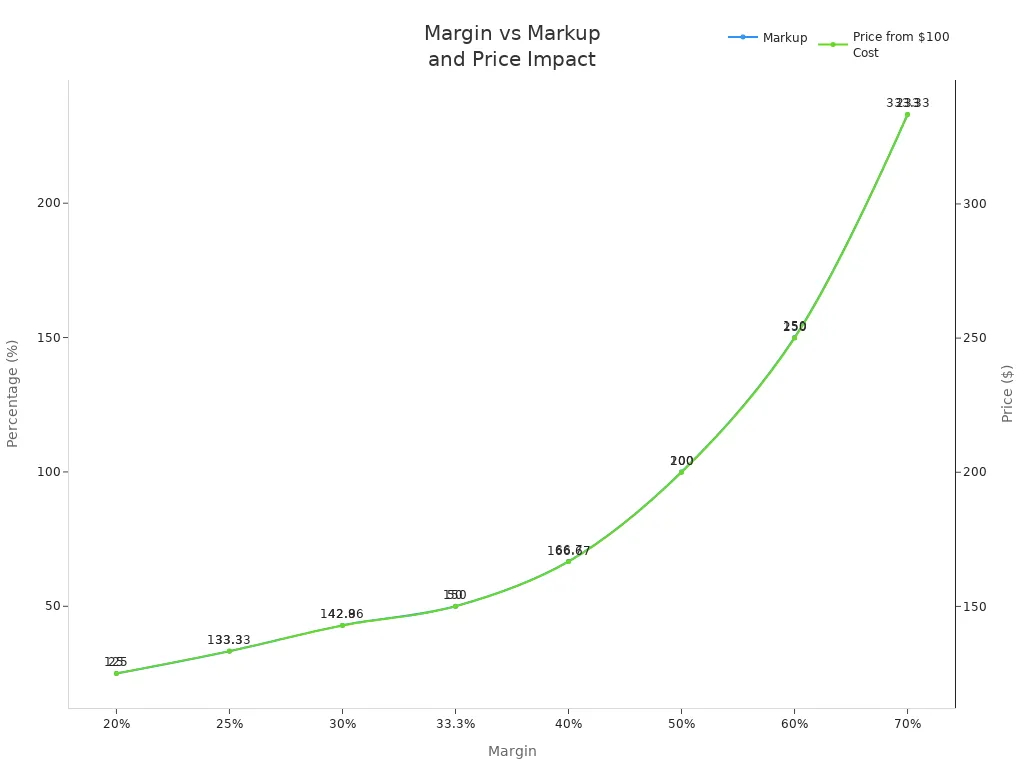
Markup is the percentage added to the cost of a product to determine its selling price, and focuses on profit as a proportion of cost. Margin measures the percentage of the selling price that is kept as profit, focusing on profit as a proportion of revenue. Because markup is based on cost and margin is based on selling price, markup is always larger than margin for the same transaction.
Here is the trap in numbers. A 30% markup on a $100 cost gives a price of $100 × 1.30 = $130. The resulting margin is ($130 − $100) / $130 ≈ 23%, not 30%. A founder who targets “50% markup” thinking it means 50% margin actually lands at 33% margin and underprices every new SKU by 17 points. The conversion is simple: margin = markup ÷ (1 + markup). A 30% markup gives 0.30 / 1.30 ≈ 23% margin.
Other frequent errors include ignoring discounts and refunds, undercounting COGS by omitting processing fees and packaging, and relying only on gross margin. Allocating overhead per unit is the step most resellers skip. It turns a profitable-looking listing into an honest one.
Identify Every Cost Before You Sell
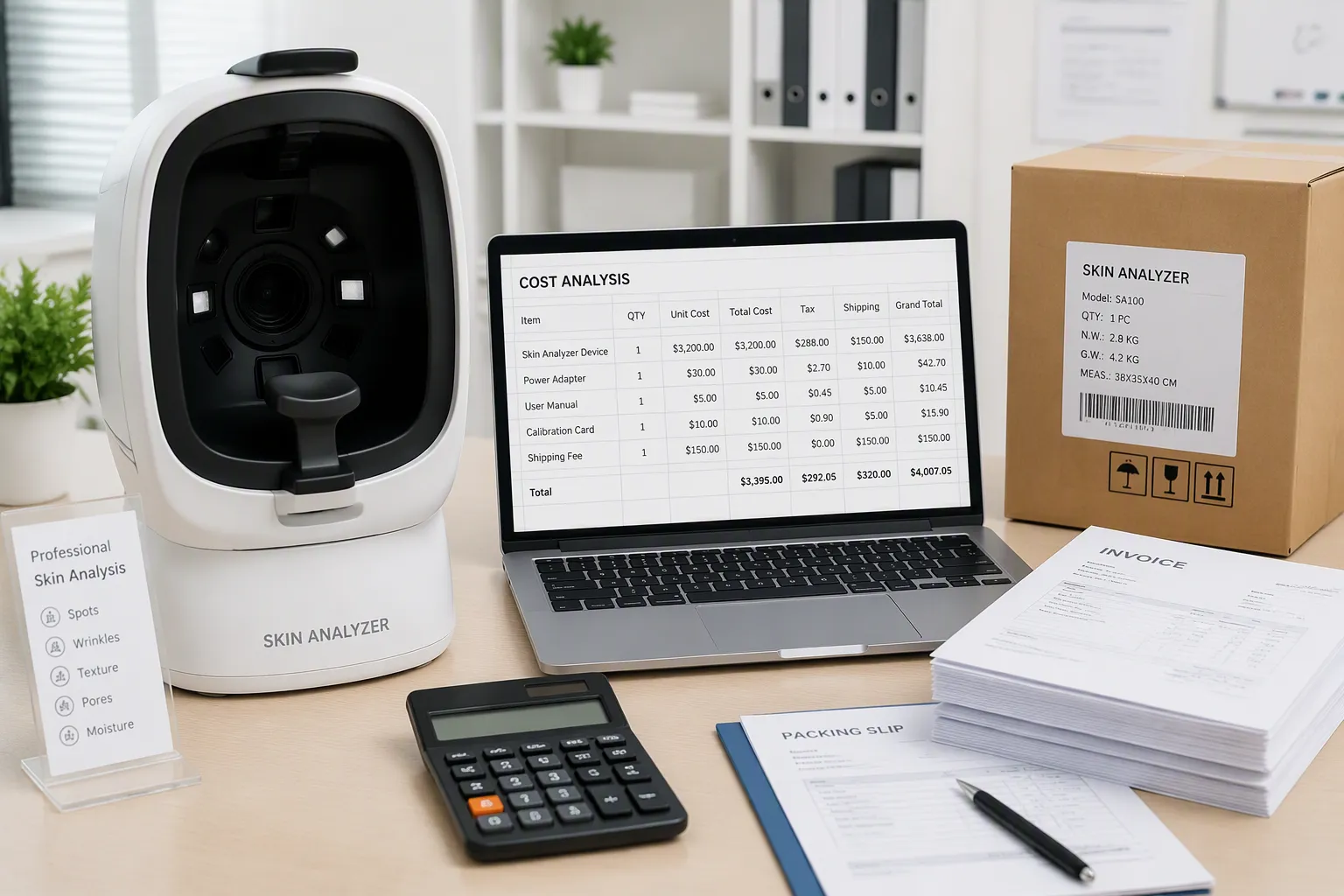
Hidden fees are the number one cause of inflated profit estimates. I learned this the hard way on my first resale. The wholesale price looked fine, so I set a price and celebrated a healthy margin. Then the invoices arrived. Freight, customs, platform commission, and payment processing ate most of my profit. Now I build a complete cost list before I quote any buyer.
Wholesale Price, Shipping, and Import Fees
The wholesale price is only the starting point. Inbound freight often surprises new resellers. Large equipment carries heavy shipping charges, and the fine print matters.
Shipping is another frequently overlooked cost. Large equipment such as treatment tables, facial beds, and multi-function devices can cost $100–$400 to ship, especially with freight delivery. A real example: a $189 treatment table came with a $147 freight bill buried in the fine print. Resellers should factor shipping into price comparisons, consider local distributors or in-person pickup, and negotiate package deals, free shipping, and extended warranties on larger orders.
Import duties and customs clearance add another layer. I always request the actual certification documents instead of assuming CE or FDA compliance. Skipping that step creates risk I cannot price. Other commonly missed items include:
●Choosing a supplier based only on the lowest quoted price, without verifying certifications or manufacturing credibility.
●Underestimating realistic shipping timelines, especially for sea freight, which can disrupt planned launches or seasonal promotions.
●Failing to clarify intellectual property protections when commissioning custom or OEM designs.
●Overlooking after-sales support, assuming the relationship ends at delivery, which leaves no recourse for technical issues or spare parts.
●Treating a first successful shipment as proof the supplier is fully vetted, rather than guarding against quality drift on later orders.
Downtime belongs on this list too. A damaged unit means delayed launch, cancelled appointments, and unused treatment space. Refunds do not recover lost time. I evaluate export packaging, repairability, and local technician availability before I confirm any order.
Platform, Payment, and Marketing Fees
Platform commissions and payment processing fees are the line items resellers forget most often. Every marketplace takes a cut. Payment processors charge a percentage plus a fixed fee per transaction. Those amounts vary by provider and region, so I check my actual statements instead of guessing.
Marketing deserves the same treatment. Advertising spend, listing fees, and promotional discounts all reduce the final number. I track them per unit, not per month. That habit keeps my cost list honest.
A skin analysis machine resale only looks profitable after I subtract every one of these costs. I add them to a spreadsheet before I set a price. The total becomes my true cost basis.
Set a Selling Price for Your Skin Analysis Machine
Research Market Rates and Salon Demand
I start pricing research by scanning what comparable units actually sell for. Mid-range wholesale models run from $2,399 to $2,999 according to Meicet.com. The same source lists mid-range costs as $899 to $2,000 in its key takeaways. MyChway reports that mid-priced professional options typically range from $1,000 to $3,500, often with digital AI integration and better sensor imaging. PerfectCorp notes a typical price of $1,500 to $2,800 per unit on Amazon for a specific skin analysis machine. These ranges give me a realistic band to work within.
Demand matters as much as the price band. A salon with mature clientele will use the device daily and justify a higher price. A newer spa may hesitate. I ask about treatment volume, client demographics, and existing equipment before I quote. Salons that can maximize the machine’s utility become repeat buyers and referral sources.
Work Backward From a Target Margin
I set a net margin target after all costs before pricing a unit. If my total cost basis is $1,800 and I want a 40% net margin, I divide $1,800 by (1 − 0.40). The result is $3,000. That price must also sit inside the market band I researched. When the math and the market disagree, I renegotiate my sourcing or walk away.
Higher margins are possible with exclusive deals or savvy sourcing. A direct factory relationship or a bulk order can lower my cost basis without lowering my price. I protect that advantage by keeping my supplier terms private and my cost spreadsheet current.
Worked Example and Break-Even
Running the Numbers on a Skin Analysis Machine Resale
I want to show you a real calculation. I buy one skin analysis machine at a wholesale price of $1,200. Inbound freight costs $180. The import duty comes to $95. Refurbishment and calibration add $75. I spend $120 on marketing to find a buyer. The platform takes a 5% commission on the sale. Payment processing charges 2.9% plus a fixed fee.
I set the selling price at $2,400. The platform commission is $2,400 x 0.05 = $120. Payment processing is $2,400 x 0.029 = $69.60, plus a small fixed fee I round to $0.40, giving $70. Now I add every cost: $1,200 + $180 + $95 + $75 + $120 + $120 + $70 = $1,860. My net profit is $2,400 − $1,860 = $540. The net margin is $540 / $2,400 x 100 = 22.5%.
That result sits below my target net margin. I have two options. I can raise the price, or I can cut costs. A better freight quote or a direct factory deal would lift the margin without touching the buyer.
Allocating Overhead and Finding Break-Even
Overhead does not disappear just because I sell one unit. I allocate a share of storage, insurance, and my own time to each machine. Suppose I set that allocation at $60 per unit. My total cost becomes $1,920, and my net profit drops to $480. The net margin falls to 20%.
Break-even is the number of units sold where total revenue equals total costs. I calculate it by dividing my fixed costs by the contribution margin per unit. If my fixed costs are $3,000 and each unit contributes $480, I need $3,000 / $480 = 6.25 units. I round up to 7 units. Every sale after the seventh is pure profit against those fixed costs.
This is why volume matters. A single resale rarely covers my overhead. A steady pipeline of buyers does. I track break-even for every model I carry, and I update the number whenever shipping or platform fees change.
I start every resale by listing every cost. I track shipping, fees, and marketing. Then I set a selling price. I apply the net margin formula. I review the result. Accurate cost tracking separates a real margin from a guessed one. Markup and margin feel similar but they differ sharply. Markup measures profit against cost. Margin measures profit against price. Hidden fees appear in every deal. I catch them with a template spreadsheet for each skin analysis machine model. That habit saves me from overestimating profit. As my order volume grows, my unit costs drop. Better freight rates and bulk discounts lift my margin. Margins scale best when I track every dollar.
FAQ
What counts as a total cost when I resell a skin analysis machine?
I count every dollar that leaves my pocket. That includes the wholesale price, inbound freight, import duties, refurbishment, calibration, marketing, platform commission, and payment processing. If I skip any of these, my margin looks better than it really is.
Why does my 30% markup only give me a 23% margin?
Markup measures profit against cost. Margin measures profit against the selling price. A 30% markup on a $100 cost produces a $130 price. The margin is ($130 − $100) / $130, which equals about 23%. The two numbers never match.
What net margin should I target on a resale?
I aim for a specific net margin after all costs. My worked example landed at 22.5%, which fell short of that target. When the math misses, I renegotiate freight, find a better sourcing deal, or raise the price.
How do I find my break-even point?
I divide my fixed costs by the contribution margin per unit. In my example, $3,000 in fixed costs divided by $480 per unit gave 6.25. I round up to 7 units. Every sale past that point is profit.
Can I lift my margin without raising the price?
Yes. I cut my cost basis instead. Better freight quotes, bulk orders, and direct factory relationships lower what I pay per unit. My selling price stays the same, and my net margin rises.
Post time: Sep-18-2026


