


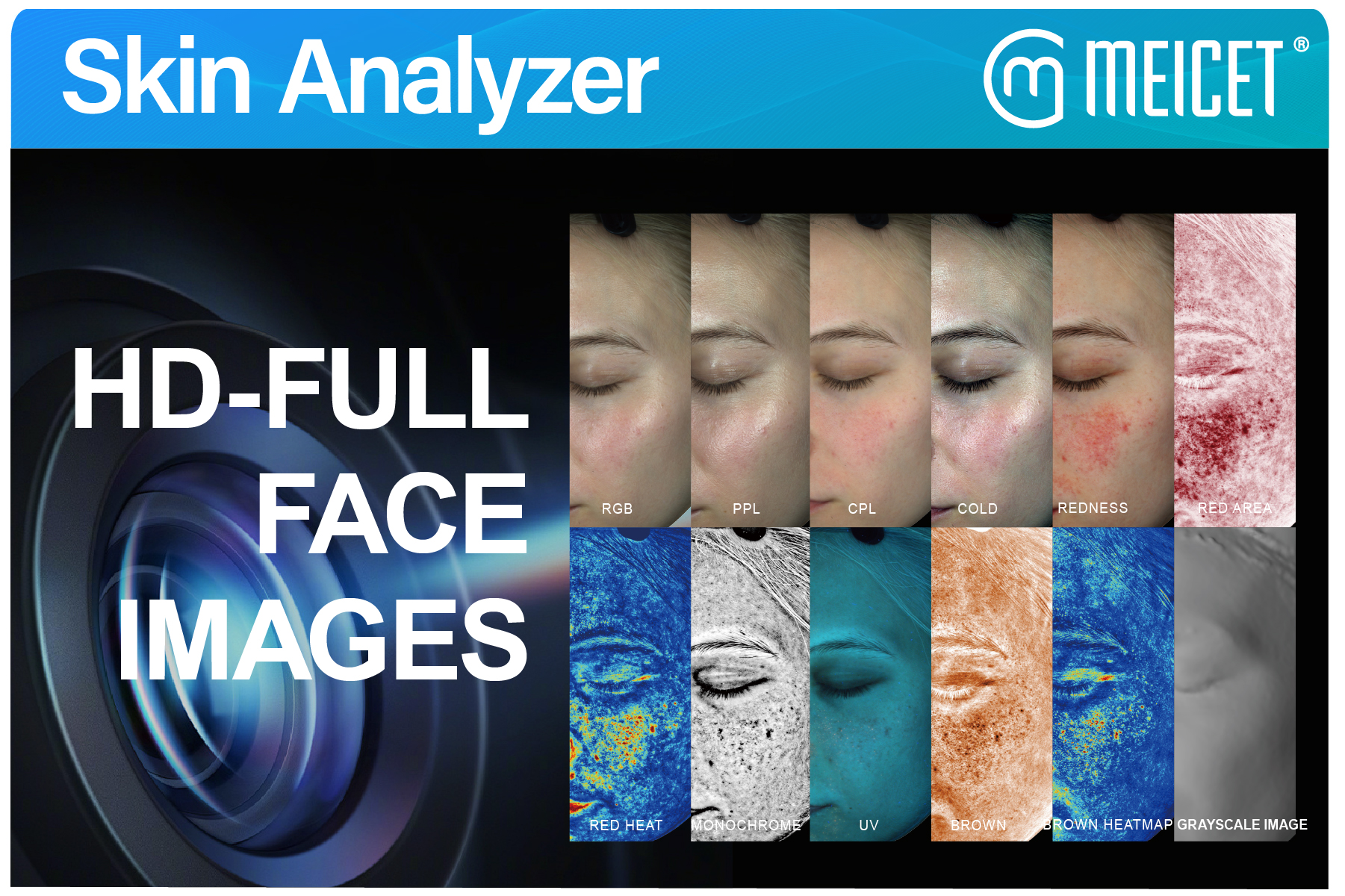
I use a Skin Analyzer to spot a wide range of skin concerns. Some of the most common issues include aging signs, texture, pores, pigmentation, redness, and moisture levels. I also check for hidden skin problems like UV damage and bacteria. Advanced technology helps me detect rosacea, psoriasis, and even skin diseases.
| Skin Concern | Description |
|---|---|
| Aging signs | Fine lines and wrinkles |
| Texture and pores | Skin texture and pore size |
| Pigmentation issues | Brown spots and hyperpigmentation |
| Redness and vascular conditions | Redness and vascular issues |
| UV damage | Damage caused by UV exposure |
| Bacteria levels | Levels of bacteria on the skin |
Key Takeaways
●A Skin Analyzer detects various skin concerns, including aging signs, pigmentation, and moisture levels, helping you understand your skin better.
●Advanced technology, like multispectral imaging and AI, allows for accurate detection of hidden issues, such as UV damage and bacteria.
●Regular skin analysis can guide your skincare routine, allowing for personalized product recommendations and improved skin health.
Skin Analyzer Technology
How Skin Analyzers Work
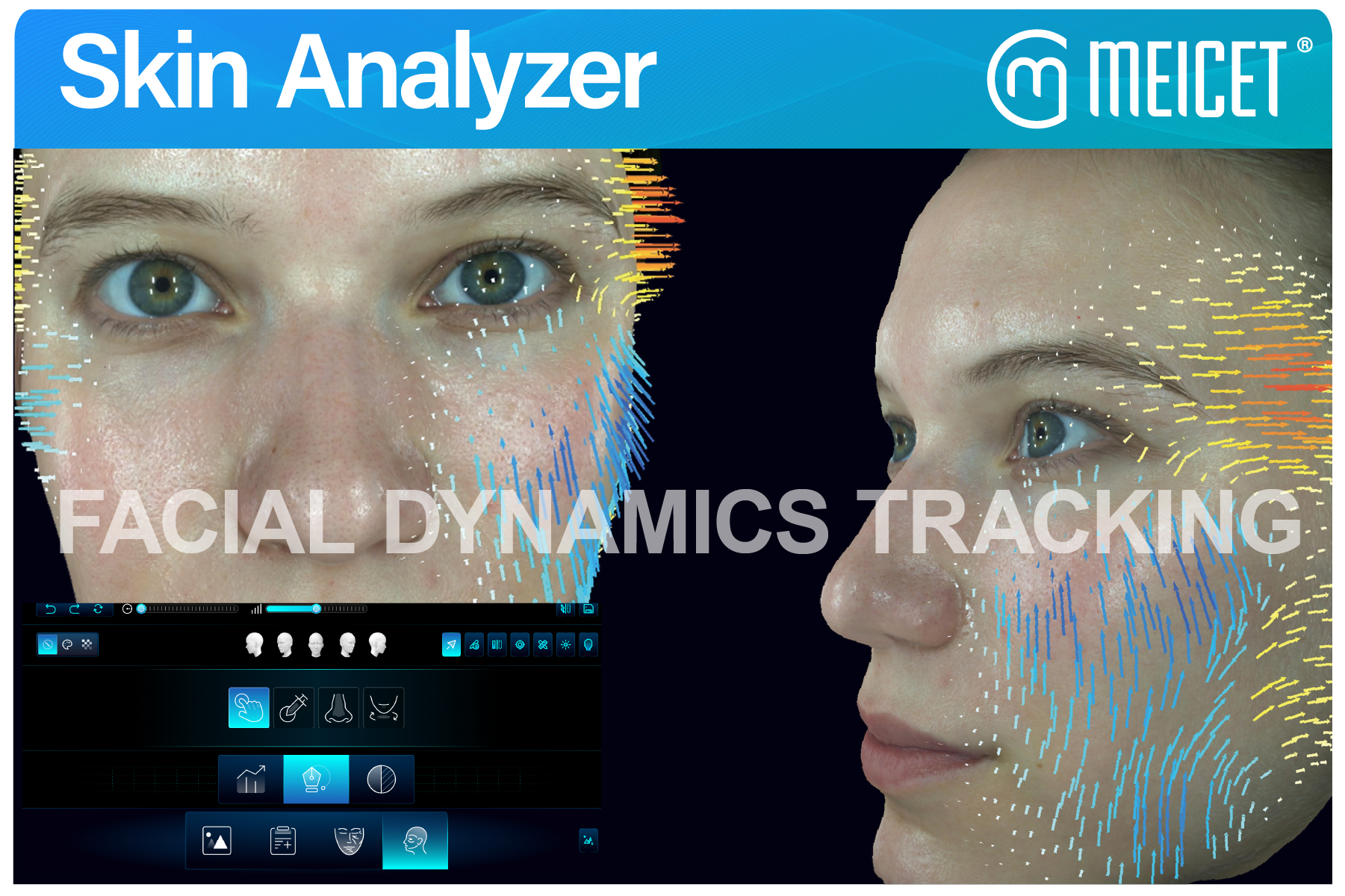
When I use a Skin Analyzer, I rely on advanced imaging tools to see what is happening on and under the skin. These devices use different types of light and cameras to capture detailed images. Here is a quick look at the main technologies I use:
| Technology | Description |
|---|---|
| Multispectral Imaging | Captures detailed information on the skin’s surface and beneath it. |
| 3D Analysis | Generates a 3D model of the facial structure for comprehensive analysis. |
| UV Light | Utilized to assess skin conditions by revealing underlying issues not visible under normal light. |
Some Skin Analyzer devices also use high-definition lenses and artificial intelligence. These features help me spot tiny problems, like early pigmentation or inflammation, that I cannot see with my eyes. Multi-spectral imaging and 3D technology allow me to check for hidden issues, such as deep spots or future skin risks.
I also measure moisture and oil levels. The device checks hydration in the top layer of the skin and looks at water loss. This helps me understand if your skin barrier is healthy. The analyzer can tell the difference between oil and sweat, which is important for accurate results.
The Analysis Process
I follow a simple process when I use a Skin Analyzer:
1.I ask you to clean your face and remove all makeup. This step ensures the results are accurate.
2.I position your face in front of the device. The analyzer takes pictures using different lights.
3.The software reviews the images and creates a report. I go over the results with you, so you understand your skin type and concerns.
Tip: For the best results, avoid using strong skincare products for a day or two before your analysis.
Skin Concerns Detected
Fine Lines & Wrinkles
I use a Skin Analyzer to check for fine lines and wrinkles. The device grades wrinkles by their depth and size. For example, the Visia system shows fine lines in light green and deeper wrinkles in dark green. This helps me create a plan that fits your skin’s needs. The table below shows how the device scores wrinkle severity:
| Severity Grade | Description | Score Range |
|---|---|---|
| Grade 1 | No visible wrinkles | 98-100 |
| Grade 2 | Fine, shallow barely noticeable wrinkles | 79-100 |
| Grade 3 | Prominent wrinkle that is deeper and wider with a visible base | 64-100 |
| Grade 4 | Deep, clearly defined wrinkle with raised borders on both sides | 46-100 |
| Grade 5 | Deep wrinkle with prominent raised borders | 27-100 |
The Skin Analyzer uses advanced imaging to measure the depth of each wrinkle. This makes it easy for me to tell the difference between fine lines and deeper creases.
Texture & Pores
I check your skin’s texture and pore size using high-resolution imaging and 3D surface profiling. The Skin Analyzer captures detailed images and uses special lighting to highlight roughness and pore diameter. Here are the main methods I use:
| Method | Description |
|---|---|
| High-resolution imaging | Captures detailed images of the skin surface to measure pore diameter and skin roughness. |
| 3D surface profiling | Provides a three-dimensional view to assess skin texture and pore size accurately. |
| Specialized lighting | Enhances visibility of skin features for better analysis of texture and pore characteristics. |
This technology helps me spot clogged pores, uneven texture, and areas that need extra care.
Pigmentation & Brown Spots
I rely on the Skin Analyzer to detect pigmentation issues and brown spots. Devices like VISIA can spot eight major skin parameters, including pigmentation and brown spots. AI-driven analyzers reach up to 90% accuracy in finding hyperpigmentation, which is much higher than what I can see with my eyes. These devices use UV light to reveal sunspots and hidden damage. They can even find spots deep in the skin, such as freckles and invisible pigmentation.
●The Skin Analyzer detects pigmentation and brown spots with high accuracy.
●AI technology helps spot hyperpigmentation better than manual checks.
●UV light shows sun damage and hidden spots.
●Professional devices give consistent results.
The most common pigmentation issues I find include:
| Type of Pigmentation Disorder | Description |
|---|---|
| Hyperpigmentation | Postinflammatory hyperpigmentation, melasma, solar lentigines, freckles, café au lait macules |
| Hypopigmentation | Vitiligo, pityriasis alba, tinea versicolor, postinflammatory hypopigmentation |
Redness & Vascular Issues
I use the Skin Analyzer to check for redness and vascular problems. The device uses polarized light to target hemoglobin in your skin. This helps me see red areas, broken capillaries, and inflammation. The VISIA system is very sensitive and can find redness, especially on the forehead. Red Zone imaging highlights inflammation and acne activity.
●Polarized light targets hemoglobin to show red areas.
●The device finds vascular lesions and broken capillaries.
●Multi-spectral imaging checks both surface and subsurface conditions.
I can spot issues like broken capillaries that are not visible to the naked eye. This helps me make a treatment plan just for you.
Moisture & Oil Levels
I measure your skin’s moisture and oil levels using sensors in the Skin Analyzer. These sensors include bioelectrical impedance (BIA) and capacitance sensors. They send a small electrical current through your skin to check hydration. The results are very accurate, with a margin of error as low as ±3%.
| Sensor Type | Description |
|---|---|
| Bioelectrical Impedance (BIA) | Measures skin hydration through electrical signals. |
| Capacitance Sensors | Measures skin moisture levels, often used in home-use devices. |
| Infrared Technology | Used in some devices, but less consistent than BIA and capacitance sensors. |
●Bioelectrical impedance measures resistance between electrodes.
●Capacitance sensors check moisture levels.
●High-quality devices have a margin of error of ±3% for hydration.
This helps me understand if your skin is oily, dry, or balanced.
Rosacea & Psoriasis
I use the Skin Analyzer to tell the difference between rosacea and psoriasis. The device looks for redness, visible blood vessels, and acne-like breakouts for rosacea. For psoriasis, it checks for thick, scaly patches and inflammation. The table below shows how I compare these two conditions:
| Condition | Symptoms | Affected Areas |
|---|---|---|
| Rosacea | Facial redness, flushing, visible blood vessels, acne-like breakouts | Mainly face, neck, chest |
| Psoriasis | Thickened, scaly patches, silver scales, inflammation, itching | Commonly joints, legs, lower back, face |
This helps me choose the right care for your skin.
Hydration & Dryness
I check hydration and dryness by measuring water content in your skin’s outer layer. The Skin Analyzer uses bioelectrical impedance and capacitance sensors to give a percentage score. Here is how I read the results:
| Hydration Level | Skin Condition |
|---|---|
| 0–30% | Very dry skin |
| 30–40% | Dry or dehydrated |
| 40–60% | Normal hydration |
| 60–80% | Well hydrated |
●The device measures water in the stratum corneum.
●Results show as percentages, making it easy to track changes.
Digital moisture meters analyze how electricity moves through your skin. Water conducts electricity better than dry skin, so the device can estimate hydration levels.
Skin Diseases & Cancer
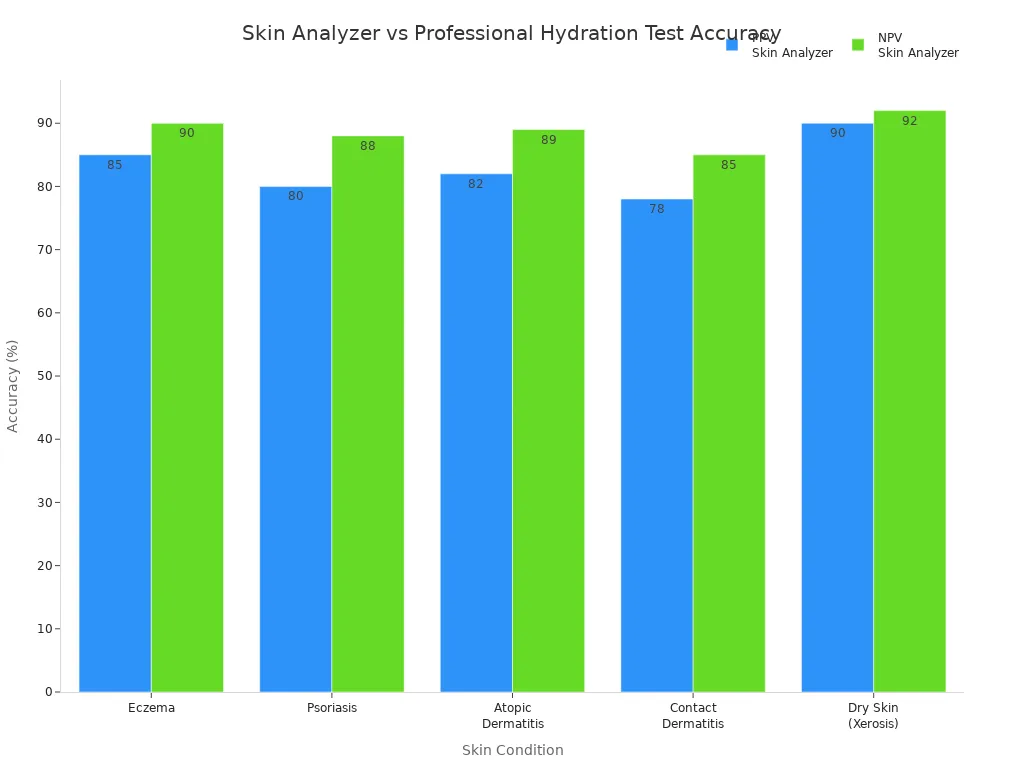
I use advanced Skin Analyzer devices to check for early signs of skin diseases and cancer. AI-powered systems like DERM AI and DermaSensor have high sensitivity and accuracy. For example, DERM AI shows an AUROC (a measure of accuracy) between 91.8% and 95.8%. DermaSensor has been trained on over 20,000 scans, including melanoma, basal cell carcinoma, and squamous cell carcinoma. Early detection is important because it improves treatment outcomes.
| Metric | DERM AI Skin Analyzer | Clinical Specialists |
|---|---|---|
| AUROC | 91.8% – 95.8% | 77.8% |
| Sensitivity (100% target) | 100% | N/A |
| Specificity | 65% | 69.9% |
| Early-stage melanoma cases | >50% | N/A |
| Metric | DermaSensor | Gold Standard |
|---|---|---|
| Sensitivity | 95.5% | N/A |
| Overall Accuracy (AUC) | Superior to PCPs | N/A |
The AI system gives instant results and helps me spot problems early. However, some limits exist. For example, the device may not see all redness, and hair or facial expressions can affect results. I always recommend seeing a dermatologist for a full diagnosis if I find something unusual.
Note: The Skin Analyzer is a powerful tool, but it does not replace a professional medical opinion.
Accuracy & Limitations
Reliability of Skin Analyzer Results
I trust the Skin Analyzer for consistent and reliable results. Studies show that these devices offer 95% test-retest reliability, which means I get similar results when I scan the same person more than once. The results also match over 80% with physician assessments and other imaging devices. This makes the Skin Analyzer a precise, fast, and cost-effective tool for skin evaluation.
| Key Findings | Description |
|---|---|
| 95% test-retest reliability | Consistent results when scanning the same individual multiple times. |
| Over 80% correlation with assessments | Strong agreement with physician and imaging device evaluations. |
| Precise, fast, and cost-effective | A viable alternative to traditional skin assessment methods. |
Preparation & Challenges
To get the most accurate results, I always follow a few simple steps:
●Cleanse your face with a gentle cleanser to remove makeup and dirt.
●Choose a comfortable environment for the test.
●Make sure the lighting is suitable for analysis.
●I avoid over-cleansing or exfoliating before the session to protect your skin barrier.
Some challenges can affect accuracy. Not all devices provide the same level of detail. Some may overemphasize certain skin conditions, which can lead to confusion. Devices that use only one measurement parameter may struggle to tell the difference between healthy skin and conditions like atopic dermatitis. Also, current analyzers cannot detect biochemical changes or internal conditions.
Benefits & Practical Considerations
I find that Skin Analyzer results help me understand your unique skin needs. The device gives precise assessments, which makes it easier to choose the right products for you. I can track your skincare progress and adjust routines as needed. The insights from the analysis allow me to recommend products that target specific concerns, such as oil production or hydration. This personalized approach improves your skincare results and builds trust in your routine.
Tip: Use your Skin Analyzer results as a guide, but always consult a professional for complex or unusual skin issues.
I see how a Skin Analyzer detects fine lines, wrinkles, pigmentation, redness, and even hidden issues. AI systems reach up to 95% accuracy, so I trust the results. I always prepare skin carefully and use these insights to create personalized skincare plans. For complex concerns, I consult a professional.
FAQ
Can a Skin Analyzer replace a dermatologist?
I use a Skin Analyzer for early detection and tracking. I always recommend seeing a dermatologist for diagnosis and treatment of serious skin concerns.
How often should I get my skin analyzed?
I suggest a skin analysis every three to six months. This helps me track changes and adjust your skincare routine as needed.
Is the Skin Analyzer safe for all skin types?
Yes, I find Skin Analyzers safe for all skin types. The device uses non-invasive technology and does not cause discomfort.
Post time: Jun-09-2026


