


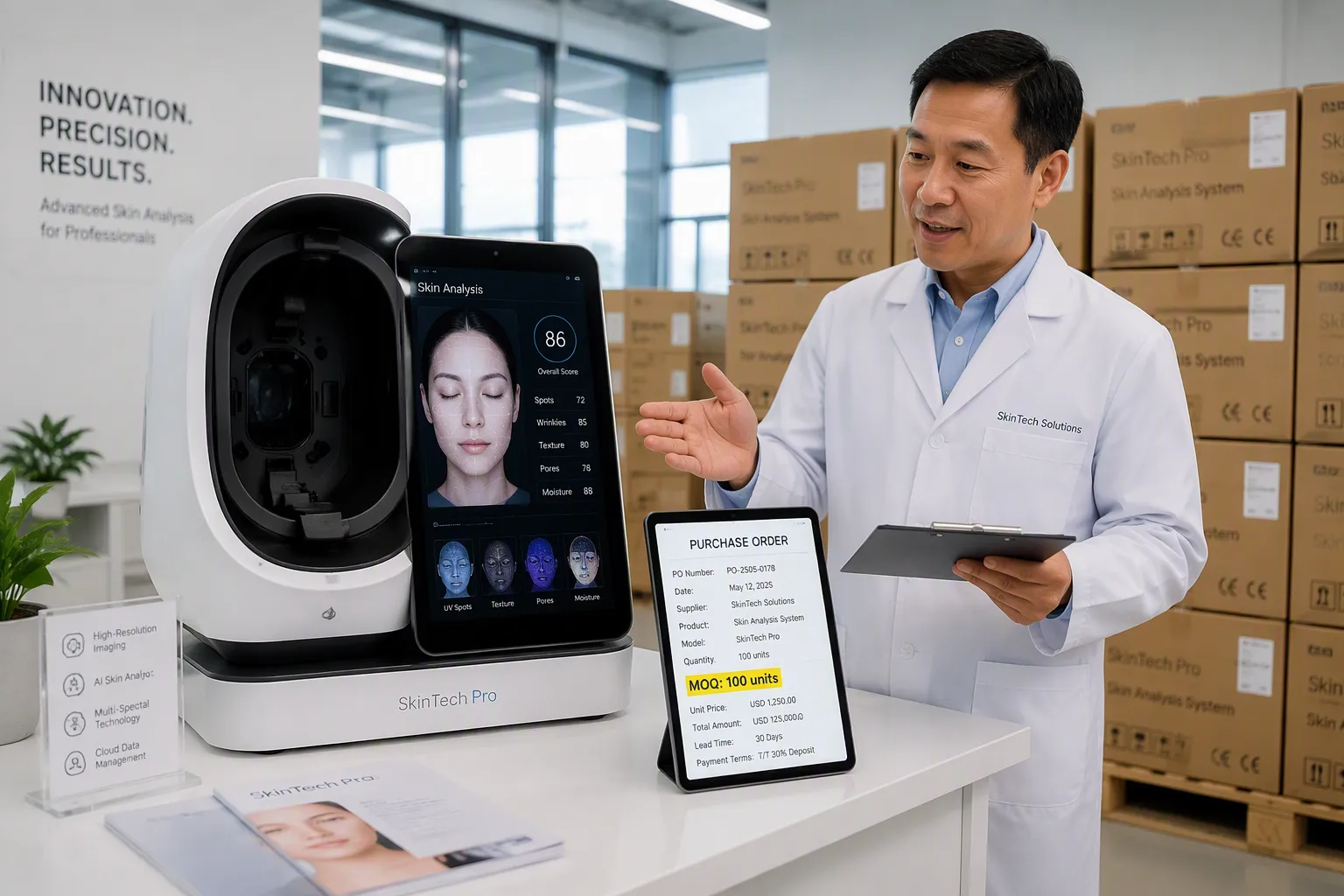
Quick Answer: Before buying a 3D skin analysis machine for distribution, verify four critical areas: regulatory classification and certifications (CE, FDA, ISO 13485), manufacturer support infrastructure (training, marketing, technical documentation), product technical specifications (imaging modes, AI capabilities, analysis depth), and total cost of ownership including shipping, duties, and after-sales support. The global skin analysis systems market is expanding, with growing demand for personalized skincare and increased use in aesthetic clinics driving adoption . Distributors who fail to validate these elements often discover that the lowest-priced equipment carries the highest hidden costs—regulatory barriers, insufficient customer training, and unreliable spare parts supply chains that erode both margins and reputation.
Key Takeaways:
Regulatory classification determines your legal pathway: A device marketed for cosmetic assessment faces different requirements than one making medical diagnostic claims.
Manufacturer support varies dramatically: Request documentation on training programs, marketing materials, and technical support SLAs before committing to inventory.
Technical specifications must match customer needs: Multi-spectral imaging modes, AI analysis depth, and workflow integration determine whether end customers can generate ROI.
Total cost of ownership exceeds purchase price: Shipping, import duties, software licensing, spare parts, and training can add 30–50% to initial equipment costs.
MEICET offers distributor-relevant products: The 3D D9 with 8K imaging and the PRO-A for high-volume clinics provide portfolio options across customer segments .
Regulatory Compliance: The First Gate You Must Pass
Regulatory classification is the single most important determinant of whether you can legally sell a 3D skin analysis machine in your market—and what claims you can make to customers. A device positioned as a cosmetic consultation tool occupies a different regulatory category than one making medical diagnostic claims. This distinction affects everything from certification requirements to marketing language restrictions.
In the European Union, devices intended for medical purposes fall under the Medical Device Regulation (MDR) 2017/745. MEICET’s 3D SKIN ANALYZER series has received Class IIb certification under this framework, meaning it meets the requirements for medium-risk medical devices . For distributors selling in EU markets, this certification provides a documented regulatory foundation. In the United States, the FDA classification depends on intended use and predicate devices—MEICET products carry FDA certification, though distributors should verify the specific clearance pathway for their target applications.
The essential documentation to request from any manufacturer includes:
CE certificate and Notified Body scope (for EU markets)
FDA clearance letters or registration (for US markets)
ISO 13485 quality management certification
IEC 60601 safety and EMC test reports
Software validation documentation
A manufacturer that cannot provide these documents limits your ability to operate in regulated markets and may expose you to liability if devices are found non-compliant. As one procurement guide notes, “the key question is not simply whether a machine is labeled ‘3D’” but whether it meets the regulatory standards applicable to your market .
Table 1: Distributor Due Diligence Checklist
| Evaluation Area | Critical Questions | Red Flags |
|---|---|---|
| Regulatory Certification | CE marking? FDA clearance? ISO 13485? | “GMP-ready” without certificates; no Notified Body documentation |
| Manufacturer Support | Training programs? Marketing materials? Technical support SLA? | No distributor training; marketing collateral not provided |
| Technical Specifications | How many imaging modes? AI analysis depth? Report generation? | Vague claims like “AI-powered” without specifics |
| Total Cost of Ownership | Software licensing fees? Calibration requirements? Spare parts availability? | Purchase price only; recurring costs not disclosed |
| Territory Protection | Exclusive territory? Minimum purchase commitments? Performance targets? | No territorial terms; direct sales by manufacturer in your market |
| Reference Customers | Can you speak with existing distributors? | No references provided; reluctance to share customer contacts |
Manufacturer Support: The Difference Between Partnership and Abandonment
The level of manufacturer support you receive directly determines your ability to close sales and retain customers. A distributor selling equipment without training, marketing materials, and technical support operates at a severe disadvantage compared to competitors backed by active manufacturer engagement.
MEICET’s distributor support structure includes several elements relevant to portfolio decisions :
- Product training: Technical training on device operation and analysis interpretation
- Marketing materials: Product brochures, ROI calculators, and patient education content
- Demo unit access: Reduced-price demonstration units for customer evaluations
- Software updates: Regular updates every 3–6 months, supporting recurring customer engagement
- Multi-language support: Software available in multiple languages for diverse markets
The critical question to ask any manufacturer is: What specifically will you provide to help me sell? Vague assurances of “support” without documented commitments create risk. Request details on:
- Training hours and delivery format (on-site, remote, or train-the-trainer)
- Marketing collateral templates and customization options
- Technical support response times and escalation paths
- Spare parts availability and lead times
- Warranty terms and claims processing procedures
Industry analysis emphasizes that “the availability of technical assistance (local or remote), response speed, initial and ongoing training, and warranty coverage are decisive elements for ensuring customer satisfaction and the sustainability of your investment” .
Technical Specifications That Matter for Distribution
Technical specifications determine whether the equipment can solve your customers‘ problems—not just whether it meets a feature checklist. For distributors evaluating 3D skin analysis machines, the specifications that matter most are those that translate directly into customer value: consultation efficiency, diagnostic confidence, and treatment plan acceptance.
MEICET’s 3D SKIN ANALYZER platform offers specifications relevant to diverse customer segments :
- Multi-spectral imaging: 5 spectral modes (RGB, cross-polarized, parallel-polarized, UV, Wood’s light) capturing both surface and subsurface skin information
- AI analysis scope: 12 key skin parameters including wrinkles, pigmentation, pores, sensitivity, and acne
- Predictive capability: 5–7 year aging trajectory simulation
- Database: 5+ million real-world skin cases for AI training
- Workflow: 30-second scan-to-report generation with cloud storage
A procurement guide notes that buyers should “confirm whether the software can generate reports, compare results over time, and provide care or product recommendations” . The distributor’s task is matching these capabilities to the specific needs of their customer segments—premium dermatology clinics may prioritize predictive modeling and 8K imaging, while high-volume aesthetic clinics may value rapid scanning and automated report generation.
Table 2: MEICET Product Portfolio for Distribution
| Product | Target Customer | Key Specifications | Distributor Support Needed |
|---|---|---|---|
| 3D D9 | Dermatology clinics, luxury medical spas | 8K ultra-HD imaging, 12-parameter analysis, predictive modeling | Clinical training, ROI calculators |
| PRO-A | High-volume aesthetic clinics | Rapid scanning (65% faster diagnosis), 8-dimension analysis | Operational training, marketing materials |
| MC Series | Skincare centers, professional practices | Reliable analysis, workflow integration | Technical support, software updates |
Total Cost of Ownership: Beyond the Purchase Price
The purchase price represents only 50–70% of the total cost of owning and distributing 3D skin analysis machines. Distributors who calculate margins based solely on equipment cost overlook significant recurring and one-time expenses that directly impact profitability.
Shipping and logistics: International shipments of 3D analyzers carry substantial freight charges. Sea freight typically costs $80–$150 per unit, while air freight for urgent orders can exceed $300. For distributors importing from manufacturers in China or other Asian production hubs, these costs must be factored into landed cost calculations.
Import duties and taxes: Duties vary dramatically by market. EU importers face 0–4.7% duties depending on product classification, plus destination VAT. US importers may encounter Section 301 tariffs on Chinese-origin goods that add 7.5–25% to landed cost.
Software licensing and updates: Some manufacturers charge annual software licensing fees or per-update charges. Clarify whether software updates are included in the purchase price or represent recurring costs. MEICET provides regular software updates every 3–6 months, and distributors should confirm whether these are provided at no additional cost .
Training and support infrastructure: Distributors must budget for their own technical training, demo unit inventory, and customer support capabilities. These investments directly impact sales effectiveness and customer retention.
Spare parts and service: Warranty terms, spare parts availability, and repair turnaround time affect both customer satisfaction and distributor operating costs. As one guide notes, “a lower equipment price may have less value if spare parts are difficult to obtain or technical support is slow” .
FAQ
What regulatory certifications should I require before distributing a 3D skin analysis machine?
At minimum, require CE marking (for EU markets), FDA clearance or registration (for US markets), and ISO 13485 quality management certification. For devices making medical diagnostic claims, verify the specific regulatory pathway (e.g., Class IIb under EU MDR). Request certificates and technical files—manufacturers should provide these as standard documentation.
How much should I budget for initial inventory and operational costs?
Initial investment typically ranges from $18,500 to $98,000 depending on market, manufacturer terms, and scale. This includes inventory (2–5 units), demo equipment, regulatory compliance, training, and working capital. Shipping and import duties can add 15–30% to equipment costs.
What manufacturer support should I expect as a distributor?
Standard support includes product training, marketing materials, technical documentation, and warranty administration. Leading manufacturers like MEICET also provide demo equipment, clinical training programs, and software updates . Request specific commitments on training hours, marketing collateral, and technical support response times.
How do I verify the technical specifications of a 3D skin analysis machine?
Request a demonstration with your actual use case—ideally with a customer’s skin type and concern. Verify imaging modes (count and type), AI analysis parameters, report generation capabilities, and workflow integration. Ask for sample reports and compare against competing products. A procurement guide recommends checking “how multiple angles are captured and combined, and whether the same positioning can be repeated” .
What are the biggest hidden costs in 3D skin analyzer distribution?
Shipping and freight ($100–$400 per unit), import duties (0–25% of product value), software licensing fees, training costs, and spare parts inventory are the most commonly underestimated expenses. Payment processing fees and returns also reduce net margin. Calculate total landed cost before setting pricing.
How do I evaluate a manufacturer‘s reliability before committing?
Request references from existing distributors in comparable markets. Ask about their experience with technical support, spare parts availability, and response times to customer issues. Verify the manufacturer’s production capabilities and quality certifications. MEICET, for example, has a 3,000-square-meter facility with dedicated clinical testing and engineering departments .
What territory and exclusivity terms should I negotiate?
Exclusive territories typically require minimum purchase commitments and performance targets. Clarify whether exclusivity is based on demonstrated sales performance or requires upfront inventory investment. Understand the manufacturer’s direct sales policy—will they sell directly into your territory, competing with you? Request written territory protection terms before signing.
Post time: Oct-13-2026


