


Quick Answer
The price of a skin analysis machine typically ranges from $750 to over $15,000, with the global average selling price for 3D skin analysis systems sitting at approximately $795 per unit as of 2025. The single largest cost driver is imaging hardware quality — specifically camera resolution, spectral modality count, and light source engineering — which can account for 40-60% of total manufacturing cost. Secondary factors include AI algorithm licensing and database access, build configuration (portable vs. workstation), software ecosystem features (CRM integration, multi-terminal access), and regional market positioning. Understanding these factors enables informed procurement decisions rather than reactive price comparisons.
Key Takeaways
Imaging resolution is the primary price lever: A 24-megapixel system with six spectral modes costs exponentially more than a basic 2-megapixel RGB-only device.
Spectral modalities multiply cost: Each additional light mode (UV, cross-polarized, parallel-polarized, Wood’s light) adds hardware complexity and calibration requirements.
AI and database access create recurring value: Devices backed by millions of training samples command premiums but deliver measurably higher diagnostic accuracy.
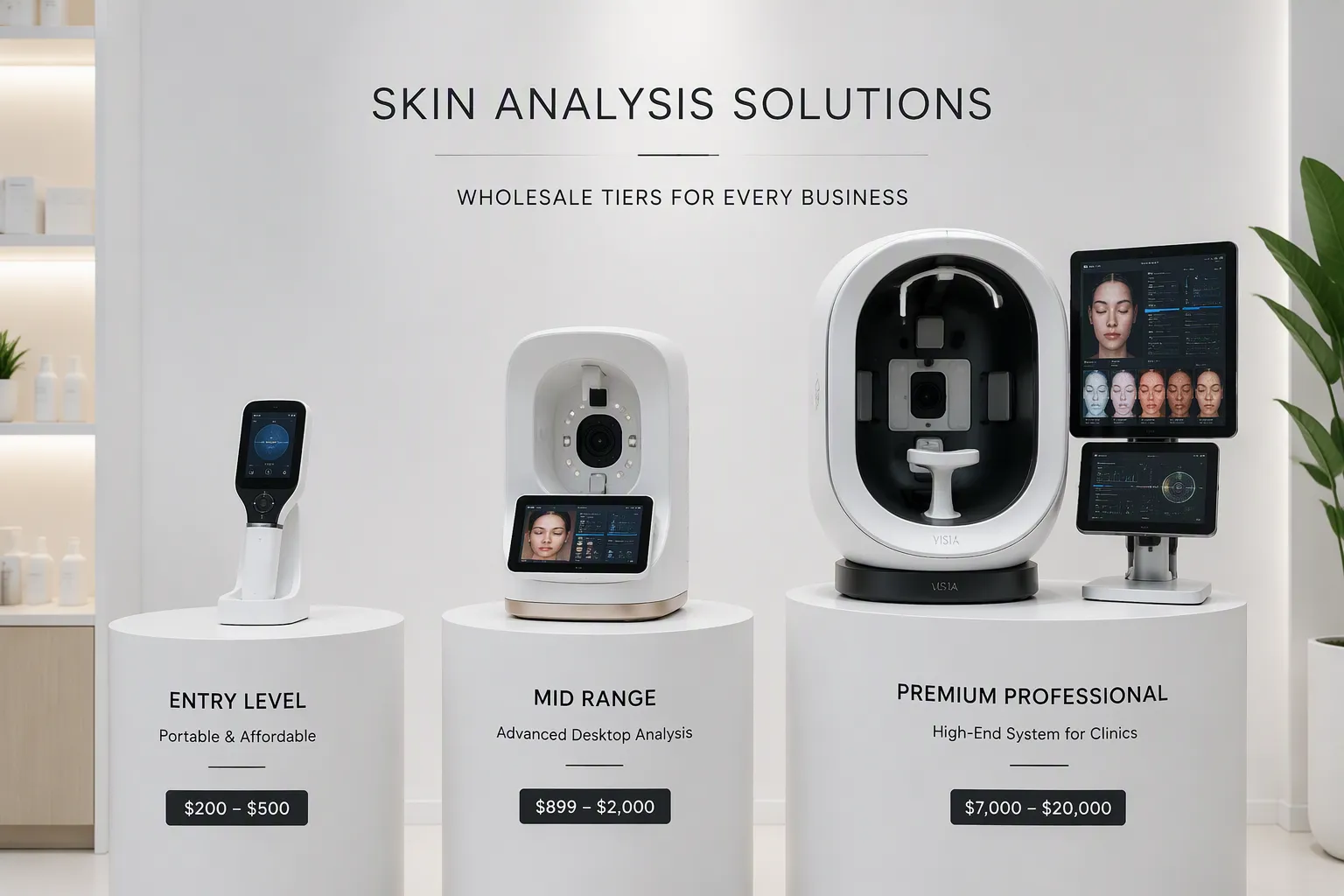
Portable vs. workstation changes the equation: Portable 3D analyzers range from $750-$3,000, while professional workstation systems exceed $10,000.
Market positioning affects price by 3-5×: Hospital-grade systems in regulated medical channels cost significantly more than equivalent hardware sold through beauty retail channels.
Why Skin Analysis Machine Prices Vary So Dramatically
A procurement manager at a dermatology clinic in Shanghai recently faced a confounding situation: two skin analysis machines, both advertised as “3D AI-powered,” differed in price by a factor of eight. The $750 unit claimed 19-language support and facial scanning. The $5,700 unit offered multi-spectral imaging with vertical screen orientation. Both were real products. The difference lay entirely in what the specifications actually delivered — and what they omitted.
The global intelligent skin analysis device market reached $16.86 billion in 2024**, projected to approach **$22.48 billion by 2031 at a 4.2% CAGR. Within this market, the 3D skin analysis segment alone produced 141,000 units in 2025 at an average selling price of $795. But that average conceals a bimodal distribution: entry-level portable units pulling the median down, and professional clinical systems pushing the ceiling into five figures.
Understanding what drives price requires examining the machine not as a monolithic product but as a stack of independently costly subsystems.
The Hardware Core: Imaging Resolution and Sensor Architecture
The camera sensor and optical lens assembly represent the single most expensive component tier in any skin analysis machine. A device’s imaging capability determines what skin conditions it can detect, which in turn determines its addressable market and clinical utility.
Professional-grade systems such as the ISEMECO S7 utilize 24-megapixel ultra-micro optical lenses, enabling visualization of deep dermal structures that lower-resolution sensors cannot resolve. At the opposite end of the spectrum, research-grade prototype systems have demonstrated skin type classification using the OV2640 camera sensor at 2 megapixels (1600 × 1200 UXGA), with data transmitted through an ESP32-CAM module. The price differential between these two imaging pipelines exceeds an order of magnitude.
Resolution affects price through three mechanisms:
Sensor cost. CMOS sensors scale non-linearly in cost with pixel density and low-light sensitivity. A 24MP sensor with large pixel pitch for reduced noise commands a premium over a 2MP sensor designed for hobbyist applications.
Optical assembly. High-quality lenses with minimal chromatic aberration and consistent edge-to-edge sharpness require precision grinding and multi-element designs. The ISEMECO systems employ “ultra-micro optical lenses” — a category that implies sub-micron surface accuracy and specialized coating.
Processing bandwidth. Higher-resolution capture generates larger data streams requiring faster on-board processing, more memory, and higher-bandwidth data ports. USB 2.0 remains standard in current professional units, but the processing pipeline behind it must handle the throughput.
For procurement purposes: resolution specifications printed on marketing materials rarely tell the full story. The relevant question is not “how many megapixels?” but “what pixel pitch, and what optical distortion at the edges?”
Spectral Imaging: The Hidden Cost Multiplier
The single most under-appreciated price driver in skin analysis machines is spectral modality count — the number of distinct light modes the device can project and capture.
Basic devices operate with RGB visible light only. Professional systems layer multiple imaging modes, each requiring its own light source, filter, calibration routine, and algorithmic interpretation path.
The ISEMECO S7 captures nine distinct image types: RGB (7200K), UV, parallel-polarized light (PPL), cross-polarized light (CPL), Wood’s light, red area mapping, gray map, green map, and purple map. Each modality reveals different skin structures:
| Spectral Mode | What It Reveals | Hardware Requirement |
|---|---|---|
| RGB visible | Surface texture, tone, pores | Standard LED array |
| UV | Sun damage, bacterial activity, porphyrins | UV LEDs (365-405nm), safety shielding |
| Cross-polarized | Sub-surface redness, inflammation, vascular patterns | Polarizing filters (two axes) |
| Parallel-polarized | Surface shine, sebum distribution | Single polarizer |
| Wood’s light | Pigmentation depth, fungal conditions | Narrow-band UV filter |
Each additional modality adds light source cost (UV LEDs require different semiconductor materials than visible LEDs), filter cost (precision polarizers and bandpass filters), mechanical complexity (polarizer rotation or switching mechanisms), and calibration burden (each mode must be normalized independently for consistent output).
Research has confirmed that cross-polarized photography using even low-cost polarizing filters enables visualization of latent spots and inflammation invisible in standard RGB. But scaling from two modalities to nine multiplies the bill of materials by a factor that can exceed the cost of the base camera itself.
A device claiming “multi-spectral analysis” without specifying modality count is a procurement red flag.
The AI Layer: Algorithms, Databases, and Diagnostic Accuracy
AI capabilities in skin analysis machines operate on a spectrum from marketing ornamentation to clinically validated diagnostic support. Price correlates with where on that spectrum a device actually sits.
Entry-level systems often implement basic image processing algorithms — contrast enhancement, threshold-based feature highlighting, template matching — branded as “AI.” These add negligible cost because they run on minimal hardware and require no training data.
Professional systems invest heavily in two expensive assets: training databases and validated algorithms.
The ISEMECO platform leverages a database of millions of skin samples, enabling more accurate analysis results across diverse skin types and conditions. Building such a database requires years of standardized image collection across demographics, expert annotation by dermatologists, and ongoing curation. This is a capital-intensive asset that directly influences diagnostic reliability.
Independent research validates the clinical value of sophisticated AI. A study on line-field confocal OCT combined with AI analysis achieved 81.5-100% sensitivity and 100% specificity for basal cell carcinoma detection using scan-level metrics that aggregate frame-level AI risk scores. This level of performance requires not just a good algorithm but a validated one — tested against histopathology-confirmed cases.
Amorepacific’s AI skin analysis technology, integrated into Samsung’s AI Beauty Mirror, draws on a dataset of over 450,000 cases to assess pores, redness, pigmentation, and wrinkles. That dataset size is a competitive moat, and it prices into the device accordingly.
For buyers: ask whether the AI system has been validated against clinical ground truth, and whether the training database includes skin types representative of your patient population. A device trained predominantly on Fitzpatrick Type I-III skin may perform poorly on Type IV-VI.
Build Configuration and Form Factor
Skin analysis machines come in three broad form factors, each with distinct cost profiles:
Portable/handheld units prioritize miniaturization. They run on embedded processors or paired smartphones, use smaller sensors, and typically offer fewer spectral modalities. Prices range from $750 to $3,000 depending on imaging quality and connectivity features. These are appropriate for mobile aesthetic services, retail counters, and preliminary screening.
Desktop workstations integrate the imaging head with a dedicated processing unit and monitor. The ISEMECO S7 configuration pairs the imaging host with a high-definition monitor and PC, with optional motorized height-adjustment platform (700-1080mm range). This configuration supports multi-image comparison (1, 2, 4, or 9 images simultaneously), report generation, and CRM integration. Prices in this tier range from $5,000 to $15,000+ depending on spectral capability.
Clinical/medical-grade systems add regulatory compliance overhead — FDA 510(k) clearance in the US, CE marking in Europe, NMPA registration in China — which can add 20-40% to the base hardware cost. A 2026 hospital procurement record from Sichuan Province shows a skin imaging analyzer winning bid at 370,000 RMB (~$51,000)**, while a lower-tier unit in the same tender was awarded at **95,000 RMB (~$13,000). The price gap reflects not just hardware but the regulatory and documentation burden of hospital-grade procurement.
Software Ecosystem: The Recurring Value Question
Software features increasingly differentiate price tiers, particularly for multi-location practices and aesthetic chains.
Multi-terminal access allows different departments or store locations to view and edit analysis results simultaneously, breaking time and geographic constraints. This requires cloud infrastructure, user authentication, and data synchronization — costs that vendors either absorb (raising device price) or pass through as subscription fees.
CRM integration enables the analysis machine to feed directly into client management workflows: treatment history, product recommendations, follow-up scheduling. Custom SaaS and CRM integration is available on professional platforms, with pricing implications for both initial setup and ongoing licensing.
Report customization — including logo placement, QR codes, and branded report templates — transforms the device from a diagnostic tool into a marketing asset for clinics. This feature often appears in professional tiers but is absent from budget devices.
The practical question for buyers: does the software create switching costs that lock you into the vendor’s ecosystem? Cloud-dependent analysis with proprietary data formats means your client records live on someone else’s server.
Regional Market Dynamics and Procurement Channels
Identical hardware can carry dramatically different prices depending on where and how it is sold.
Direct-from-manufacturer channels (Alibaba, Made-in-China, manufacturer websites) offer the lowest base prices but shift integration burden to the buyer. A 15.6-inch screen portable skin analyzer listed on Yiwugo shows a range of 4,400-5,700 RMB for 100-unit wholesale orders, with plug type and language options affecting the final price.
Distributor/authorized reseller channels add margin, local support, warranty service, and often regulatory compliance documentation. The markup ranges from 30-100% depending on region and support level.
Medical tender channels command the highest prices due to specification requirements, compliance documentation, and procurement processes. The Sichuan hospital tender illustrates this: the winning bid for a mid-tier unit was 95,000 RMB, while the premium unit reached 370,000 RMB.
Currency, import duties, certification costs (FCC, CE, NMPA), and local technical support infrastructure all layer onto the base manufacturing cost in ways that can double the final price relative to ex-factory.
Feature-to-Cost Mapping: A Procurement Framework
The table below maps specific features to their approximate contribution to total device cost, based on the component cost analysis discussed above:
| Feature | Cost Impact | Why It Matters |
|---|---|---|
| 24MP vs. 2MP camera | +$1,500-4,000 | Determines detectable skin feature size |
| Each additional spectral mode | +$300-800 per mode | Expands diagnostic range |
| UV imaging capability | +$500-1,200 | Enables sun damage and bacterial assessment |
| Validated AI with 1M+ training samples | +$2,000-5,000 | Improves diagnostic accuracy |
| Multi-terminal/cloud access | +$500-1,500 (or subscription) | Supports multi-location operations |
| Motorized height adjustment | +$400-800 | Ergonomic for high-volume clinics |
| CRM/SaaS integration | +$1,000-3,000 or monthly fee | Workflow efficiency |
| Medical device registration | +20-40% of base cost | Legal market access |
Frequently Asked Questions
What is the average price of a professional 3D skin analysis machine?
The global average selling price for 3D skin analysis systems was $795 per unit in 2025**, but this figure encompasses the entire market from budget portables to clinical workstations. For a professional-grade system with multi-spectral imaging and validated AI, expect **$5,000-$15,000**. Hospital-grade systems with regulatory clearance can exceed **$50,000.
Does higher camera resolution always mean better skin analysis?
No. Resolution determines the smallest detectable feature, but spectral modality count and calibration quality often matter more for diagnostic utility. A 12MP camera with five well-calibrated spectral modes outperforms a 24MP camera with only RGB for detecting subsurface conditions. Sensor pixel pitch (affecting noise) and optical distortion at image edges are equally important specifications.
Why do two machines with similar specifications differ in price by 3×?
Three factors typically explain the gap: (1) AI validation depth — a system trained on millions of clinically annotated images costs more to develop than one using generic image processing; (2) regulatory compliance — medical device registration adds 20-40% to cost; (3) support infrastructure — local technical support, warranty, and training are priced into authorized channel devices but absent from direct-from-manufacturer sales.
Is UV imaging worth the price premium?
UV imaging reveals sun damage, bacterial porphyrins, and pigmentation depth that visible light cannot detect. For dermatology and advanced aesthetic practices, this diagnostic capability justifies the premium. For retail or basic consultation settings, the clinical value may not materialize into revenue.
Can I use a portable skin analyzer for clinical diagnosis?
Portable units ranging from $750 to $3,000 are appropriate for screening, client education, and treatment progress tracking. They generally lack the spectral depth and resolution for diagnostic-grade assessment. Regulatory clearance for clinical diagnosis typically accompanies workstation-class systems.
What ongoing costs should I budget beyond the purchase price?
Consider: software licensing or SaaS fees for cloud-based analysis and CRM integration; calibration and maintenance to maintain imaging consistency; training for staff on image interpretation; and consumables if the device uses disposable contact elements. Cloud-dependent systems may charge per-analysis or per-user fees.
How do I evaluate AI claims in a skin analysis machine?
Ask three questions: (1) What is the training database size and demographic composition? A system trained on 450,000+ cases across diverse skin types is more reliable than one trained on 10,000. (2) Has the algorithm been validated against clinical ground truth in peer-reviewed studies? Sensitivity and specificity metrics should be available. (3) Does the AI provide explainable output (heatmaps, confidence scores) or just a binary result?
Post time: Oct-16-2026


