


A professional skin 3D measurement scanner takes you beyond merely “seeing” to truly “understanding” your skin, empowering you to directly comprehend deep-seated skin concerns.
Traditional skincare often relies on rough visual and tactile judgments. Today, skin 3D measurement scanners are revolutionizing this approach. These devices elevate the act of “looking” from a sensory experience to a scientific one. They go beyond surface-level concerns like spots and pores to delve into underlying issues such as collagen loss and capillary dilation. All this information is transformed into intuitive, visual data, making previously “invisible” problems clearly visible.
The skin’s “red zones” and “brown zones” are fully revealed under spectral analysis. Red images expose inflammatory concerns like acne, rosacea, or telangiectasia; dark images reflect pigmentation issues such as sunspots, melasma, or moles. A skin analysis device is no longer just a powerful diagnostic tool but also a scientific foundation for guiding aesthetic treatment decisions.
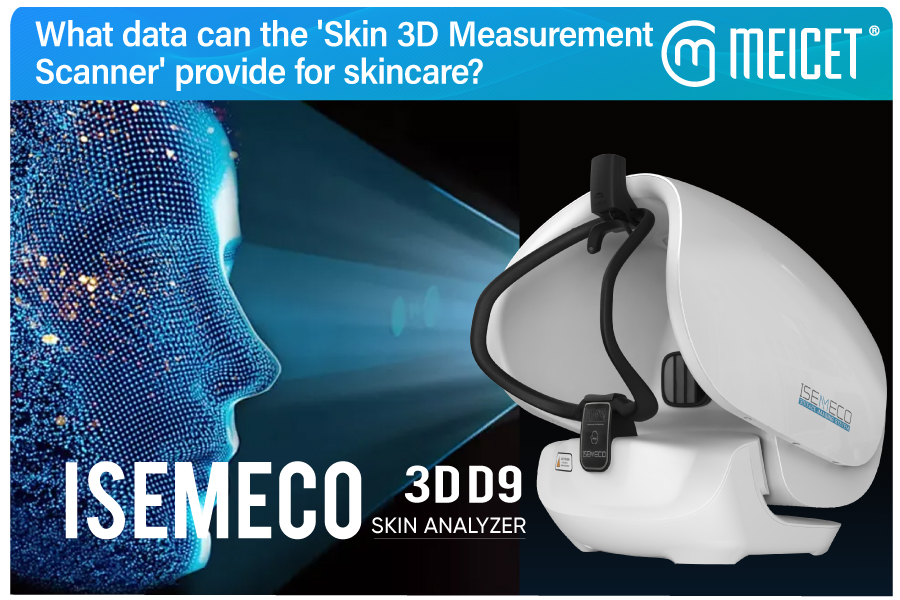
Among the various scanners available, the ISEMECO 3D D9 Skin Imaging Analyzer represents an advanced industry standard. This skin 3D measurement scanner features a high-precision “binocular structured light” scanning system. It captures ultra-high-definition spectral images of up to 36 million effective pixels across the entire face, revealing every fine line and pore with incredible detail. This provides diagnostic visuals that surpass what the naked eye can see.
To ensure consistent, high-definition 3D images, the D9 employs a fully automated scanning device with a remarkable 0.1 mm precision. This allows users to obtain a complete 180-degree 3D facial model from a single capture, eliminating the need for repeated adjustments and ensuring precise, stable imaging.
Regarding the common concern of aging, the D9 skin analyzer offers an unprecedented scientifically quantified solution. Based on the “Human Skin Aging Evaluation Standard” published by the Chinese Association of Anti-Aging and analyzing hundreds of thousands of facial images, it has developed a scientific aging index model by identifying the wrinkles and pigmentation changes most correlated with aging.
This skin 3D measurement scanner divides the face into seven key wrinkle zones and further classifies wrinkles into four grades: skin lines, fine lines, moderate wrinkles, and deep wrinkles. Using AI deep learning to analyze the quantity and relationships of different wrinkle types, it precisely assigns an aging severity level from 0 to 8 for each zone. This transforms aging from a vague concept into a precise measurement.
For pigmentation, it similarly focuses on changes in brown spots, classifying them into nine levels (0-8) for accurate assessment. The D9 can also rank the contributing factors based on various aging grade data, directly pinpointing the primary elements affecting your facial condition, ensuring your skincare or treatment plan is precisely targeted.
Historically, misunderstandings about aesthetic outcomes could arise between practitioners and clients. 3D scanners help bridge this gap through predictive simulation. The D9 skin analyzer utilizes AIGC (AI-Generated Content) to simulate a user’s potential appearance from ages 20 to 80, helping individuals plan targeted long-term anti-aging strategies.
For clients with specific improvement goals, the D9′s 3D aesthetic design function is even more practical. Practitioners can use it for pre-procedure 360-degree light and shadow analysis to visually demonstrate issues like volume loss or sagging. More importantly, it can simulate the projected results based on a proposed treatment plan, allowing clients to preview potential outcomes and aiding in informed, confident decision-making.
Precise outcome verification is key to building trust between practitioner and client—a unique advantage of professional skin 3D measurement scanners. The D9′s “Volume Difference Calculation” feature boasts an accuracy of up to 0.1 ml. It specifically quantifies post-treatment improvements, clearly showing the amount of volume added or reduced in the face.
This is particularly valuable for subtle treatments like small-volume hyaluronic acid fillers, as it objectively demonstrates changes that might be imperceptible to the naked eye. It effectively resolves potential trust issues stemming from subjective perception differences by letting the data speak for itself.
Furthermore, the D9 supports an “Overlay Comparison” function for images taken at different times. Using color-coded overlays (typically warm and cool tones), it clearly shows the location and extent of volume changes, making the results of every skincare treatment or procedure verifiable and traceable.
The D9 skin analyzer transcends the role of a mere analysis tool. It is deeply integrated with institutional SaaS systems, allowing image data to be synchronously accessed and analyzed across multiple terminals. Doctors can remotely interpret images via iPad or computer and even generate personalized reports. These reports can include 3D full-face images, analysis, advice, and recommended treatment plans, all viewable and shareable directly via a mobile device.
editor:henry
Post time: Dec-19-2025


