


In the rapidly evolving landscape of skincare technology, the demand for precision has never been higher. Gone are the days when a simple magnifying lamp sufficed for skin analysis. Today, the Skin Analyzer has emerged as an indispensable tool for dermatologists and aestheticians, offering a deep, data-driven look beneath the skin’s surface. By utilizing advanced imaging systems and proprietary algorithms, these machines are changing how we understand skin health.
At its core, a modern Skin Analyzer operates on the principle of multispectral imaging. Unlike the human eye, which only perceives visible light, these devices capture images using different light spectra. By employing cross-polarized, parallel-polarized, and UV lights, the machine can visualize layers of skin that are otherwise invisible. For instance, UV light helps reveal sun damage and porphyrins (bacterial buildup in pores), while polarized light eliminates surface glare to assess texture and pigmentation more accurately.
One of the leading innovators in this field is MEICET, a brand that has become synonymous with high-precision skin diagnostics. MEICET analyzers utilize proprietary software to capture up to eight different spectral images in a single session. The process is simple for the client—they place their face into the device, and within seconds, high-definition images are captured. However, the real magic happens in the software.
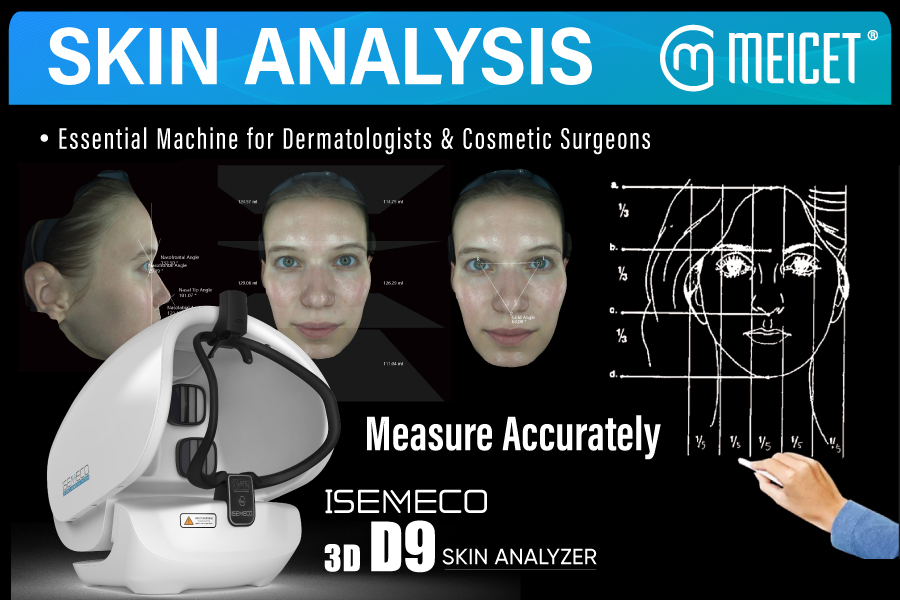
Once the images are captured, the MEICET system employs advanced algorithms to map the face. It identifies and quantifies specific skin concerns such as spots, wrinkles, texture, pores, and porphyrins. The technology doesn’t just show a spot; it classifies it. It can differentiate between a brown spot (melanin aggregation) and a red spot (inflammation or vascular lesions) by analyzing the light absorption and reflection data. This RGB (Red, Green, Blue) analysis, combined with UV and Wood’s lamp effects, provides a comprehensive “skin map.”
Furthermore, these analyzers utilize feature positioning technology. The software recognizes facial landmarks—like the eyes, nose, and mouth—to ensure that follow-up scans are aligned perfectly with previous ones. This allows practitioners to track the progression of skin conditions or the effectiveness of treatments over time with scientific accuracy. For example, a MEICET device can overlay a current image with a baseline image to show a percentage reduction in pore size or pigmentation area, providing tangible proof of product efficacy.
The integration of big data is another key principle. MEICET’s cloud-based system compares individual results against a vast database of skin types from around the world. This allows the analyzer to provide not just a diagnosis, but a relative ranking, telling a user how their skin ages compared to peers of the same age group.
In conclusion, the Skin Analyzer represents the convergence of optics and data science. By removing guesswork and subjectivity, brands like MEICET are empowering professionals to offer personalized treatment plans backed by quantifiable evidence. As technology advances, these analyzers will continue to be the cornerstone of objective skincare, illuminating the path to healthier skin.
Post time: Feb-03-2026


