


The skincare and aesthetic medicine industry in China is undergoing a profound digital transformation, with 3D skin analyzers at the forefront of this shift. Moving beyond traditional visual assessments, these advanced devices offer objective, high-precision, and quantitative analysis, driving the industry from an experience-based model to one grounded in data-driven precision. The Chinese market, characterized by its vast scale, rapid technological adoption, and booming demand for aesthetic services, has become a crucial and dynamic battlefield for both domestic and international players in the skin analysis arena.
1. The Core of Precision: Professional 3D Imaging Systems
At the professional end of the spectrum, several high-performance 3D imaging systems have gained significant traction in Chinese clinics, hospitals, and premium aesthetic centers.
A leading example is the Yisemeike D9 Skin Imaging Analyzer, a prominent domestic product. It features a dedicated 3D camera capable of capturing 36-megapixel ultra-high-definition images of the entire face. Its fully automatic rotating shooting system, with a high-precision 0.1mm external scanning device, can acquire a 180-degree 3D facial image in a single capture, eliminating the need for multiple posture adjustments and ensuring comprehensive data collection.
Another notable domestic contender is the Meiji 3D Skin Analyzer. It utilizes a 35-megapixel high-definition imaging system and professional lenses to construct a highly detailed 3D facial model with a precision of 0.2mm. This level of detail allows for the clear visualization and measurement of subtle facial morphological features and signs of aging, such as nasolabial folds and marionette lines.
Internationally, the VISIA 7 Skin Analysis System from the US remains a widely recognized benchmark. It employs standard white light, ultraviolet light, and polarized light to capture images from three angles (front, left, and right). Through optical imaging and proprietary software, it analyzes and quantifies eight key skin indicators, including spots, wrinkles, pores, and porphyrins (related to bacteria), providing a comprehensive assessment of both superficial and subsurface conditions.
2. Expanding Capabilities: AI-Powered Comprehensive Assessment
The evolution of skin analyzers extends beyond pure 3D morphology. The next generation integrates artificial intelligence (AI) and multi-spectral imaging to offer holistic assessments of skin health and aesthetic features.
The OBSERV 520X Comprehensive Facial Assessment System from the Netherlands exemplifies this trend. It is more than a standard skin detector; it functions as an AI-powered platform for facial rejuvenation assessment. Its system incorporates a 360-degree lighting assessment for aging analysis and even features an emotional aesthetics evaluation tool. By leveraging patented optical technology and AI, it assists practitioners in creating highly personalized treatment plans and tracking results with objective data.
Similarly, the Think View Sito II Skin Analyzer from Taiwan emphasizes true spectral analysis. It utilizes a six-spectrum detection mode imaging system, including parallel/cross-polarized light and UV imaging. This allows it to reveal underlying skin conditions like inflammation and vascular issues with high fidelity, providing crucial information for therapeutic guidance.
3. MEICET Skin Analyzer: Integrating Professional Analysis
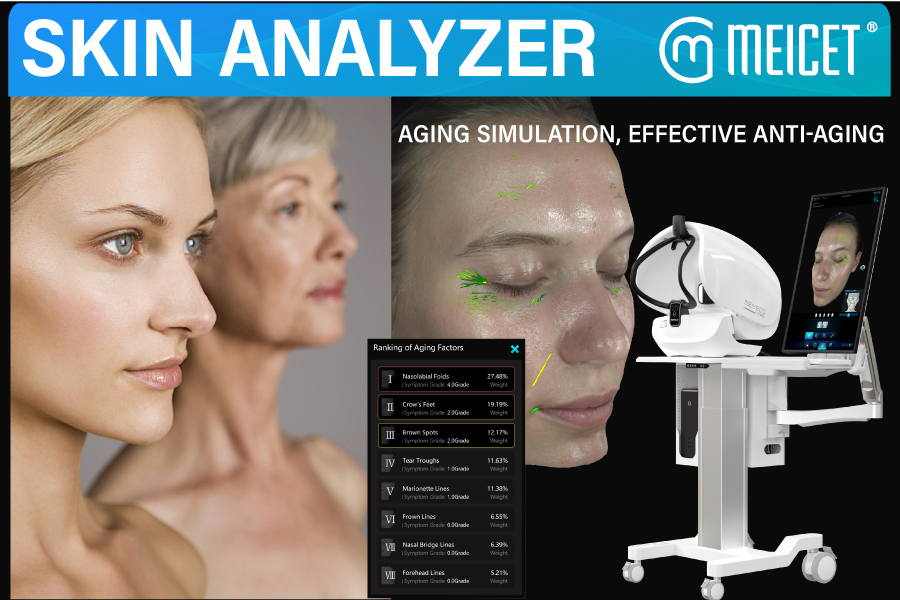
Within this diverse ecosystem, the MEICET Skin Analyzer has established its presence as a professional tool designed for clinical and high-end aesthetic settings. While specific details on its latest 3D models are not covered in the provided sources, MEICET is recognized in the industry for developing systems that typically combine high-resolution imaging with multi-spectral analysis. Such devices are engineered to assess a wide range of parameters, from pigmentation and redness to wrinkles and texture. The focus is on delivering accurate, repeatable data that professionals can use for client consultation, treatment planning, and efficacy monitoring, aligning with the market’s demand for reliable diagnostic tools.
4. The Accessible Frontier: The Emergence of Smart Home Devices
Parallel to the professional market, a new segment of smart, consumer-grade skin analysis devices is rapidly emerging. These products, often developed by internet and consumer electronics companies, aim to bring basic skin tracking into the home.
A pioneer in this field was Meitu’s Meitukey Skin Detector, a compact, handheld device that connects to a smartphone app. Using AI algorithms, it performed a 12-dimensional skin analysis, covering aspects like moisture, oil, pores, and dark circles. While not a true 3D scanner, it represented an early step towards personalized, at-home skin data collection. Today, the market is seeing more advanced proposals, with devices focusing on multi-spectral imaging coupled with AI skin mapping analysis to move beyond simple “photo magnification”. Brands like Yuefuti and devices within the Xiaomi ecosystem are offering features such as pore detection and historical data tracking, making preliminary skin analysis more accessible to the general public.
Post time: Nov-26-2025


