


The medical aesthetics industry is undergoing a profound transformation in 2026, driven by a wave of technological innovation in skin diagnostic tools. Skin analyzers have evolved from basic magnification instruments into comprehensive diagnostic platforms that integrate artificial intelligence, three-dimensional imaging, and advanced data analytics. As consumers demand ever more personalized and evidence-based skincare, manufacturers have responded by equipping their devices with a host of powerful new capabilities. Among the brands at the forefront of this evolution is MEICET, whose latest product lineup demonstrates how the industry is redefining what skin analysis can achieve.
AI-Powered 3D Imaging and Reconstruction
One of the most significant advancements in recent skin analyzers is the integration of high-precision 3D imaging technology. MEICET’s new AI 3D Skin Analyzer series, unveiled at the 2026 IMCAS Americas congress and the 60th China International Beauty Expo, features flagship models including the ISEMECO 3D D9 and the 3D MD300. The 3D D9 employs high-precision automatic rotating scanning to capture 180-degree full-face ultra-high-definition images, while its AI analysis engine evaluates over 30 skin dimensions ranging from deep pigmentation and vascular lesions to surface texture and pore conditions. The system generates one-click visual reports that eliminate the subjectivity of traditional assessments. Similarly, the Canfield Scientific next-generation VISIA system has embraced 3D capabilities, integrating VECTRA 3D imaging tools with AI-driven analysis in a single consultation platform that delivers instant 3D capture across standard, cross-polarized, and UV lighting modes.
Deep-Algorithmic Quantification and Trend Analysis
Beyond mere visual enhancement, the new generation of skin analyzers leverages sophisticated AI algorithms to transform raw image data into actionable clinical intelligence. MEICET‘s pro-A algorithm intelligent platform, debuted at IMCAS Paris 2026, represents a major leap forward. Built on a neural network trained on millions of verified dermatological data points, the pro-A platform does more than just identify skin problems—it understands their context and interrelationships. It distinguishes between different types of pigmentation, assesses skin barrier integrity through subtle indicators, and even predicts potential sensitivity flare-ups. This capability is complemented by MEICET’s AI scoring system, which quantifies skin issues across five core dimensions—aging, sensitivity, pigmentation, texture, and skin tone—assigning specific scores that enable precise tracking of treatment progress over time. Other players are adopting similar approaches, such as Haut.AI, which introduced a new hydration parameter algorithm in 2026 to measure skin moisture levels across different facial zones, and Perfect Corp. , which upgraded its analysis pipeline to deliver 2‑second detection across 15 skin health dimensions.
Dynamic Tracking and Before-and-After Comparison
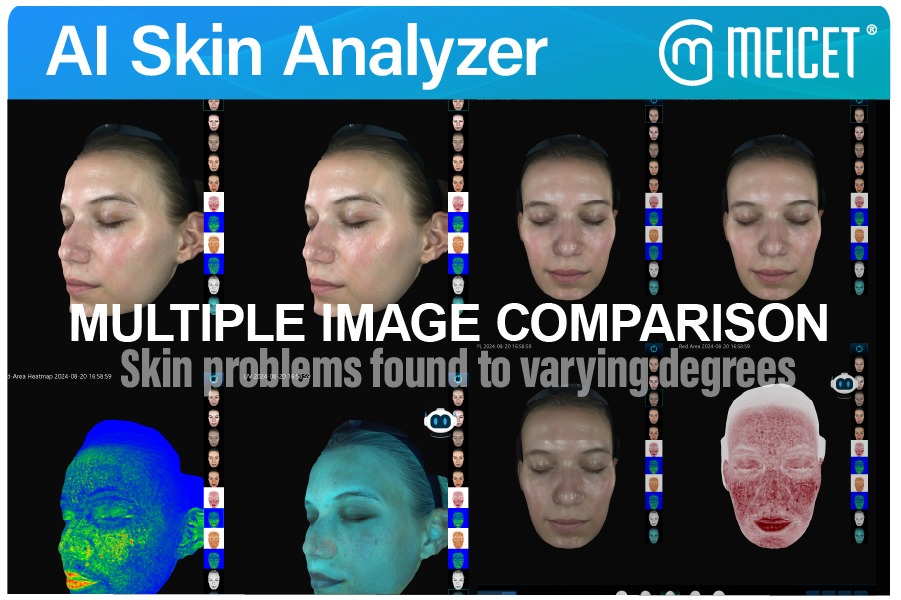
Perhaps the most impactful new feature for both professionals and clients is the ability to monitor skin changes over time with scientific rigor. MEICET has enhanced its devices with AI-driven dynamic tracking algorithms that enable long-term monitoring of skin conditions and result visualization. The MD200 and MD300 models incorporate multi-spectral imaging that captures skin conditions across multiple layers. This approach is consistent with broader industry trends: AI is no longer confined to static image analysis but now monitors skin longitudinally, learning from physiological reactions to adapt care in real-time. Devices can now track changes hour‑to‑day, enabling professionals to demonstrate treatment efficacy with concrete evidence. The Meicet Pro app, for instance, added a chart comparison mode in version 10.3.0, allowing users to view before-and-after data in clear graphical formats.
Cloud Integration and Remote Diagnostics
Seamless connectivity has emerged as another defining feature of the latest skin analyzers. MEICET‘s 3D MD300 integrates with cloud-based platforms, facilitating remote consultations and long-term patient tracking beyond the confines of the clinic. Similarly, the company’s AI store management system connects skin imaging data directly with daily operations, enabling efficient customer file management and making it especially suitable for both single-location and chain operations. This movement toward connected beauty is echoed across the industry, with products such as Amorepacific’s CES 2026 Innovation Award-winning Skinsight™—a next-generation “electronic skin” platform developed with MIT that uses flexible sensor patches and AI to predict aging factors in real time.
Portability and Accessibility
Another notable trend is the miniaturization and portability of advanced skin analysis. MEICET’s 3D MD300, equipped with a mobile-adaptive 3D camera, allows small and mid-sized practices to perform detailed skin analyses on the go. This device combines a 15‑second rapid diagnosis with multi‑terminal cloud connectivity and AI‑generated personalized care recommendations, making it ideal for mobile beauty services and smaller clinics. On the consumer side, devices such as NU SKIN‘s compact, portable Prysm iO use advanced fingertip scanning to deliver personalized wellness readings within seconds.
The latest features in skin analyzers reflect a decisive shift toward AI-driven 3D imaging, long-term dynamic tracking, and seamless cloud connectivity. MEICET’s 2026 lineup—particularly the 3D D9, MD300, MD200, and pro-A platform—demonstrates how precision, portability, and clinical utility are being integrated into comprehensive diagnostic solutions. As brands like MEICET continue to push the boundaries of what skin analysis can achieve, the focus is moving from generalized observations to truly individualized, data-driven skincare. The new era of skin diagnosis has arrived, and it is more intelligent, precise, and accessible than ever before.
Post time: Apr-27-2026


