


The landscape of skin diagnostic technology is undergoing rapid transformation as new optical imaging, artificial intelligence, and cloud-based analytics converge. Today’s skin analyzers are no longer simple magnifying cameras; they are intelligent diagnostic hubs capable of capturing subsurface skin conditions, predicting future damage, and personalizing treatment plans. Among the companies driving this innovation, MEICET has emerged as a key player, integrating cutting-edge hardware with advanced software to meet the demands of modern dermatology clinics, aesthetic centers, and beauty retailers worldwide.
One of the most significant breakthroughs in recent skin analyzer technology is multispectral imaging. Traditional devices often rely solely on standard white light, which only reveals surface-level issues like visible spots and wrinkles. Next-generation analyzers, including those developed by MEICET, utilize cross-polarized light, parallel-polarized light, and UV light to penetrate different layers of the skin. Cross-polarized light eliminates surface glare, allowing the device to visualize vascular lesions, redness, and pigmentation beneath the stratum corneum. UV light, on the other hand, highlights porphyrins (bacterial metabolites), sun damage, and oil gland activity. By capturing and combining these spectral images, MEICET’s latest skin analyzers generate a comprehensive map of both visible and latent skin conditions.
Another hallmark of advanced skin analyzers is the integration of deep learning algorithms. Where older models required manual selection of regions of interest, modern AI-powered systems automatically detect facial landmarks—eyes, nose, mouth, and forehead—and segment the skin into zones. The AI model, trained on diverse datasets comprising thousands of clinical images, quantifies features such as pore size, wrinkle depth, texture uniformity, and melanin density with high reproducibility. MEICET’s proprietary algorithm further refines this process by using a convolutional neural network that adapts to different lighting conditions and facial angles, reducing positioning errors and improving scan-to-scan consistency. This level of precision is particularly valuable for tracking treatment progress over time, as even small changes in pigmentation or erythema can be reliably measured.
The latest skin analyzers also embrace cloud connectivity and big data. Standalone devices are giving way to integrated systems where each scan is uploaded to a secure cloud platform. From there, both practitioners and patients can access historical comparisons, trend charts, and product recommendations. MEICET’s cloud solution not only stores longitudinal data but also aggregates anonymized skin condition statistics across populations. This aggregated data enables the company to continuously retrain its AI models, improving accuracy for diverse ethnicities and skin types—a crucial advantage as MEICET expands into Europe, the Middle East, and Southeast Asia. For clinic chains, centralized cloud management means consistent reporting standards across all branches, simplified software updates, and remote technical support.
Real-time operation is another area where recent technological leaps are evident. The latest MEICET skin analyzer completes a full multispectral capture and AI analysis in under 30 seconds. The device automatically detects the subject’s face, adjusts exposure, and captures three to five spectral images in rapid succession. Within seconds, the system outputs a detailed report including a skin age score, individual parameter measurements, and recommended skincare ingredients. Such speed not only improves patient throughput in busy clinics but also enhances the user experience, as clients receive immediate feedback without lengthy waiting times.
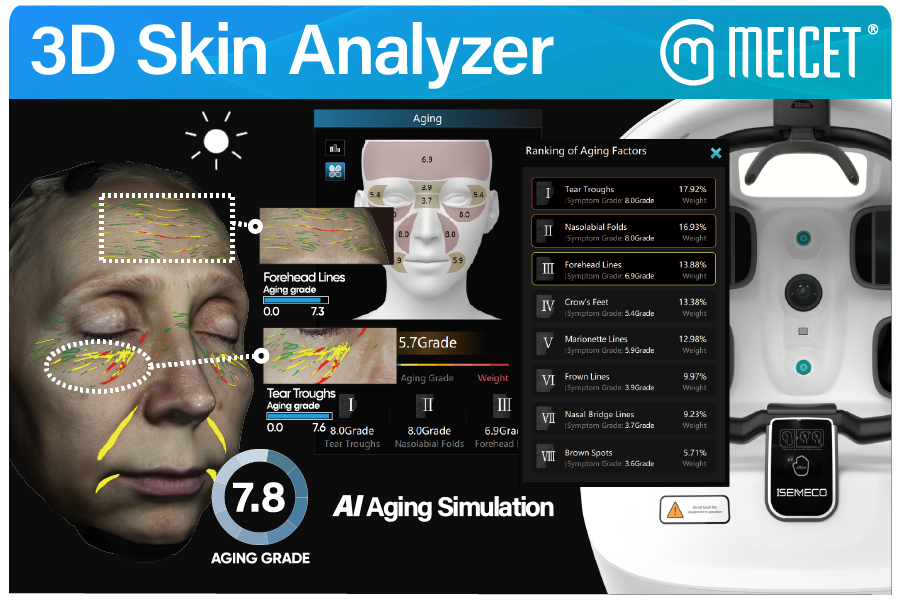
Furthermore, modern skin analyzers are becoming more portable and user-friendly. Heavy, tripod-mounted devices are being replaced by compact, all-in-one units that require minimal training. MEICET’s latest model features a touchscreen interface with step-by-step guidance, one-click scanning, and auto-generated PDF reports that can be shared via email or messaging apps. Some versions also integrate with practice management software, allowing seamless appointment scheduling and inventory updates for recommended products.
In terms of clinical validation, leading brands are subjecting their devices to rigorous testing against established dermatological standards. MEICET has conducted correlation studies comparing its AI-derived measurements with expert manual assessments and biopsy-validated references. Results have shown high agreement coefficients, giving clinicians confidence in using the analyzer for diagnosis and treatment monitoring.
As global demand for non-invasive, data-driven skincare continues to rise, the role of advanced skin analyzers will only expand. From detecting subclinical photoaging to guiding precise laser settings and retail skincare recommendations, these devices are becoming indispensable tools. With continuous improvements in imaging hardware, AI, and cloud analytics, companies like MEICET are setting new benchmarks—ensuring that the latest skin analyzer technology translates directly into better patient outcomes and more efficient practice management. The era of intelligent, connected skin diagnosis has firmly arrived.
Post time: May-19-2026


