


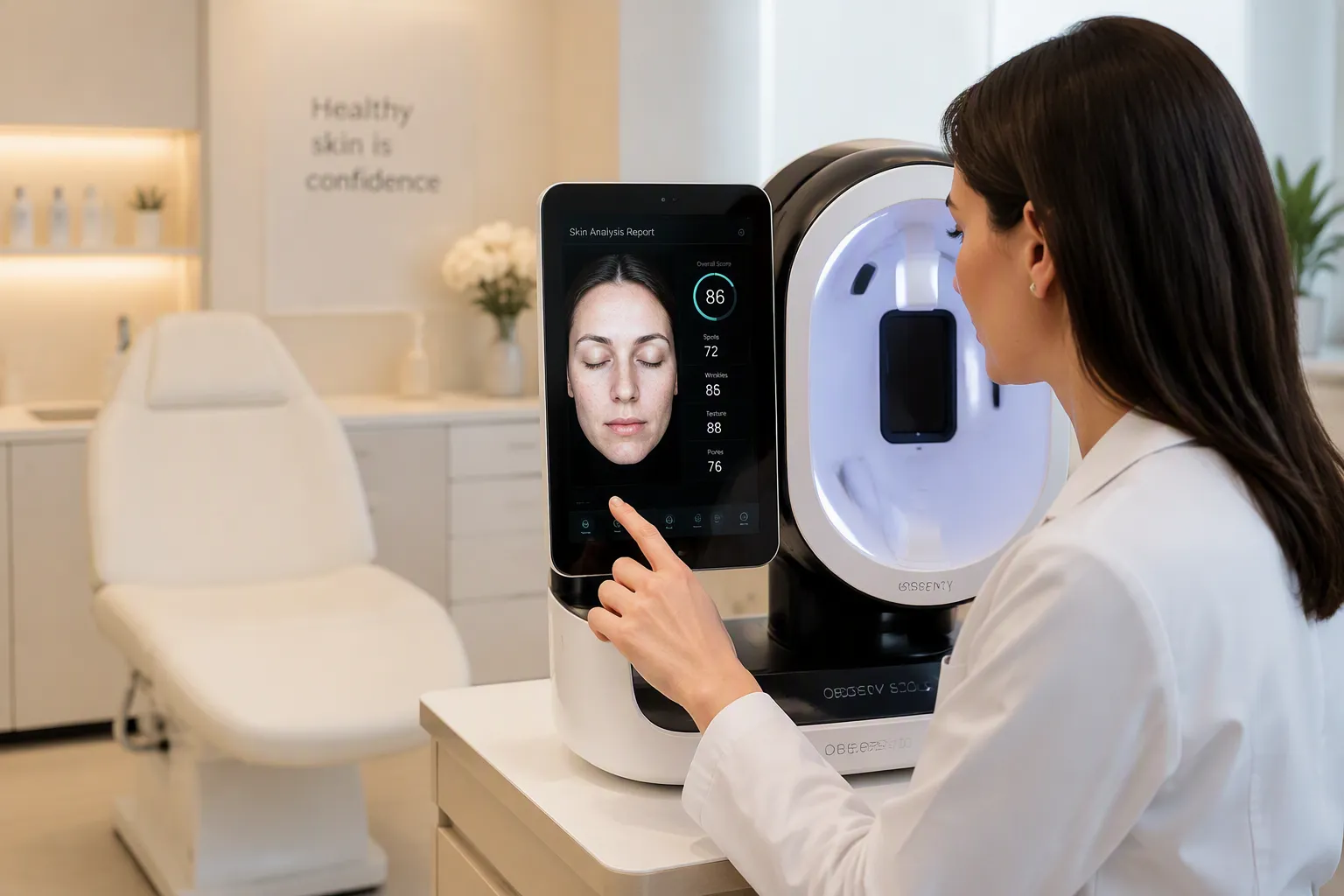
Quick Answer
A high-end skin analyzer typically costs between $5,000 and $20,000, with medical-grade workstations exceeding this range. For most beauty businesses, the investment is worth it only if the device generates measurable revenue impact — not merely if it produces impressive images. Clinical evidence shows that AI-powered skin analysis can drive 30-60% increases in average basket size, 40% improvements in client loyalty, and 30%+ uplift in treatment upsells . The critical variable is not the machine’s price tag but whether staff use it as a consultation and conversion engine rather than a novelty photo booth. A $2,500 mid-tier system** typically delivers higher ROI for a single-location salon than a **$15,000 workstation whose advanced modules remain unused.
Key Takeaways
Revenue impact, not hardware specs, determines ROI: The same device can generate 50% basket lift or zero depending on staff integration and consultation workflows.
Mid-tier systems ($1,500-$2,500) represent the value inflection point for most salons and single-location clinics .
High-end systems justify their premium through: multi-spectral 3D imaging, validated AI databases, and software ecosystems that support multi-location operations .
Payback periods range from under 14 days (software-based analysis on existing iPads) to 6-12 months (hardware workstations) .
The most common failure mode is purchasing a high-end machine without training staff to translate scan results into treatment conversations.
Why “Worth It” Depends on What You Measure
A beauty business owner evaluating a skin analyzer faces a binary question: does this device pay for itself? The answer hinges on which metrics enter the calculation.
If the evaluation stops at “cost of machine” versus “number of scans performed,” virtually every device appears overpriced. Scans themselves are rarely billable events in competitive markets. The revenue derives from what follows the scan: treatment packages, product recommendations, rebooking intervals, and client retention.
Case evidence illustrates the range. Bee Renee Aesthetics, a solo practitioner using AI analysis on an iPad, reported 50% boost in product sales, 40% higher customer loyalty, and 30% increase in service upsells after integrating skin analysis into every consultation . AIREM, a dual-location medical aesthetics practice, saw 31% more recurrent visits and 47% higher average client spend per visit following deployment of real-time AI skin analysis . At the software end of the spectrum, ScanSkinAI users on a $299.95/year plan achieved under 14-day payback through basket-size lifts of 52% and return-rate reductions of 41% .
The pattern is consistent: skin analysis generates revenue by converting subjective recommendations into objective, visualized treatment plans. The machine is the catalyst; the staff conversation is the reaction.
What Separates a High-End Skin Analyzer from Mid-Tier and Entry Options
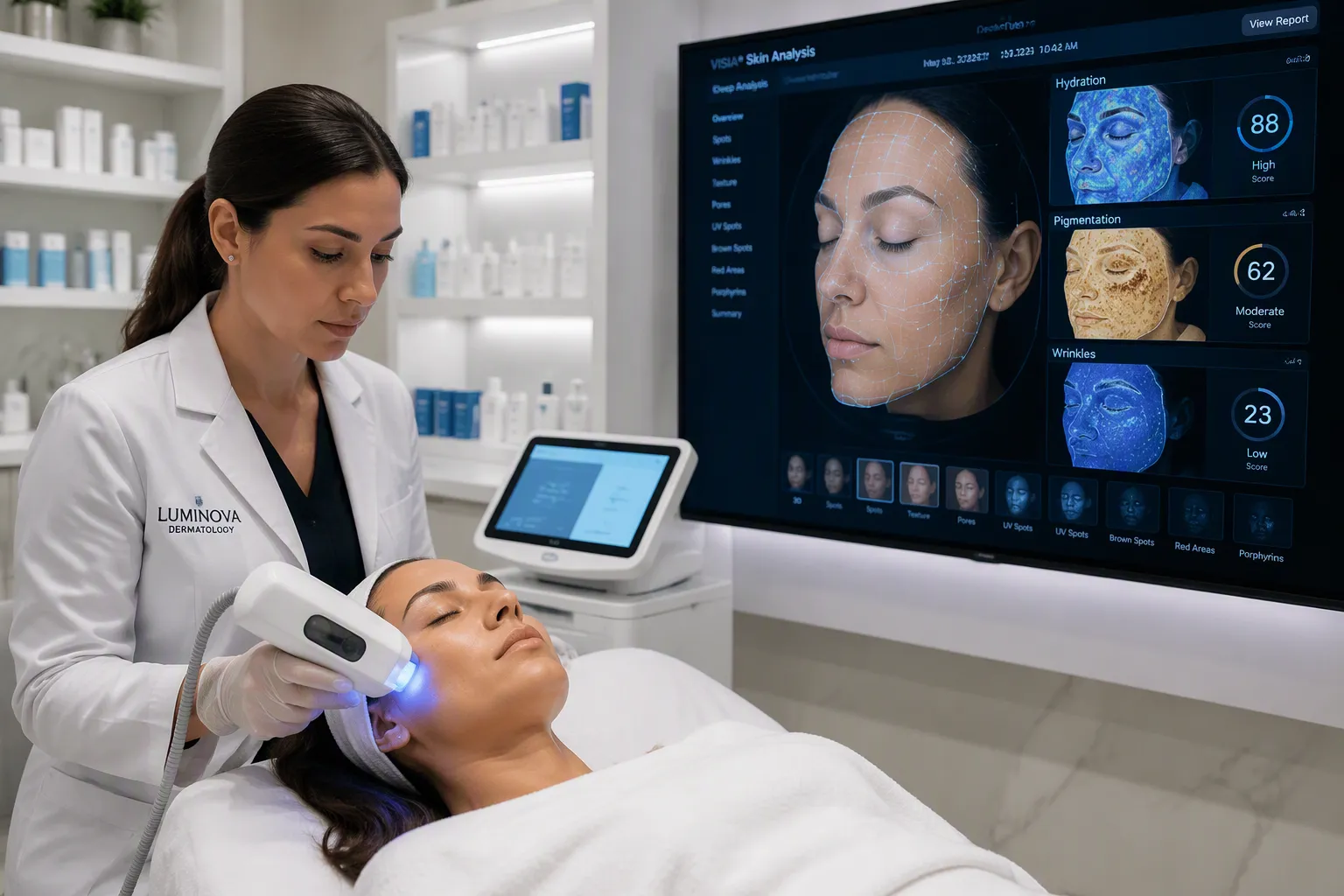
A high-end skin analyzer is defined by three characteristics that mid-tier and entry devices cannot replicate: multi-spectral 3D imaging with calibrated accuracy, AI validated against clinically annotated databases, and software ecosystems designed for multi-location operations. Each characteristic carries a cost that must be justified by specific business use cases.
The ISEMECO D9 MAX represents the high-end specification. It captures 48 million pixels across four spectral modes (RGB, cross-polarized, parallel-polarized, UV), generates a 0.02mm-precision 3D model using binocular grating structured light, and delivers AI skin analysis in 30 seconds via a proprietary skin large model . The system produces 11 ultra-high-definition 3D spectral images per scan, enabling visualization of deep dermal structures invisible to surface-level photography . The D9 platform also includes an aging analysis framework — aging grade, aging ranking, anti-aging validation, and aging prediction — mapped against China’s national skin aging evaluation standard .
For a single-location salon generating $10,000-$20,000 monthly revenue, these capabilities often exceed operational requirements. For a multi-location clinic or medical aesthetics practice performing hundreds of consultations monthly, the D9-class system becomes a standardization tool — ensuring every clinician, at every location, uses identical diagnostic criteria and produces comparable reports.
The table below maps price tiers to their actual operational capabilities:
| Tier | Price Range (USD) | Imaging Capability | AI/Software | Best Fit |
|---|---|---|---|---|
| Entry portable | $700-$1,200 | 1-2 spectra, basic camera, app-based | Basic scoring, limited storage | High-volume front desk, quick photo documentation |
| Mid clinical 3D AI | $1,500-$2,500 | High-resolution sensor, 4-8 spectra, 3D capture | AI analysis, on-screen display, patient history | Single-location salon/clinic seeking consultation engine |
| High medical multispectral | $2,700-$18,000+ | 36-48MP, 5-11 spectra, 0.02mm 3D modeling | Validated AI, multi-terminal, CRM/SaaS integration | Multi-location clinics, dermatology-adjacent practices |
The Revenue Mechanics: How Skin Analysis Converts to ROI
Skin analysis generates revenue through four quantifiable pathways, each with industry-benchmarked performance ranges. Understanding these mechanics allows buyers to model expected returns before purchase rather than relying on vendor claims.
Basket Size Lift (30-60%)
Clients who receive a scan-led product recommendation buy 2-3 SKUs instead of one because the recommendation is tied to a measurement, not a guess . ScanSkinAI reports median basket lifts of 30-60% across active customers, with the effect stabilizing by week four. The underlying mechanism is straightforward: when a client sees their hydration score at 66/100 and understands that dehydration accelerates wrinkle formation, the purchase of a hydrating serum becomes a logical response to data rather than a sales pitch .
Treatment Upsell Rate (30%+)
Scan results identify which skin layer or condition requires priority treatment, enabling staff to recommend targeted procedures with visual evidence. Bee Renee Aesthetics documented a 30% increase in service upsells after implementing scan-based consultations . AIREM’s medical aesthetics practice achieved 47% higher average client spend per visit by using scan scores to construct multi-treatment plans .
Retention and Rebooking (31-40% Uplift)
The most durable revenue effect is improved retention. When clients receive re-scan reminders at 4-8 week intervals, they return to track progress — and to purchase maintenance products or schedule follow-up treatments. AIREM reported 31% more recurrent visits . Bee Renee documented 40% increased customer loyalty . ScanSkinAI users show 2.1× loyalty program engagement and 34% higher repeat-visit rates within 90 days .
Return Rate Reduction (30-45%)
For product-retailing businesses, skin analysis reduces returns by 30-45% because recommendations are tied to measurement rather than opinion . This effect directly improves margin: a $50 product with a 20% return rate effectively costs $10 in reverse logistics, restocking, and margin erosion. Reducing returns to 10% recovers $5 per unit in pure profit.
The Hidden Costs That Determine Actual ROI
The purchase price of a skin analyzer is only the first line in the total cost of ownership. Businesses that model ROI without accounting for the following factors consistently overestimate returns.
Staff training and workflow integration. A machine without trained operators is a decorative object. Training costs range from $0 (bundled with purchase) to $1,500 for comprehensive programs . The more consequential investment is the time required to integrate scan results into consultation scripts, treatment planning protocols, and follow-up communication sequences. Practices that designate a “scan champion” — one staff member responsible for workflow design — show the highest utilization rates.
Software licensing and cloud storage. Many professional systems operate on subscription or per-scan models. Cloud storage for image retention, multi-terminal access, and CRM integration may carry monthly or annual fees. Cloud-dependent architectures create switching costs: client records stored in proprietary formats cannot easily migrate to a competing platform.
Calibration and maintenance. Multi-spectral imaging requires periodic calibration to maintain color accuracy and spectral consistency. UV light sources degrade over time, affecting image quality and diagnostic reliability. Budget for annual calibration service and replacement components.
The utilization risk. The single largest determinant of ROI is not the machine’s capability but its actual utilization rate. A $10,000 system used for 10 scans monthly generates dramatically different returns than the same system used for 200 scans monthly. The practical question is not “can this machine do X?” but “will my staff actually use it for every relevant client?”
When a High-End Analyzer Makes Sense — and When It Doesn’t
A high-end skin analyzer (over $5,000) is justified when the business case requires standardization across multiple locations, clinical-grade diagnostic depth for medical-adjacent treatments, or validated AI for outcomes documentation. The device becomes a revenue infrastructure asset, not a consultation accessory.
Scenario 1: Multi-location aesthetic chain. Consistency across locations is operationally critical. A client scanned at Location A should receive identical analysis at Location B. High-end systems with cloud-based data management and multi-terminal access enable this. The ISEMECO D9’s multi-terminal sharing system, personalized digital reports, and unlimited cloud storage directly address this requirement .
Scenario 2: Medical aesthetics or dermatology-adjacent practice. When treatments involve injectables, energy devices, or prescription-strength topicals, documentation of baseline skin condition and treatment progress has clinical and legal significance. Validated AI systems with sensitivity and specificity metrics provide defensible documentation. High-end platforms often include predictive aging simulation and post-treatment verification modules that support informed consent and outcome claims .
Scenario 3: Anti-aging specialty clinic. The revenue model centers on long-term treatment plans rather than single-visit services. High-end analyzers with aging prediction, treatment simulation, and progress tracking become core to the value proposition. The D9’s aging analysis framework — including aging grade, ranking, validation, and prediction — maps directly to anti-aging treatment packages .
For a single-location salon performing under 50 consultations monthly, a mid-tier system ($1,500-$2,500) typically delivers superior ROI. The mid-tier provides high-resolution imaging, multiple spectra (sufficient for identifying common concerns), and AI analysis without the cost of validated clinical algorithms or multi-location infrastructure. The practical test remains: does the machine give staff three concrete talking points within 90 seconds of a scan? If yes, the tier is appropriate.
Frequently Asked Questions
How much does a high-end skin analyzer cost for a professional clinic?
High-end multispectral workstations range from $2,700 to $18,000+, with medical-grade systems from established brands exceeding this range . Premium 3D systems with 48MP imaging, multiple spectral modes, and validated AI — such as the ISEMECO D9 class — sit at the upper end. Training, software licensing, and calibration are typically separate costs.
What ROI should a beauty business expect from a skin analyzer investment?
Published case studies report basket-size lifts of 30-60%, return-rate reductions of 30-45%, and loyalty engagement increases of 2× or more . Payback periods range from under 14 days for software-based analysis on existing tablets to 6-12 months for hardware workstations, depending on utilization rate . The variance is driven by staff integration, not device specifications.
Is a high-end analyzer necessary, or can a mid-tier system deliver similar results?
For single-location salons and clinics, mid-tier systems ($1,500-$2,500) typically capture 80-90% of the practical revenue benefit at 20-30% of the cost . High-end systems justify their premium through multi-location standardization, clinical documentation requirements, and advanced modules (aging prediction, treatment simulation) that only generate ROI in specific practice models.
What specifications actually matter when comparing skin analyzers?
The three specifications that most directly affect diagnostic utility are: sensor resolution (36-48MP enables visualization of fine texture and early pigmentation), spectral modality count (more modes separate conditions that appear identical under single lighting), and AI training database size and demographic composition (a system trained on diverse skin types performs better across patient populations) .
How do I evaluate whether AI claims are substantive or marketing?
Ask for three pieces of evidence: (1) training database size and demographic composition — is it representative of your client population? (2) published validation metrics — sensitivity and specificity against clinical ground truth; (3) output explainability — does the AI provide confidence scores or heatmaps, or only a binary result?
What ongoing costs should I budget beyond the purchase price?
Budget for: software licensing or subscription fees (cloud storage, CRM integration, multi-terminal access), annual calibration and maintenance, UV light source replacement (if applicable), staff training refreshers, and the opportunity cost of staff time spent on scan consultations. Some vendors bundle these; others price them separately.
Can a skin analyzer pay for itself in a single-location salon?
Yes — but the timeline depends on consultation volume and upsell execution. A salon performing 20 scan-led consultations monthly with a 30% basket lift on $150 average tickets** generates an additional **$900/month in incremental revenue, yielding payback on a $2,000 mid-tier system in under 3 months. At 50 monthly consultations, payback compresses to under 6 weeks. The device is the enabler; the staff conversation is the revenue mechanism.
Post time: Oct-16-2026


