


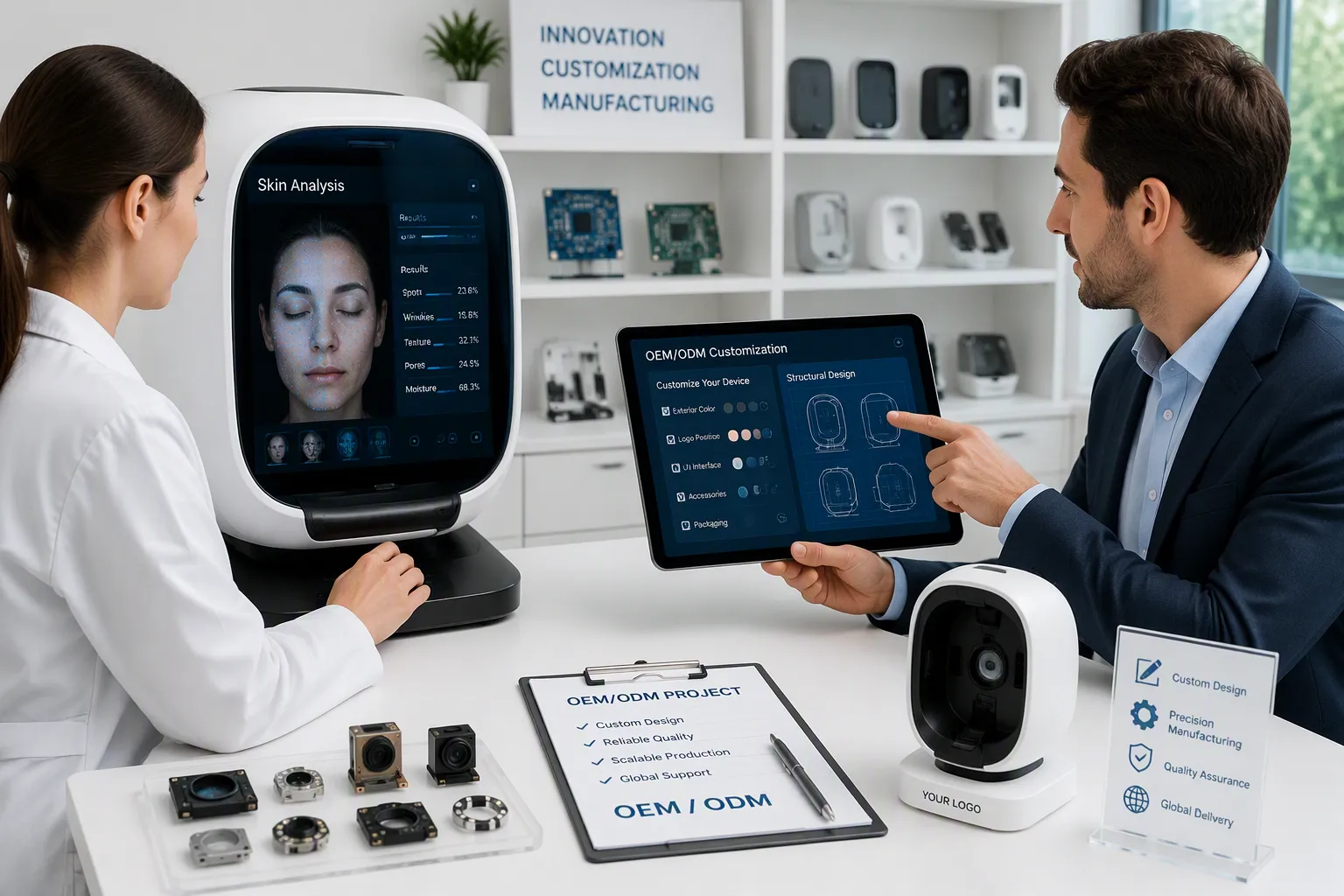
I know the struggle: you need a skin analysis machine manufacturer that supports your brand and custom features. I will walk you through three steps — understanding OEM versus ODM, sourcing and evaluating candidates, and verifying claims with samples. I will help you avoid false promises, MOQ surprises, and language gaps. Consider LangWen Beauty, UTECHSKIN, and HUIMAIN as real market examples.
Key Takeaways
●Know the difference: OEM builds to your design, ODM customizes an existing product. Choose based on your need for control or speed.
●Find manufacturers on B2B platforms, trade shows, and factory directories. Evaluate them on certifications, customization, MOQ, and communication.
●Always request a sample with your branding and check references. Sign a clear contract to protect your intellectual property.
Understanding OEM vs ODM for Skin Analysis Machines
What Is OEM Customization?
OEM means “build to my design.” You bring the specifications, and the manufacturer produces the skin analysis machine to match your blueprint. This path suits buyers who already have a clear product vision and need a factory to execute it.
HUIMAIN provides full OEM services. As they state:
We provide customization, design services, and OEM&ODM production.
Another manufacturer puts it this way:
We work closely with our OEM partners to develop customized skin analysis machines that meet their specific requirements.
This approach gives you maximum control over hardware, software, and branding.
What Is ODM Customization?
ODM means “customize your existing design.” The manufacturer already has a finished product platform. You adapt it with your brand, language settings, or minor feature tweaks. UTECHSKIN’s customization options serve as a good example. It serves as an ODM base that you can brand and modify its AI features.
ODM typically offers faster timelines and lower costs. UTECHSKIN, for instance, lists customization options including exterior design, report output, software features, and packaging. LangWen Beauty, with over 16 years of experience, also provides OEM/ODM customization for beauty devices including skin analysis machines.
The trade-off? The underlying analysis engine usually stays standard. You gain speed and affordability but sacrifice deep technical changes. For many brands entering the market, ODM provides the right balance between customization and speed to market.
Where to Find Skin Analysis Machine Manufacturers
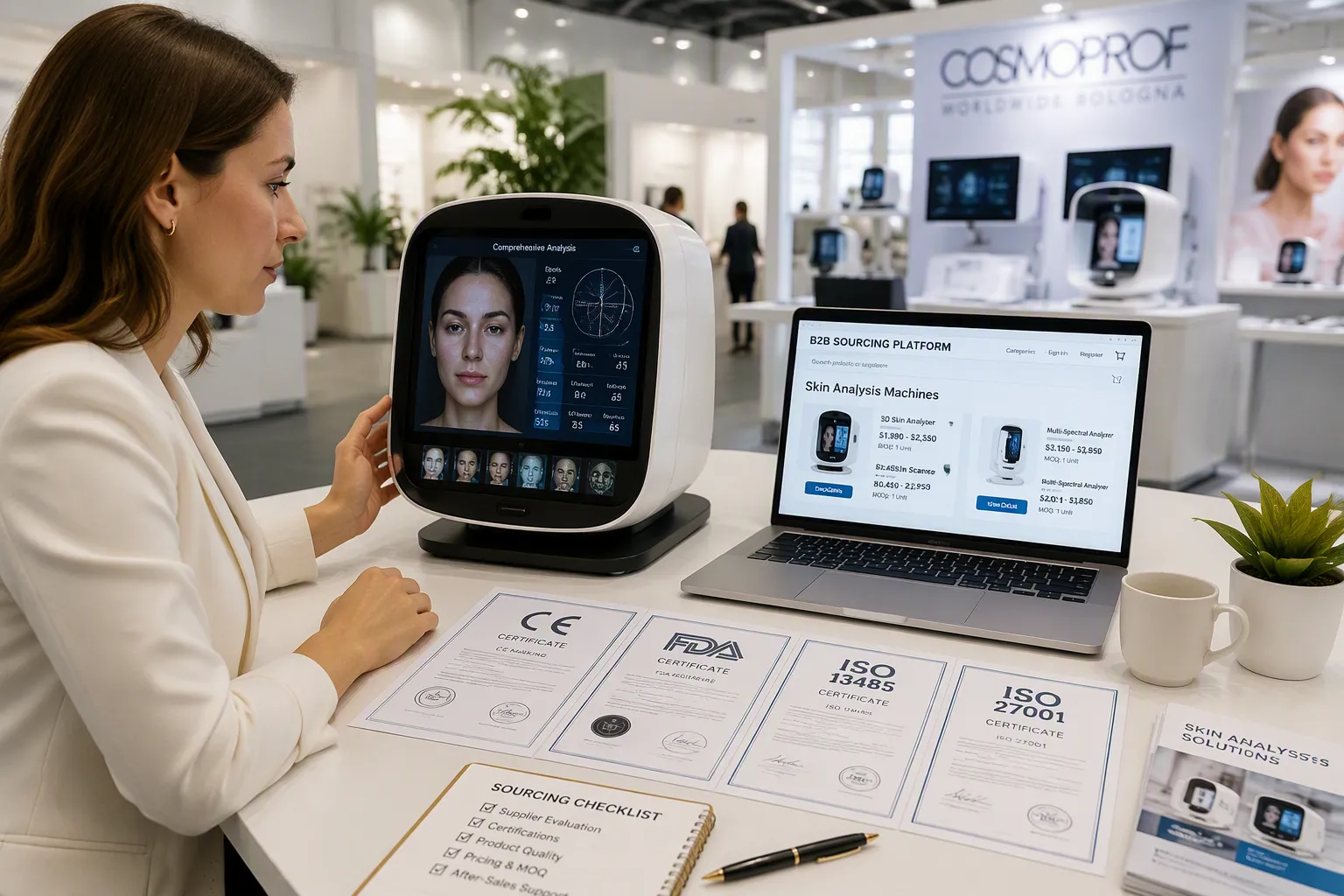
You now understand the difference between OEM and ODM. The next step is knowing where to look. I will guide you through the best channels for sourcing manufacturers. Then, I will show you how to evaluate them effectively.
Top Sourcing Channels (B2B Platforms, Trade Shows, Directories)
I recommend three main channels for finding manufacturers. The most accessible option is B2B platforms like Alibaba and accio.com. These sites host thousands of suppliers. You can see product listings, price ranges, and minimum order quantities immediately.
| Channel | Examples | What to Expect |
|---|---|---|
| B2B Platforms | Alibaba.com, accio.com | Listings show prices from $40 to $1,500 per unit; MOQ as low as 1 piece |
| Trade Shows | Cosmoprof, medical beauty expos | Meet factory representatives; see machines in person; discuss customization face-to-face |
| Factory Directories | Manufacturer websites (e.g., LANGDAI, SculptParco) | Browse OEM/ODM service pages directly; contact sales teams without middlemen |
Alibaba gives you a quick overview. I found listings for portable skin analyzers ranging from $40 to $1,500. But price alone tells you nothing about quality or customization ability. Trade shows allow you to test machines and ask detailed questions. I suggest attending at least one major event. Factory directories work well when you already know a brand. LANGDAI, for example, lists its OEM/ODM services clearly on its website.
Key Evaluation Criteria for Manufacturers
Once you have a list of candidates, you need a clear evaluation system. I focus on four areas.
Certifications: Reliable manufacturers hold recognized certifications. Look for these key credentials:
| Certification | Purpose |
|---|---|
| CE (Class III) | Medical device safety in Europe |
| FDA Breakthrough Designation | US market access |
| ISO 13485 | Quality management for medical devices |
| ISO 27001 | Information security management |
| GDPR Compliant | Data protection in Europe |
These certifications prove the manufacturer meets regulatory standards. I always verify certificates directly before proceeding.
Customization Flexibility: I ask manufacturers about their specific OEM and ODM offerings. Can they change the software language? Can they modify the treatment plan settings? LANGDAI offers extensive customization options. Newangie emphasizes cutting-edge technology in their designs. I look for manufacturers who clearly state their capabilities.
Minimum Order Quantity (MOQ): Some factories require orders of 100 units or more. Others accept smaller batches. I match the MOQ to my business plan. A high MOQ increases your upfront cost dramatically.
Communication Quality: I test how quickly and clearly the manufacturer responds. Do they understand your customization requests? Do they speak fluent English? Good communication prevents costly mistakes later.
I use these criteria to narrow my list from twenty potential partners down to three to five strong candidates. This saves weeks of wasted effort.
Verifying OEM/ODM Support and Finalizing Agreements
Confirming OEM/ODM Support (Samples, References)
I never trust a manufacturer’s customization claims without physical proof. I request a sample unit that demonstrates my specific requirements. This means a machine with my brand logo printed on the casing, a custom language interface loaded into the software, and any adjusted treatment plan settings I need. A factory that truly supports OEM/ODM will deliver these samples without excessive delays or excuses.
I also ask for references from past OEM/ODM clients. HUIMAIN’s support can be verified by checking its client testimonials. I contact these references directly and ask about their experience with customization timelines, communication quality, and whether the final product matched the sample. This step separates real manufacturers from trading companies that outsource production.
Negotiating and Signing Agreements
The contract stage protects your investment. I pay close attention to intellectual property clauses. In OEM arrangements, I provide the designs and I retain IP ownership. In ODM deals, the factory’s core design remains its IP unless I negotiate exclusive geographic distribution rights. Paying a tooling fee does not grant IP ownership by itself. Without robust clauses, the factory can sell identical machines to my competitors.
I include an explicit NNN Agreement covering non-disclosure, non-circumvention, and non-competition. I specify that co-developed IP, such as software firmware improvements, belongs exclusively to my company. The agreement should state:
●Ownership clauses defining who retains IP before, during, and after production
●Non-compete terms preventing the supplier from producing similar designs for competitors
●Confidentiality provisions protecting trade secrets for three to five years after termination
I also clarify MOQ commitments, lead times, and payment terms in writing. Custom skin analysis machine pricing varies by features and customization level. Current market listings show the MX Skin Analysis Machine at $1,999.00 original or $1,299.00 on sale, the SK-M17 AI Skin Analyzer at $998.00, and the SK-X5-Pro AI Skin Analyzer at $1,698.00, all with shipping included. I use these figures as negotiation benchmarks, not final quotes.
Never sign an agreement without a clause stating that custom software and prototypes remain your property.
Finding a skin analysis machine manufacturer for OEM or ODM follows a clear path. I understand my needs first. I search credible channels like Meicet. I verify claims with samples and references. Use this checklist:
●Define whether you need OEM or ODM
●Shortlist 3–5 manufacturers from credible sources
●Request samples with your branding and custom features
●Review MOQ, pricing, and lead times
Start your research today.
FAQ
How do I know if a manufacturer truly supports OEM versus just claiming it?
I request a sample with my logo and custom software settings. Real OEM support shows in physical proof, not sales talk. I also contact past clients for honest feedback.
What minimum order quantity should I expect from skin analysis machine factories?
MOQ varies widely. Some B2B listings show orders as low as one piece. Others demand much larger batches. I match the MOQ to my budget and business plan before committing.
Which certifications matter most when I evaluate a skin analysis machine manufacturer?
I prioritize CE for European safety, FDA for US market access, and ISO 13485 for medical device quality. These credentials prove the factory meets regulatory standards. I verify certificates directly.
Post time: Sep-14-2026


