


The global skin analysis market has experienced remarkable growth in recent years. According to market research reports, the global market for AI-Driven Skin Imaging Systems was valued at approximately US$100 million in 2024 and is projected to reach US$150 million by 2031, growing at a compound annual growth rate of 6.3%. At the same time, the broader skin imaging systems market was estimated at US$160 million in 2024 and is forecast to reach US$259 million by 2031, with a CAGR of 7.2%. Against this backdrop of rapid expansion, skin analysis machines have become indispensable tools for both beauty salons and medical institutions. However, the selection criteria differ significantly between these two contexts. This article will explore how businesses should approach the selection process.
Why Invest in a Professional Skin Analysis Machine
Modern consumers increasingly demand data-driven skincare solutions. A professional skin analysis machine empowers businesses to enhance client trust by offering scientific, visual proof of skin concerns, personalize treatments based on accurate diagnostics, track progress over time to demonstrate treatment efficacy, and boost revenue through targeted product or service recommendations. Whether you operate a salon or a hospital, a well-chosen skin analyzer can significantly elevate practice standards.
Key Factors to Consider When Buying
Before diving into specific recommendations for salons versus hospitals, it is essential to understand the fundamental factors that should guide any purchasing decision.
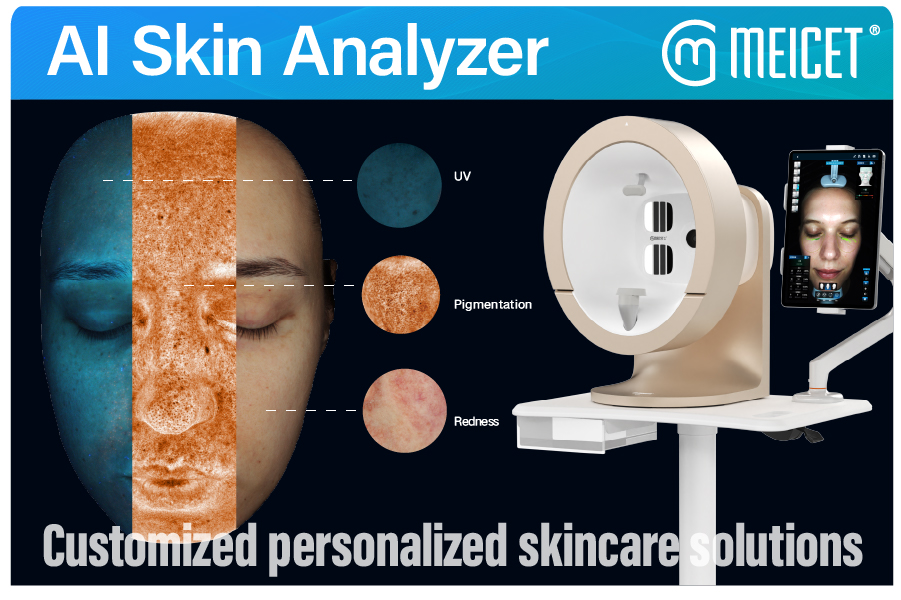
Technology and imaging capabilities are paramount. The best skin analyzers utilize multiple imaging modalities to capture comprehensive data. UV imaging detects sun damage, hidden pigmentation, and bacterial activity. Polarized light analyzes surface-level concerns such as redness and texture irregularities. Cross-polarized light penetrates deeper to reveal vascular issues and sub-surface pigmentation. RGB standard imaging provides baseline facial assessment, while advanced 3D imaging maps skin topography to quantify wrinkles, pore depth, and even subtle volume changes such as sagging or localized depressions.
Accuracy and reliability are critical, particularly for clinical applications. Look for clinically validated devices with high-resolution cameras—at least 8 megapixels for basic assessment and 24 megapixels or higher for medical-grade precision. MEICET analyzers are developed in collaboration with dermatologists, ensuring their diagnostic outputs meet medical-grade standards.
Data management and reporting capabilities cannot be overlooked. Advanced systems store complete client histories, enable before-and-after comparisons, and generate shareable reports. Cloud-based platforms offer secure data storage and remote access, facilitating both treatment tracking and tele-dermatology consultations.
Clinic vs. Salon: Different Environments, Different Needs
The best skin analysis machine for a hospital or dermatology clinic is not always the same as the best one for a beauty salon. Medical institutions and aesthetic clinics typically require a stronger consultation structure, more detailed imaging, and professional-grade presentation to support precise diagnosis and treatment planning. They prioritize clinical depth—the ability to measure biological data such as hydration levels, pH balance, sebum production, melanin concentration, and elasticity—over purely visual appeal. For hospitals, reproducibility across different operators and time periods is essential; a patient’s skin should be assessed with consistent accuracy regardless of which technician performs the scan.
In contrast, salons and beauty centers often prioritize smooth workflow, visual presentation, and ease of customer communication. Their primary goals are customer engagement, retail conversion, and operational simplicity. A salon machine should be intuitive to operate, generate easy-to-understand reports that convince clients to purchase treatments or products, and integrate seamlessly into the consultation flow without disrupting daily operations.
Specific Considerations for Hospitals and Dermatology Clinics
For medical institutions, the ability to objectively quantify skin conditions is non-negotiable. A high-quality skin analysis device should deliver measurable, client-specific skin readings—not merely visually detect surface concerns. Hydration, pH balance, sebum, elasticity, and melanin are no longer optional parameters in today‘s data-driven medical aesthetic environment. These metrics form the foundation of credible, customized treatment plans.
Furthermore, hospitals require integration with electronic health record systems, the ability to track treatment efficacy over multiple sessions, and diagnostic precision that informs clinical decisions. MEICET devices, for instance, provide quantifiable metrics—percentages, scores, and area measurements—for each detected skin feature. This numeric data allows skincare professionals to track progress and document changes with precision, transforming subjective observations into objective, data-driven consultations. The MEICET 3D D9 Skin Analyzer, with its enhanced depth analysis capabilities, delves into microcirculation and subdermal inflammation to precisely identify root causes of redness in sensitive skin or deep-seated acne issues—making it essential for dermatology clinics.
Specific Considerations for Salons and Spas
Salons and spas place greater emphasis on customer-facing value. The machine should generate visually compelling reports that help clients immediately “see” their skin concerns. The before-and-after comparison feature is particularly powerful in this context—seeing objective data change over time builds client confidence and encourages consistency in skincare routines. The Pro A Skin Analyzer from MEICET, for example, combines AI intelligence with an extensive skin database to generate visual reports across eight key skin dimensions in minutes, paired with personalized care recommendations. This helps boost conversion rates and repeat business.
Usability is another critical factor. A salon device should minimize training time and allow even new staff to conduct professional consultations. MEICET’s systems feature user-friendly touchscreen interfaces and automatic report generation, streamlining daily operations.
A Deep Dive into MEICET — Meeting Both Worlds
MEICET has emerged as a leading brand that successfully bridges the gap between hospital-grade precision and salon-friendly usability. Under its brand, MEICET designs high-end skin analyzer systems specifically to meet the usage requirements of hospitals, dermatology practices, medical aesthetic clinics, medical spas, and skincare centers. The company’s competitive advantage lies in its proprietary AI algorithms, which have been continuously refined through extensive data sets since its establishment in the skin analyzer market in 2008.
MEICET‘s product lineup addresses diverse professional needs:
The 3D MD300 Skin Analyzer integrates high-precision 3D modeling with multi-spectral analysis, instantly capturing intricate facial details and reconstructing a three-dimensional structure—elevating skin assessment from flat observation to stereoscopic. It not only analyzes surface concerns like pigmentation, pores, and wrinkles but also deeply evaluates skin texture, firmness, and elasticity, revealing subtle issues such as gradual sagging or hidden fine lines that are difficult to detect with the naked eye. Its portability and efficiency make it suitable for both small clinics and larger institutions.
The 3D D9 Skin Analyzer focuses on depth analysis, delving into microcirculation and subdermal inflammation. It precisely identifies root causes of redness in sensitive skin conditions or deep-seated acne, making it particularly valuable for dermatology clinics and specialized skincare studios.
The Pro A Skin Analyzer is optimized for customer-facing businesses. It combines AI intelligence with an extensive skin database, generating comprehensive visual reports and personalized care recommendations to drive conversions and client retention.
After-Sales Support Matters
Finally, no article on purchasing decisions would be complete without addressing post-purchase support. Ensure the supplier offers adequate training, regular software updates, and warranty coverage. MEICET provides professional after-sales support, including ongoing AI diagnostic software updates that incorporate new data to maintain high accuracy rates across diverse skin types.
Choosing the right skin analyzer requires honest self-assessment of your business type, consultation workflow, technical needs, and budget. Hospitals should prioritize clinical depth, diagnostic accuracy, and data reproducibility. Salons should focus on usability, visual presentation, and customer engagement. MEICET skin analyzers represent a versatile solution capable of serving both ends of the spectrum, offering medical-grade precision alongside intuitive operation. As the industry continues to evolve toward 3D volumetric imaging and AI-powered hyper-personalization, investing in the right skin analysis technology is no longer a luxury—it is the essential foundation for delivering trusted, effective, and profitable skincare services.
Post time: Apr-13-2026


