


Quick Answer
Choosing a reliable skin analyzer manufacturer requires verifying four critical dimensions: regulatory certification (ISO 13485, CE, FDA clearance), real manufacturing capability (in-house R&D), software validation depth (algorithm training data), and after-sales infrastructure. The global market reached $16.86 billion in 2024, yet 90% of complaints stem from inadequate support, not hardware defects.
Key Takeaways
- ✔ ISO 13485 is the minimum quality threshold; trading companies unable to produce this should be disqualified.
- ✔ In-house R&D separates genuine manufacturers from assemblers; always request patent filings.
- ✔ Clinical testing reports with quantified metrics distinguish validated AI from marketing claims.
- ✔ After-sales infrastructure directly affects total cost of ownership; slow support renders hardware unreliable.

Why Manufacturer Selection Determines Long-Term Value
A beauty business owner in Southeast Asia purchased five skin analyzers from a supplier offering the lowest quotation — $1,200 per unit versus the next-lowest at $1,800. The units arrived on schedule. Software worked initially. Then, eight months later, the manufacturer’s website went offline. The cloud-based analysis software stopped functioning. Calibration services, promised in the sales contract, became impossible to obtain. The supplier had been a trading company reselling generic hardware, with no development capability and no long-term support infrastructure.
The skin analysis systems market is substantial and growing. The global market reached $16.86 billion in 2024 and is projected to approach $22.48 billion by 2031 at a 4.2% CAGR. Manufacturer longevity and roadmap clarity matter because the software ecosystem surrounding a device determines its useful lifespan far beyond the hardware warranty period.
Dimension 1: Regulatory Certification and Quality Management
Regulatory certification is the non-negotiable foundation of manufacturer credibility. A supplier that cannot produce verifiable certificates for the specific factory manufacturing the device should be disqualified before technical evaluation begins.
ISO 13485: The Medical Device Quality Standard
ISO 13485 is the international quality management standard for medical devices. Certification demonstrates that the manufacturer has implemented controlled procedures for design controls, supplier management, and corrective actions. A manufacturer holding only ISO 9001 for beauty equipment may be entirely credible for salon-grade products but insufficient for clinical applications.
| Certification | Scope | When Required |
|---|---|---|
| ISO 13485 | Medical device QMS | Clinical/diagnostic claims |
| IEC 60601-1 | Electrical safety | Clinical environments |
| CE (MDR) | EU market access | Medical claims in EU |
| FDA 510(k) | US market clearance | Diagnostic/therapeutic claims |
Dimension 2: Real Manufacturing Capability vs. Trading Companies
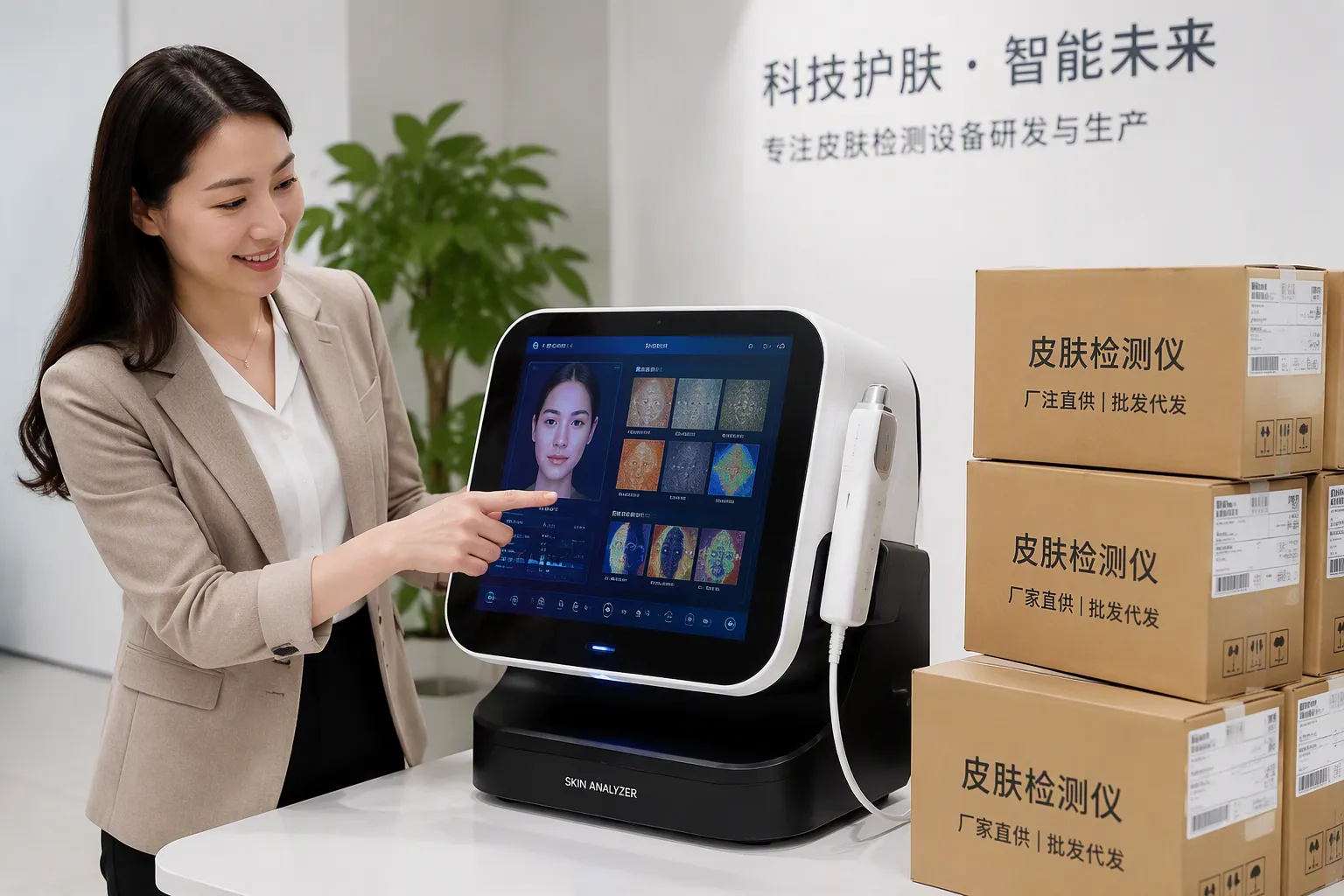
A genuine skin analyzer manufacturer maintains in-house R&D across hardware and software. A trading company that sources completed units from contract factories offers none of these capabilities.
- Factory address consistency on business licenses
- Presence of R&D staff (optics, image processing engineers)
- Patent filings for imaging modules or algorithms
- Direct assembly lines and QC stations
Dimension 3: Software Validation and Algorithm Credibility
Software distinguishes a professional system from a simple camera. Algorithm performance should be documented with sensitivity and specificity metrics against clinical ground truth.
Dimension 4: After-Sales Support and Calibration Infrastructure
Industry experience indicates that 90% of skin analyzer buyer complaints originate from after-sales service failures. Multi-spectral systems require periodic calibration to maintain accuracy. A manufacturer without service infrastructure leaves the buyer with a device whose reliability degrades over time.
Evaluation Checklist
| Dimension | Critical Questions | Red Flags |
|---|---|---|
| Certification | Can you provide ISO 13485 for this factory? | “We are working on it.” |
| Manufacturing | Can we schedule a video tour? | Showroom visits only. |
| Software | Can you provide clinical validation reports? | “Our partner developed it.” |
Frequently Asked Questions
What certifications must a skin analyzer manufacturer have?
For clinical applications, ISO 13485, IEC 60601, and CE marking (MDR) are essential. FDA 510(k) is required for diagnostic claims in the U.S.
How can I tell if a supplier is a real manufacturer or a trading company?
Verify business license addresses, request factory tours, and check patent filings. Trading companies typically lack engineering staff and production facilities.
How important is after-sales support compared to product specifications?
It is equally important. 90% of complaints stem from service failures. Without calibration and spare parts, high-spec hardware becomes useless.
How do I evaluate the credibility of AI analysis claims?
Request clinical validation data with sensitivity/specificity metrics. Systems trained on diverse, large datasets perform significantly better.
Post time: Oct-16-2026


