


You already know a household body composition analyzer is not a medical device. It won’t give you DEXA-level accuracy—DEXA scans, the gold standard, show an error margin of ±0.8% to ±2%, while BIA scales range from ±3% to ±10%. That daily change can upset you. The same body can show readings three to five percentage points apart just because of hydration changes. You will learn why this happens and how to get steady results. Used right, a body composition analyzer becomes a helpful tool for tracking trends over time. It should not replace a professional check-up.
Key Takeaways
●Home body composition analyzers are not medical tools. They can be off by 3% to 8%.
●Hydration changes can cause big shifts in the readings. For the best results, measure in the morning after using the restroom.
●Focus on trends over time, not single numbers. Your scale tracks the trend well even if the actual numbers are off.
●Measure once a week on the same day. This steady habit gives you clear progress info.
●Use the scale along with other clues, like how your clothes fit. Look at patterns over time to help guide your health path.
How a Body Composition Analyzer Works
Understanding BIA Technology
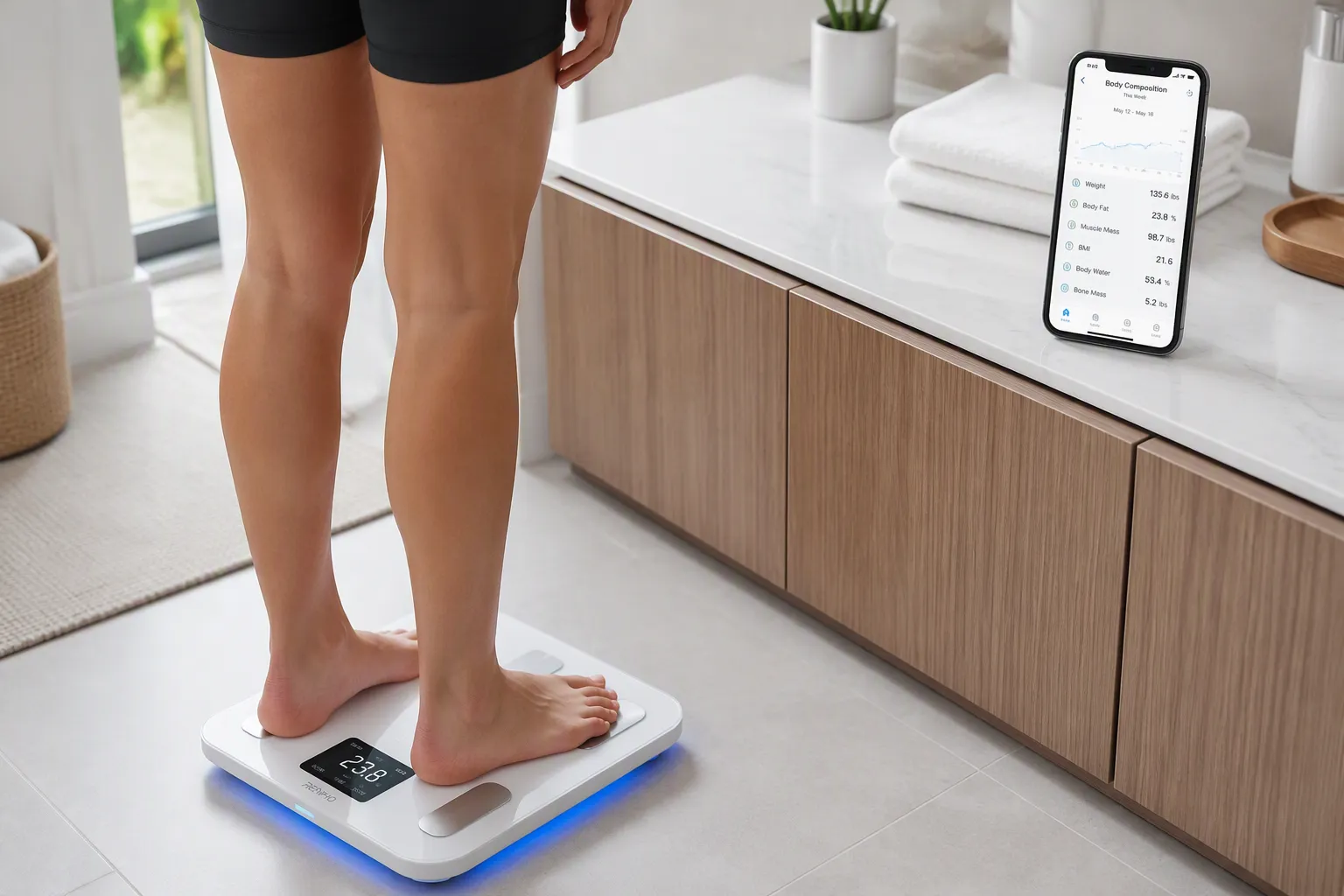
Most home body composition analyzers use Bioelectrical Impedance Analysis, or BIA. This method sends a weak alternating current through your body. The current moves through different tissues at different speeds. Muscle, blood, and organs have high water and electrolyte levels. These tissues pass electricity easily. Fat tissue holds less water and fewer electrolytes. It does not pass electricity well. The device measures the resistance, or impedance, to that current. Higher impedance means more fat. Lower impedance means more lean mass.
The science behind this method goes back many years. Researchers have shown that whole-body impedance can predict total body water with high correlation against reference methods. Later researchers improved the approach, leading to the development of predictive equations that use impedance index, body weight, and reactance to boost prediction accuracy. These developments built the foundation for the scale you use at home.
Single-frequency BIA devices work at 50 kHz. They use predictive equations to estimate fat mass, fat-free mass, skeletal muscle mass, and total body water. Multifrequency devices go further. They use the frequency-dependent permeability of cell membranes to tell intracellular water from extracellular water. This difference improves accuracy for water measurements.
The device measures impedance and then uses algorithms to turn that number into body composition estimates. These algorithms come from population averages. They do not account for your unique body shape, age, ethnicity, or fitness level. The scale measures your total weight with high accuracy. The derived metrics, however, are estimates. Compared to DEXA scans, body fat percentage readings typically have an error margin of ±3% to ±10%.
Your body composition analyzer reports several metrics. Weight stands as the most accurate measurement. The scale measures it directly. Body fat percentage, muscle mass, water percentage, and visceral fat all come from calculations. Each metric carries different accuracy levels.
Body fat percentage shows the most variability. Different smart scales can produce readings 3–5% apart for the same person under identical conditions. Proprietary algorithms and electrode configurations cause these differences. Muscle mass estimates prove reliable for tracking trends, especially with eight-electrode models. Visceral fat measurements improve significantly with eight-electrode devices because they measure the trunk directly. Water percentage fluctuates with your hydration state and time of day.
Research supports the general validity of BIA for body composition tracking. Studies show high correlation with DXA for fat-free mass, though individual readings can vary significantly. Consumer scales tend to underestimate body fat, with an average underestimation of 1.9 kg and individual errors up to 7.5 kg compared to clinical methods. Linear correlation between consumer scales and MRI runs 0.75 for females and 0.81 for males.
Your body composition analyzer gives you useful trend data. The absolute numbers may not match clinical measurements precisely. But the direction of change over weeks and months provides valuable feedback for your health journey.
Key Factors That Affect Accuracy
Hydration and Food Intake
Your hydration level is the biggest thing that changes your body composition readings. Even small changes in hydration can move the numbers a lot. BIA technology measures the electrical current that travels through your body water. Less water means higher impedance. The device reads that higher impedance as more body fat. Your morning coffee, a glass of water, or a sweaty workout can change the reading by several percentage points.
Drinking water affects your measurements for some time after you drink. Your body needs time to absorb and spread the water before readings settle down.
Food intake causes significant shifts. Research has shown that eating within 2–4 hours before a measurement can decrease impedance, which affects the accuracy of the body fat reading. Researchers suggest following pretest fasting rules to avoid meal-related errors.
Eating and strenuous exercise 2-4 hours before assessment have been shown to lower impedance, which affects the accuracy of the measurement.
Time of day matters too. Your hydration changes naturally. You wake up slightly dehydrated after a night without water. Your body composition analyzer will show different numbers in the morning compared to the evening.
Device Quality and User Variables
Not all scales work the same way. Device quality directly affects how consistent your readings are. Entry-level scales use single-frequency BIA technology with simpler algorithms. High-end models use multi-frequency BIA. These devices can measure intracellular and extracellular water separately.
| Scale Type | Typical Accuracy vs. DEXA |
|---|---|
| Consumer BIA scales | ±3% to ±10% |
Medical-grade BIA devices can achieve higher accuracy under controlled conditions, but no home device matches clinical precision. The algorithms are still based on population averages, not your unique body.
Your body traits also affect accuracy. Age and sex matter a lot. BIA tends to overestimate body fat in lean people and underestimate it in obese people. Sex affects where body fat is stored. Hand-held devices may miss lower-body fat in females. Your body fat level also affects the core assumption of BIA technology. The method assumes fat-free mass has a stable hydration level of 73%. In people with higher body fat, hydration can be higher, violating this assumption. This violation reduces accuracy.
This is why a Body Composition Analyzer cannot replace a clinical assessment. The device gives you useful trend data. But the absolute numbers carry real uncertainty. You must understand these limits to use the tool well.
Body Composition Analyzer vs. Professional Method
The Gold Standard: DEXA Scans
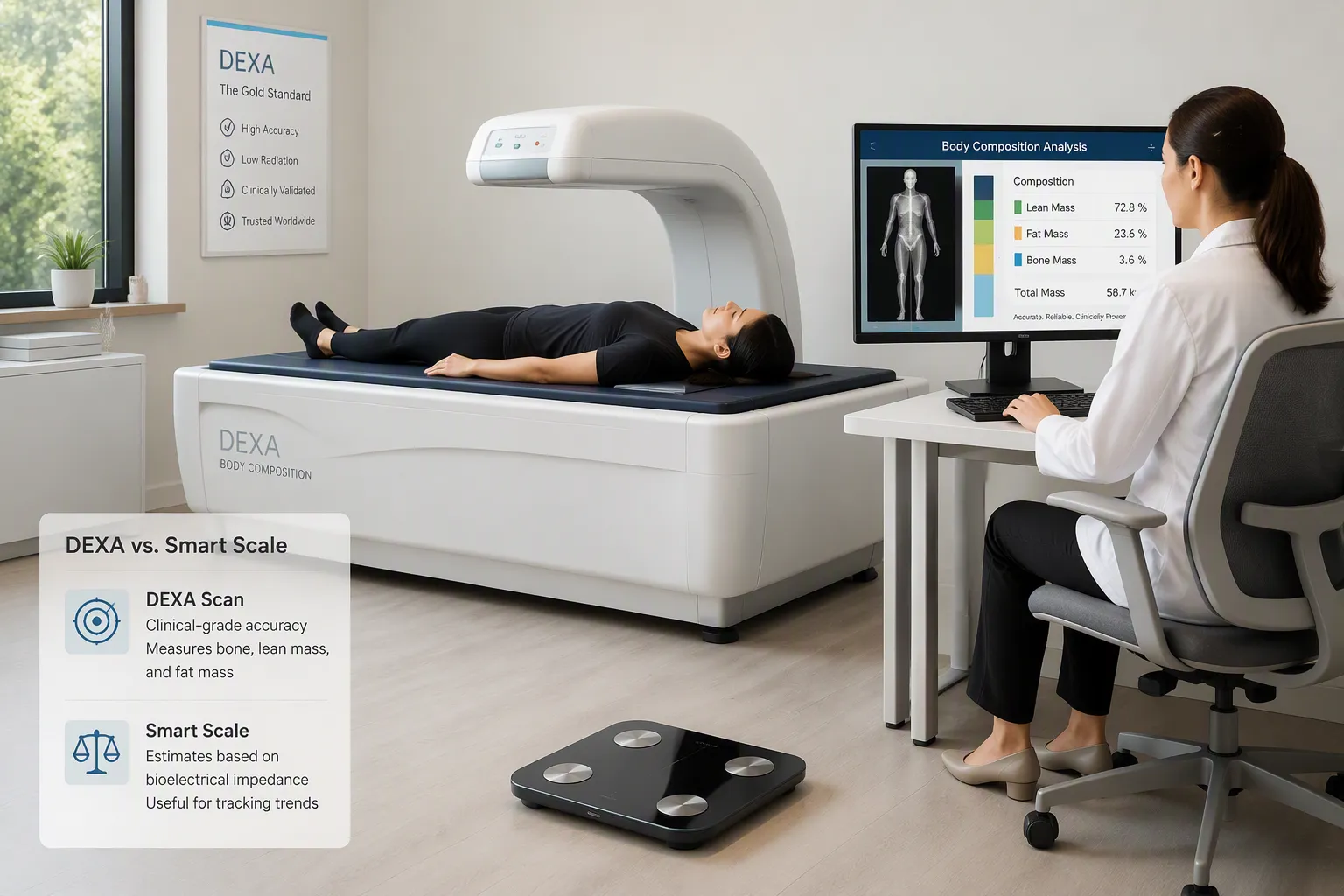
When you want the most accurate picture of your body, you turn to a professional method. DEXA (Dual-Energy X-ray Absorptiometry) stands as the gold standard. It uses two X-ray beams to measure bone density, fat mass, and lean tissue. Unlike BMI, which can mislabel people, DEXA looks inside your body and breaks down composition into bone, fat, and lean tissue.
DEXA (DXA) looks inside the body to break down composition into bone, fat, and lean tissue. This ability to accurately measure fat makes DEXA an invaluable tool for weight loss and muscle gain.
DEXA offers several advantages that a home Body Composition Analyzer cannot match:
●Precision over estimates: Unlike BMI or smart scales, DEXA delivers reliable, detailed results.
●Fat distribution analysis: Identifies dangerous visceral fat around organs, which is critical for health risk assessment.
●Muscle mass tracking: Measures lean muscle mass, allowing you to see growth and track strength changes over time.
●Bone density measurement: Quantifies bone mass, providing a complete picture of body composition.
The table below shows how different technologies compare to DEXA:
| Technology | Margin of Error (Body Fat %) | Key Limitations | Unique Capabilities |
|---|---|---|---|
| DEXA | ±0.8% to ±2% | Requires lying on a table for ~4 minutes | Measures visceral fat, bone mineral density, regional lean mass, and left-to-right muscle symmetry |
| Body Fat Scale (BIA) | ±3% to ±10% | Highly sensitive to hydration, food intake, exercise timing, caffeine, and room temperature | Provides total body water and intracellular/extracellular water ratio |
Understanding the Accuracy Gap
You now see the gap between home devices and clinical tools. Professional-grade BIA devices correlate strongly with DEXA scans for body composition, but they are not recommended for replacing DEXA scans in clinical care. Smart scales lack accuracy for bone density and visceral fat measurements.
Consumer testing has found that some body fat scale results can be significantly off.
Research shows that BIA can have an error of 2.5–3% against DEXA, though the direction varies by body type. Consumer BIA scales have an accuracy of ±3% to ±10% from DEXA. Individual error rates compared to four‑compartment models can reach up to 8%. Fat mass underestimation can reach up to 7.5 kg in some subjects.
Professional methods like DEXA and hydrostatic weighing are highly accurate. But they are expensive. A single DEXA scan is expensive and not suitable for daily use. Your Body Composition Analyzer fills this gap. It gives you trend data over time. The absolute numbers carry uncertainty, but the direction of change remains useful.
How to Get Consistent Readings
Best Practices for Daily Measurements
Your measurement routine determines your data quality. Follow the same steps every day. This consistency removes variables that distort your readings.
Start with a morning routine. Wake up and use the restroom first. An empty bladder matters because fluid has weight and conductivity. Then measure before eating or drinking anything. Your body reaches its most stable state after an overnight fast. This baseline gives you the most reliable comparison point.
Follow this sequence each morning:
1.Wake up and go directly to the scale area.
2.Empty your bladder completely.
3.Step on the scale before consuming any food or drink.
4.Measure before showering, since heat and moisture change skin conductivity.
5.Stand barefoot with full foot contact on the electrode zones.
Place your scale on a hard, flat surface. Carpet or uneven flooring absorbs weight and disrupts electrode contact. Your feet should be clean and slightly damp for better conductivity. Remove metal jewelry like rings or bracelets. These items can interfere with the electrical signal.
Avoid exercise for at least 2–4 hours before measuring. Physical activity redirects blood flow and causes fluid loss through sweat. Both effects alter conductive pathways in your body. Also avoid alcohol prior to measurement. Alcohol dehydrates tissues and changes water distribution.
Focus on Trends, Not Numbers
The absolute number on any single day carries limited meaning. Your scale might read 22% body fat when your true value is 18%. This offset does not matter for tracking progress.
Trend vs. Absolute Accuracy: If your scale reads 22% body fat but you’re actually 25%, it doesn’t matter for progress tracking. What matters is that next month it reads 20% (showing you lost ~2% body fat), even if your true measurement is 23%. The trend is accurate even when the absolute number isn’t.
Research supports this approach. Multi-frequency BIA shows higher correlation with clinical methods than single-frequency consumer devices. These numbers mean your scale tracks direction well, even when individual readings deviate.
Measure once per week on the same day. Choose a consistent time, preferably morning. This frequency gives you enough data points without daily noise. Within 4–6 weeks, you will see a clear pattern emerge.
Your Body Composition Analyzer serves as a directional tool. Watch whether the number moves up or down over months. Combine this data with other health indicators like how your clothes fit and your energy levels. The trend tells you what works. The absolute number only tells you where you started.
Your household body composition analyzer serves one purpose: tracking change over time. The absolute numbers may miss the mark by ±3% to ±10% or more. Yet the direction of your readings remains reliable when you measure under the same conditions daily.
BIA scales respond to transient states. Hydration changes, recent exercise, meal timing, and even your menstrual cycle can skew a single reading. These factors make isolated measurements unreliable for health decisions.
BIA scales are accurate for total body weight, but they should not be used routinely to assess body composition, especially in patients with severe obesity, due to large individual errors.
Combine your scale data with other signals. Notice how your clothes fit, track your energy levels, and take progress photos monthly. Use the data as a guide, not a verdict. For clinical concerns, consult a healthcare professional.
FAQ
How often should I measure my body composition?
Measure once a week on the same day, ideally in the morning. Daily readings change too much with hydration and food intake. Weekly measurements show a clear trend without the extra noise. Consistency matters more than how often you measure for reliable data.
Can I trust my scale to show weight loss progress?
Yes, for tracking direction. Your scale might show 22% body fat when your real number is 18%. But if it reads 20% next month, you know you lost fat. The trend stays accurate even when the exact numbers are off.
Why do my morning and evening readings differ so much?
Your hydration shifts during the day. You wake up a bit dehydrated after sleeping. Food and drinks add water weight. Exercise causes fluid loss. These changes alter electrical conductivity in your body, which changes the impedance reading and the estimated body fat percentage.
Will a more expensive scale give me better accuracy?
Higher-end models use multi-frequency BIA and better algorithms. They may improve consistency, but no home device matches clinical accuracy. The difference between entry-level and premium scales remains small compared to the gap between home and professional equipment
Post time: Sep-01-2026


