


Dermatology Clinics
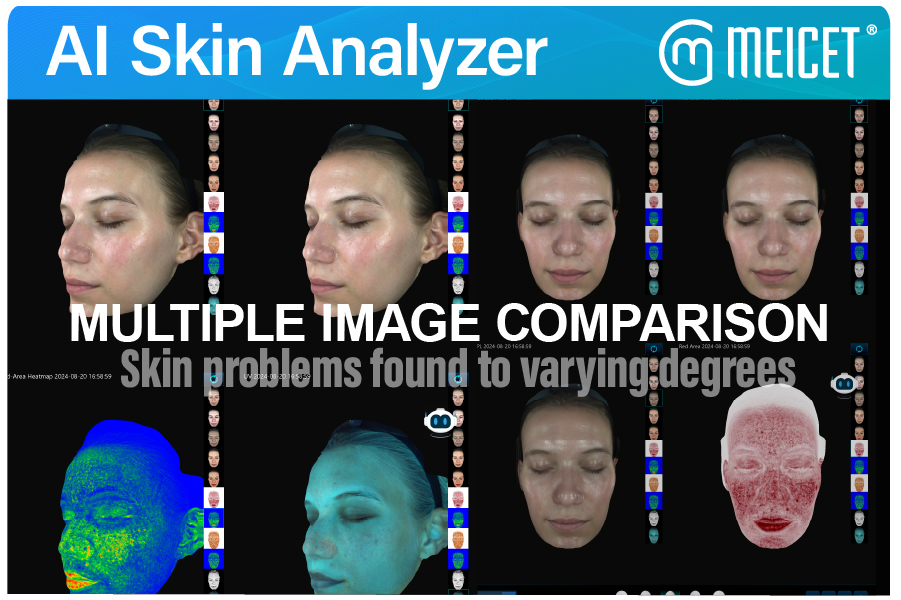
I use a skin analyzer in dermatology clinics to deliver objective skin color measurements and quantitative skin analysis. The device relies on advanced imaging, such as multi-spectral technology, to capture detailed skin data. I trust the standardized scoring systems, like the Skin Pigmentation Score, to provide numerical evaluations of skin health. This approach eliminates human bias and ensures consistent imaging conditions. I track treatment efficacy over time and monitor changes in skin conditions. The skin analyzer supports early detection and helps me tailor personalized skincare plans for each patient.
I see the following benefits when I use a skin analyzer in clinical settings:
●I obtain objective skin color readings for fitzpatrick skin type classification.
●I rely on high accuracy for diagnosis and treatment planning.
●I monitor results and track progress for personalized skincare regimens.
●I use skin analysis to compare results with physician assessments, which often show over 80% correlation.
●I complete skin analysis in under 60 seconds, improving efficiency.
| Outcome Description | Metric |
|---|---|
| Test-retest reliability | 95% |
| Correlation with physician assessments | Over 80% |
| Speed of analysis | Under 60 seconds |
I use the skin analyzer as a pre-consultation screening tool. This gives me richer data for physicians and helps track treatment outcomes. I also make personalized product recommendations based on skin analysis, which improves retail performance.
I follow regulatory standards to ensure safety and accuracy. I check for device performance, labeling, and proper sterilization. I avoid errors by using precision testing and software validation. I also complete training and certification to operate the skin analyzer. I join training programs, practice machine operation, and pass certification exams. I renew my certification to stay updated with new trends and tools.
| Step | Description |
|---|---|
| Step 1 | Learn about certification needs, including education and skills required. Most programs require basic esthetics knowledge and a high school diploma or GED. |
| Step 2 | Join a training program, which can be online or in-person, focusing on practical skills and machine operation. |
| Step 3 | Practice using skin analysis machines to gain confidence and hands-on experience. |
| Step 4 | Pass the certification exam, which includes both written and practical components. |
| Step 5 | Keep and renew your certification to stay updated with new trends and tools in the skincare field. |
Medical Spas and Esthetic Centers
I rely on a skin analyzer in medical spas and esthetic centers to deliver high accuracy and personalized results. The device uses a 36 million high-definition camera and 8-spectrum imaging to capture detailed skin images. The AI algorithm analyzes skin conditions such as acne, pigmentation, and moisture levels. It compares results against a large database to ensure accuracy for fitzpatrick skin type and objective skin color.
| Advantage | Description |
|---|---|
| Advanced Imaging Technology | Utilizes a 36 million high-definition camera and 8-spectrum imaging to capture detailed skin images. |
| AI Data Analysis | Automatically identifies and quantitatively analyzes various skin features, ensuring data accuracy. |
| Comprehensive Reporting | Generates detailed reports showing skin problems, severity, and tailored skincare suggestions. |
| Improved Hygiene and Safety Standards | Enhances safety protocols compared to traditional methods, ensuring a cleaner assessment process. |
I use the skin analyzer to generate intuitive reports that detail skin issues and suggest targeted treatments. I enhance safety protocols and maintain a cleaner assessment process. I analyze a wide range of skin conditions, including surface texture, fine lines, deeper wrinkle formation, pigmentation, vascular changes, hydration, pores, sun damage, and skin age compared to chronological age.
| Skin Condition Type | Description |
|---|---|
| Surface Texture & Fine Lines | Captures micro-topography, showing early fine lines and texture irregularities. |
| Deeper Wrinkle Formation | Identifies where wrinkles are forming beneath the surface for preventative treatment planning. |
| Pigmentation & Melanin Distribution | Reveals deeper pigmentation clusters that may rise to the surface over time. |
| Vascular Changes & Redness | Maps broken capillaries, hidden redness, and chronic inflammation. |
| Hydration & Barrier Strength | Measures skin hydration levels and barrier function. |
| Pores and Congestion Patterns | Identifies pore dilation and micro-congestion issues. |
| Sun Damage Indicators | Shows UV-induced changes in collagen and pigmentation, even if not visible on the surface. |
| Skin Age Compared to Chronological Age | Compares skin aging to expected patterns, providing insights into skin health. |
I use skin analysis to classify fitzpatrick skin type and recommend personalized skincare products. I rely on the skin analyzer for accuracy and objective skin color measurements. I track results and monitor progress for each client.
Cosmetic Testing Labs
I use a skin analyzer in cosmetic testing labs to validate skincare products and measure results. The device generates quantitative data through acceptance threshold testing, texture analysis, sensory panel testing, home-use testing, and claims validation studies. I rely on skin analysis to provide statistical backing for advertising claims and to ensure product efficacy for fitzpatrick skin type and objective skin color.
| Testing Method | Purpose | Data Generated |
|---|---|---|
| Acceptance Threshold Testing | Determines minimum performance standards expected by consumers | Quantifiable consumer feedback on product performance |
| Texture Analysis Testing | Measures viscosity, spreadability, and absorption rates | Data on formulation issues and consumer preference scores |
| Sensory Panel Testing | Evaluates attributes like spreadability and skin feel | Ratings on product attributes using standardized scales |
| Home-Use Testing | Captures real-world performance data over 2-4 weeks | Insights into product satisfaction and usage patterns |
| Claims Validation Studies | Validates marketing claims through controlled sensory studies | Statistical backing for advertising claims |
I use skin analysis to track results and compare product performance across fitzpatrick skin type groups. I rely on the skin analyzer for accuracy and objective skin color measurements. I make personalized recommendations based on skin analysis results.
I believe that the skin analyzer transforms clinical and professional environments. I use it to deliver objective skin color readings, accurate fitzpatrick skin type classification, and personalized skincare solutions. I trust the device to improve diagnosis, treatment planning, and product validation. I rely on skin analysis to monitor results and enhance patient and client satisfaction.
Commercial, Personal, and Research Applications for Skin Analyzer
Beauty Salons and Spas
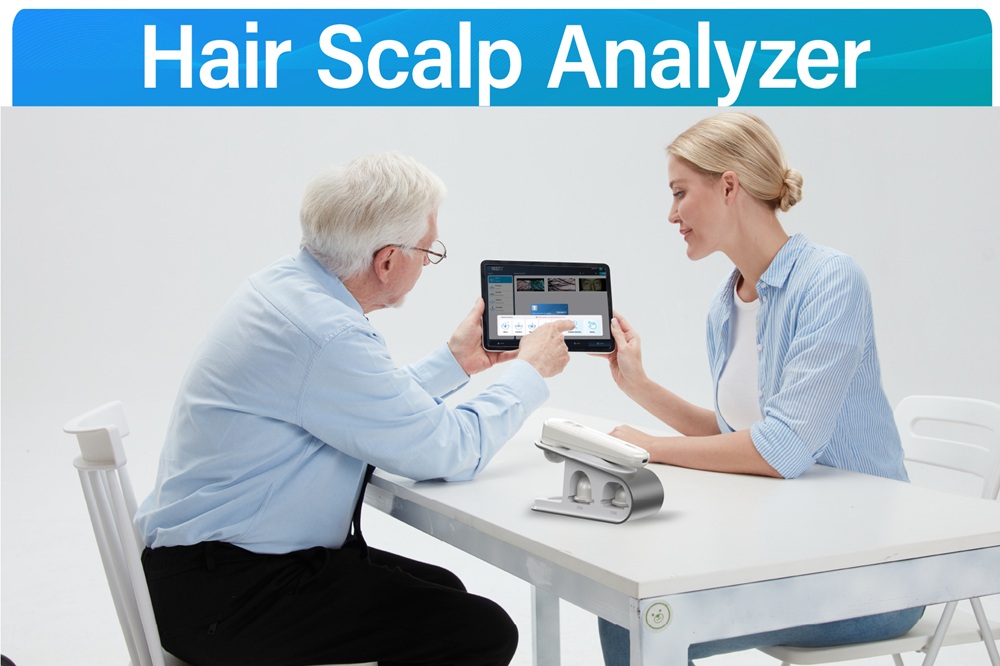
I use a skin analyzer in beauty salons and spas to deliver personalized skincare for every client. The skin analysis process is non-invasive and gives me a complete picture of skin health. I rely on advanced technology and my expertise to evaluate hydration, oil levels, sun damage, and more. This thorough skin analysis helps me create a treatment plan that matches each client’s unique needs. I see how the skin analyzer assesses texture, clarity, and radiance, which lets me recommend the best products and services.
| Aspect of Skin Analysis | Benefit |
|---|---|
| Hydration Levels | Helps identify dryness and tailor moisturizing treatments |
| Sun Damage | Guides protective measures and treatments for UV exposure |
| Fine Lines | Informs anti-aging strategies and product recommendations |
| Collagen Levels | Assists in selecting treatments that boost skin elasticity |
| Skin Density | Aids in understanding overall skin health and resilience |
I check many skin parameters during each session. The skin analyzer measures hydration, pore size, pigmentation, wrinkle development, and surface texture. I use this digital data to track changes over time and adjust personalized skincare regimens. I also use fitzpatrick skin type classification and skin color identification to make sure my recommendations are accurate for every client.
| Skin Parameter | Description |
|---|---|
| Hydration Levels | Surface hydration levels measured across the skin. |
| Pore Size | Size and visibility of pore openings across facial zones. |
| Pigmentation Patterns | Hyperpigmentation, age spots, and overall skin luminosity. |
| Wrinkle Development | Depth and distribution of wrinkles across various areas. |
| Surface Texture | Smoothness and irregularity of the skin’s surface. |
●The skin analyzer assesses many skin conditions.
●I create personalized treatments based on individual skin needs.
●The analysis includes evaluation of texture, clarity, and radiance.
I trust the skin analyzer to help me deliver advanced technology and digital solutions in my salon. I see how it improves client satisfaction and supports my goal of offering the best personalized skincare.
At-Home Skin Analysis
I notice a growing trend in at-home skin analysis. The market for these digital devices reached USD 17.1 billion in 2023 and is expected to grow to USD 91.8 billion by 2030. I believe this growth comes from advanced technology, higher demand for personalized skincare, and the rise of e-commerce. I see more people using a skin analyzer at home to monitor their skin and make better choices.
At-home skin analyzers are easy to use. I do not need special training to operate them. The digital interface is simple, and I can check my skin whenever I want. I find these devices portable and easy to fit into my daily routine. I use them to track hydration, oiliness, and other skin parameters. I also use fitzpatrick skin type and skin color identification features to get more accurate results.
| Feature/Benefit | At-Home Skin Analyzers | Professional Skin Analyzers |
|---|---|---|
| User Accessibility | Simple, user-friendly interfaces | Requires trained staff |
| Operation | No special training needed | Expertise required for operation |
| Maintenance | Minimal, usually just cleaning | Regular calibration and servicing needed |
| Customization | Basic monitoring, limited feedback | High level of customization and detailed analysis |
| Portability | Portable, fits into daily routines | Usually stationary, used in clinics |
I always consider privacy and data security when I use digital skin analysis at home. The data collected is personal and sensitive. I look for devices that follow regulations like GDPR and are transparent about how they use my information.
| Consideration | Description |
|---|---|
| Data Sensitivity | The data collected by skin analysis devices is personal and sensitive, necessitating careful handling. |
| Regulatory Influence | Regulations like GDPR in Europe dictate how companies must manage and protect user data. |
| Transparency | Companies must be transparent about data collection and usage to maintain consumer trust. |
I see how at-home skin analyzers make personalized skincare more accessible. I can monitor my skin, adjust my routine, and see real results with digital tools.
Research and Educational Settings
I use a skin analyzer in research and educational settings to study skin conditions and treatment effects. High-precision digital systems, especially computer-assisted full facial imaging, give me objective and quantitative assessments. I rely on these non-invasive tools to evaluate pigmentation, inflammation, and texture. I also use them to monitor how treatments work over time.
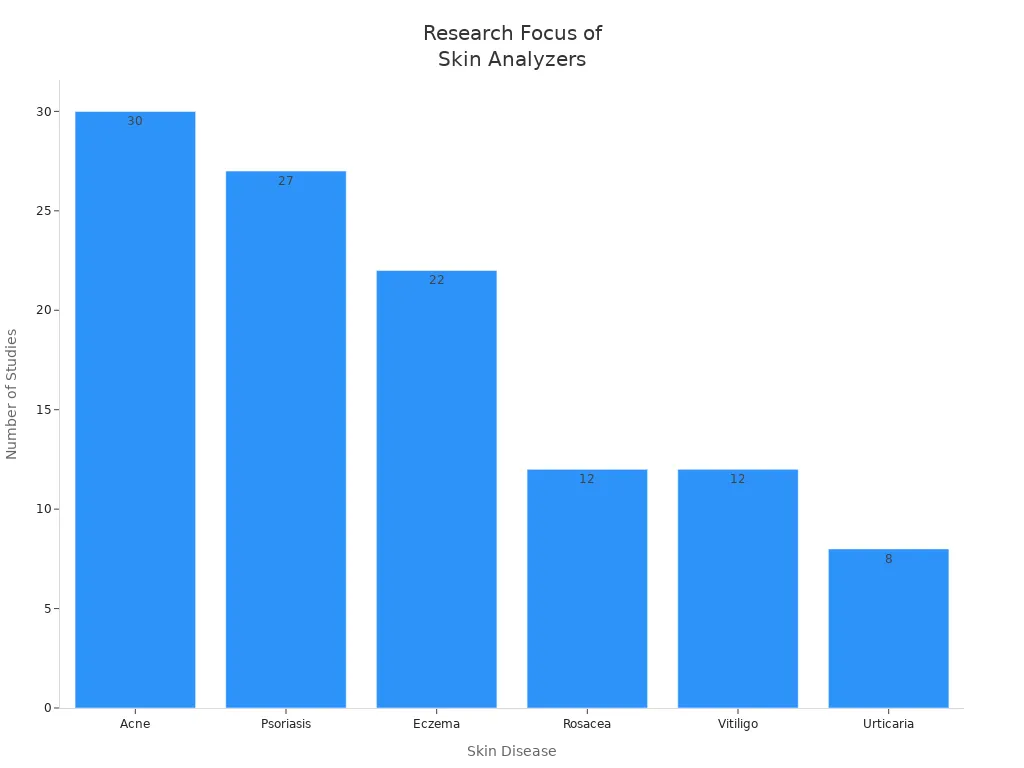
I have seen research from Wake Forest School of Medicine that shows AI skin technology can identify up to 14 major skin concerns, including wrinkles, redness, and acne. This digital approach has a big impact on dermatology. I use the skin analyzer to study diseases like acne, psoriasis, eczema, rosacea, vitiligo, and urticaria. The digital data helps me understand how different treatments affect various skin types, including fitzpatrick classifications.
| Skin Disease | Number of Studies |
|---|---|
| Acne | 30 |
| Psoriasis | 27 |
| Eczema | 22 |
| Rosacea | 12 |
| Vitiligo | 12 |
| Urticaria | 8 |
●I achieve high accuracy in diagnosing skin diseases such as acne (median 94%), rosacea (94%), eczema (93%), and psoriasis (89%).
●I identify multiple skin concerns through AI technology.
I use advanced technology and digital imaging in my research. AI imaging systems use RGB, UV, and polarized light to analyze skin from different layers and angles. This gives me a complete view of the skin’s condition. I rely on intelligent algorithms to address issues like inaccurate diagnoses and limited detection. I see that AI skin analysis matches or exceeds the accuracy of dermatologists, with some machines reaching over 95% accuracy. This makes the skin analyzer a reliable tool for research and education.
| Method | Annual Cost | Time Investment | Improvement Rate |
|---|---|---|---|
| Traditional Approach | $800 | 12 hours/year | 60% after 6 months |
| ML-Integrated Approach | $320 | 3 hours/year | 75% after 6 months |
I use the skin analyzer to support digital research, improve personalized skincare, and advance my understanding of fitzpatrick skin types. I believe that advanced technology and digital solutions will continue to shape the future of skin analysis.
I see high-precision skin analyzers used in clinics, spas, labs, research, and at home. These devices help me create personalized skin regimens, identify skin issues, and integrate skin analysis with products. I rely on advanced technology for deeper insights into skin conditions.
●High-precision imaging and machine learning give me comprehensive skin assessments.
●Personalized treatment plans adapt as my skin changes.
●Clinics focus on accuracy and privacy, beauty brands engage with skin analysis, and consumers enjoy simple tools.
| Technology | Impact on Skincare Outcomes |
|---|---|
| AI-driven diagnostics | Accurate assessments of skin conditions |
| Multi-spectral imaging | Monitors environmental impact on skin issues |
| 3D mapping | Enables tailored skin treatments in various settings |
I choose a high-quality skin analyzer for my needs. Future innovations in artificial intelligence will help me predict skin issues and customize my skin routine. I believe advanced skin analysis improves skin health for everyone.
FAQ
How does a high-precision skin analyzer help with skin type categorization?
I use the device to identify my skin type. The analyzer measures hydration, oil, and pigmentation. This process supports accurate skin type categorization for personalized care.
Can I use a skin analyzer for a study at home?
I conduct a study at home using the skin analyzer. I track changes in my skin over time. The device gives me reliable data for personal research.
What parameters does the skin analyzer measure?
I check hydration, oil levels, pigmentation, and texture. The analyzer also assesses pore size and sun damage. I use these results to improve my skincare routine.
Post time: Jun-25-2026


