


Quick Answer
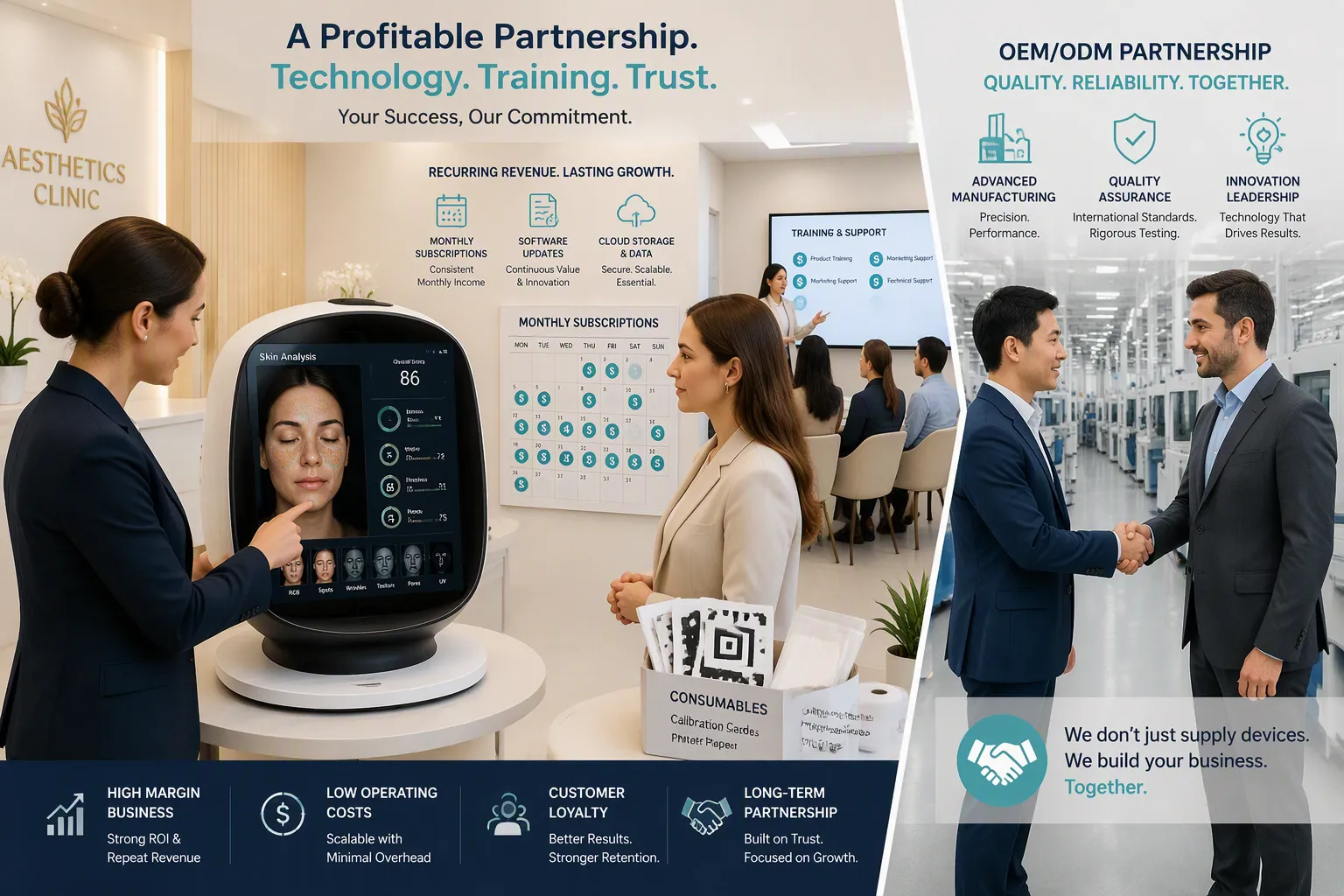
Yes—3D skin analysis machines can be extensively customized for different brands and regional markets, but the scope of customization falls into three distinct tiers: cosmetic customization (logo, boot screen, packaging, color), software customization (language localization, analysis dimensions, report templates, skin type databases), and hardware customization (sensor configuration, enclosure design, accessory bundles). Cosmetic and software customizations are typically achievable within 4–8 weeks with minimum order quantities starting at 10–50 units. Hardware customization requires 3–6 months and significantly higher investment. The critical constraint is regulatory: any customization that alters intended use claims may invalidate existing certifications, requiring recertification that adds 6–18 months and $30,000–$100,000 per market.
Key Takeaways
●Customization exists on a spectrum, not as a binary: Cosmetic branding is fast and low-cost; software localization requires engineering resources; hardware redesign demands substantial investment and recertification.
●Language and skin type databases are the highest-value software customizations: Regional skin type distribution (Fitzpatrick I-VI prevalence) directly affects diagnostic accuracy and clinical relevance.
●Regulatory boundaries constrain customization scope: Changing intended use claims—from cosmetic imaging to diagnostic assessment—may invalidate FDA 510(k) clearance and EU MDR certification.
●OEM/ODM experience is the strongest predictor of customization capability: Manufacturers with 15+ years of contract manufacturing typically offer mature processes for private-label programs.
●Minimum order quantities vary by customization tier: Cosmetic branding may start at 10 units; software localization at 50 units; hardware customization at 100+ units.
1. What Customization Actually Means in the 3D Skin Analysis Market
Customization in the 3D skin analysis machine market spans a wide spectrum, from simple logo printing to complete hardware redesign. Understanding where a specific requirement falls on this spectrum determines cost, timeline, and feasibility.
1.1 The Three Tiers of Customization
| Tier | Customization Scope | Typical MOQ | Lead Time | Investment Level |
|---|---|---|---|---|
| Tier 1: Cosmetic | Logo, boot screen, packaging, color | 10–50 units | 4–6 weeks | Low ($1,000–5,000) |
| Tier 2: Software | Language, analysis dimensions, report templates, skin databases | 50–200 units | 6–12 weeks | Medium ($5,000–30,000) |
| Tier 3: Hardware | Sensor configuration, enclosure, accessory bundles | 100–500 units | 3–6 months | High ($30,000–150,000+) |
1.2 Why Distributors and Brands Pursue Customization
Customization serves three strategic objectives for distributors and brands: differentiation from competing offerings, alignment with regional market requirements, and building brand equity that reduces price sensitivity.
A distributor selling in the Middle East faces different requirements than a distributor selling in Northern Europe. Skin type distribution, language, cultural preferences for report presentation, and regulatory expectations all vary. A one-size-fits-all product rarely achieves optimal market fit across diverse regions.
2. Tier 1: Cosmetic Customization
2.1 What Cosmetic Customization Includes
Cosmetic customization changes the product’s visible identity without altering its technical function. This is the fastest and most accessible customization tier.
Common cosmetic customization elements:
●Logo and brand name on device housing, boot screen, and software interface
●Packaging design including boxes, inserts, and protective cases
●Color options for device housing and accessories
●Startup and shutdown screens with brand imagery
●User manual branding with distributor contact information
2.2 Timeline and Cost Factors
Cosmetic customization typically adds 4–6 weeks to production lead time and $1,000–5,000 in one-time setup costs, depending on complexity. The primary cost drivers are:
●Tooling modifications: If the housing requires physical changes (embossed logo, custom color), new molds or inserts may be needed.
●Minimum order quantity: Suppliers typically require 10–50 units for cosmetic customization to justify setup costs.
●Packaging design: Custom packaging requires design, proofing, and printing setup.
2.3 What Cosmetic Customization Does Not Change
Cosmetic customization does not affect regulatory status, diagnostic capability, or software functionality. The device’s FDA 510(k) clearance, CE marking, and ISO 13485 certification remain valid because the product’s intended use and technical characteristics are unchanged.
3. Tier 2: Software Customization
3.1 Language Localization
Language localization is the most frequently requested software customization and the most impactful for user adoption. A device that displays analysis results in the user’s native language reduces training time and improves consultation quality.
Localization scope options:
| Localization Level | What Changes | Typical Timeline |
|---|---|---|
| Interface Only | Menus, buttons, system messages | 2–4 weeks |
| Reports Only | Analysis report templates and terminology | 3–6 weeks |
| Full Localization | Interface, reports, help content, training materials | 6–10 weeks |
| Cultural Adaptation | Full localization plus imagery, color, and presentation preferences | 8–12 weeks |
Languages commonly requested: Arabic, Spanish, French, German, Portuguese, Russian, Japanese, Korean, Thai, Vietnamese, and Indonesian.
3.2 Analysis Dimensions and Report Templates
Customizing analysis dimensions allows distributors to align the device with regional clinical priorities and competitive positioning. A distributor targeting the acne treatment market may prioritize sebum and porphyrin analysis; a distributor targeting anti-aging may emphasize wrinkle depth and elasticity measurement.
Customizable analysis elements:
●Analysis dimension selection: Which of the available 12+ dimensions appear in the default report
●Severity grading scales: Adjustment of thresholds based on regional skin type norms
●Report layout: Custom templates with distributor branding
●Treatment recommendation logic: Linking analysis findings to specific product or treatment recommendations
3.3 Regional Skin Type Databases
Skin type distribution varies significantly by region, and AI algorithms trained primarily on one population may perform differently on another. Customizing the skin type database improves diagnostic relevance for regional populations.
Fitzpatrick skin type distribution by region (approximate):
| Region | Predominant Fitzpatrick Types | AI Performance Consideration |
|---|---|---|
| Northern Europe | I–III | Standard training data well-represented |
| Southern Europe | II–IV | Moderate representation |
| Middle East | III–V | Underrepresented in many training datasets |
| South Asia | IV–V | Underrepresented |
| East Asia | III–IV | Moderate representation |
| Africa | V–VI | Significantly underrepresented |
Industry research finding: Dermatology AI models demonstrate AUROC of 0.89 on light skin (Fitzpatrick I-III) but only 0.82 on darker skin (types IV-VI). This gap stems from long-standing underrepresentation of darker skin populations in training data. Manufacturers offering regional database customization address this gap.
3.4 Software Customization Boundaries
Software customization cannot change the device’s intended use without triggering regulatory implications. If customization alters diagnostic claims—for example, adding “melanoma screening” functionality—the device may require new regulatory submissions.
Safe software customizations: Language, report layout, analysis dimension ordering, branding.
Regulatory-triggering software customizations: New diagnostic claims, altered severity thresholds that change clinical meaning, addition of medical conditions not covered by existing clearance.
4. Tier 3: Hardware Customization
4.1 Hardware Customization Scope
Hardware customization involves physical changes to the device beyond cosmetic branding. This tier requires significant investment, extended timelines, and careful regulatory planning.
Common hardware customizations:
| Customization Type | Description | Timeline | Investment |
|---|---|---|---|
| Sensor Configuration | Different resolution, spectral modes | 4–6 months | $50,000–150,000 |
| Enclosure Design | Custom housing shape, materials, mounting | 3–5 months | $30,000–100,000 |
| Accessory Bundles | Custom carry cases, stands, lighting | 2–3 months | $5,000–20,000 |
| Integrated Solutions | Combined with other devices (e.g., treatment lasers) | 6–12 months | $100,000+ |
4.2 Regulatory Implications of Hardware Customization
Hardware customization that alters the device’s technical characteristics may invalidate existing certifications. Changes to sensors, light sources, or electrical components can affect:
●IEC 60601-1 compliance: Electrical safety re-testing required
●FDA 510(k) clearance: May require new 510(k) if changes affect safety or effectiveness
●CE marking: Notified body review may be required for significant changes
●EMC compliance: Electromagnetic compatibility re-testing
Practical guidance: Manufacturers typically maintain a “platform” certification covering core hardware, with cosmetic and software variations covered under the same certification. Hardware changes that affect the platform require recertification.
4.3 OEM/ODM Experience as a Capability Indicator
Manufacturers with extensive OEM/ODM experience possess the engineering resources, quality systems, and regulatory knowledge to execute hardware customization successfully. QM Medical indicates 19 years of OEM/ODM experience, supporting comprehensive customization.
Capability assessment questions for distributors:
●How many OEM projects has the manufacturer completed in the last three years?
●Does the manufacturer have in-house engineering for hardware design?
●Can the manufacturer provide references from previous OEM clients?
●What is the manufacturer’s process for managing regulatory implications of customization?
5. Regional Market Customization Requirements
5.1 Middle East Market
Middle East markets require specific customizations driven by skin type distribution, language, and cultural presentation preferences.
Key customization requirements:
●Language: Arabic interface and reports
●Skin type database: Fitzpatrick III–V representation
●Report presentation: Culturally appropriate imagery and color schemes
●Regulatory: Compliance with regional medical device regulations (varies by country)
5.2 European Market
European markets require EU MDR compliance, which imposes specific constraints on customization scope.
Key customization requirements:
●Language: Major EU languages (German, French, Spanish, Italian)
●Regulatory: Class IIb certification limits customization that alters intended use
●Data privacy: GDPR-compliant patient data management
●Report standards: Alignment with European clinical documentation practices
5.3 Asia-Pacific Market
Asia-Pacific markets represent diverse requirements across countries, with language and skin type variation as primary drivers.
Key customization requirements:
●Language: Mandarin, Japanese, Korean, Thai, Vietnamese, Indonesian
●Skin type database: Fitzpatrick III–IV representation for East Asia
●Regulatory: NMPA (China), PMDA (Japan), MFDS (Korea) compliance
●Price sensitivity: Multi-tier product offerings for different market segments
5.4 North American Market
North American markets prioritize FDA clearance and English-language functionality, with increasing demand for Spanish localization.
Key customization requirements:
●Language: English (primary), Spanish (growing demand)
●Regulatory: FDA 510(k) clearance required for clinical claims
●Skin type database: Fitzpatrick I–VI representation (diverse population)
●Integration: Compatibility with existing practice management software
6. Pre-Order Customization Checklist
Before committing to a customization program, confirm:
Customization Scope Definition
Customization tier identified (cosmetic, software, or hardware)
Specific elements documented (logo, language, analysis dimensions, etc.)
Regional market requirements mapped
Regulatory implications assessed
Supplier Capability Verification
OEM/ODM experience years confirmed
In-house engineering resources verified
Previous OEM project references obtained
Regulatory support capability confirmed
FAQ
1. What is the minimum order quantity for customizing a 3D skin analysis machine?
Minimum order quantities vary by customization tier: cosmetic branding typically starts at 10–50 units; software localization at 50–200 units; hardware customization at 100–500 units. Lower MOQs are sometimes negotiable for distributors with strong ongoing volume commitments.
2. Can I add my own brand logo and packaging to a 3D skin analysis machine?
Yes. Cosmetic customization—including logo, boot screen, packaging, and color—is the most accessible tier. It typically adds 4–6 weeks to lead time and $1,000–5,000 in setup costs, with no impact on existing regulatory certifications because the product’s intended use and technical characteristics remain unchanged.
3. Will customizing the software language affect the device’s certifications?
Language localization alone does not affect certifications because it does not change intended use or technical characteristics. However, if localization includes new diagnostic claims or altered clinical terminology, regulatory review may be required. Safe software customizations include interface translation, report templates, and branding.
4. Can I customize the skin type database for my regional market?
Yes, this is one of the highest-value software customizations. Regional skin type distribution varies significantly—Fitzpatrick types III–V predominate in the Middle East, IV–V in South Asia, V–VI in Africa. Customizing the analysis database for regional populations improves diagnostic relevance and addresses the underrepresentation of darker skin types in standard training data.
5. How long does hardware customization take, and what does it cost?
Hardware customization—including sensor configuration, enclosure design, or accessory bundles—typically takes 3–6 months and costs $30,000–150,000+ depending on scope. It also may trigger recertification requirements, adding 6–18 months and $30,000–100,000 per market. Hardware customization is typically justified only for distributors with large volume commitments.
6. What happens to FDA 510(k) clearance if I customize the device?
If customization changes the device’s intended use, technical characteristics, or safety/effectiveness profile, a new 510(k) may be required. Cosmetic and software customizations that do not alter intended use typically do not affect clearance. Hardware changes affecting sensors or electrical components may require re-testing and new submission.
7. How do I choose a manufacturer capable of executing my customization requirements?
Look for manufacturers with 15+ years of OEM/ODM experience, in-house engineering resources, and verifiable references from previous OEM projects. Ask specific questions about their process for managing regulatory implications, their minimum order quantities for different customization tiers, and their timeline for first article approval. A manufacturer that cannot provide references or clearly explain their customization process should be scrutinized.
Post time: Oct-10-2026


