


With the rapid upgrading of China’s consumer market and the growing consumer demand for specialized personal care, skin analyzers have transformed from high-end equipment in professional medical institutions into popular tools widely used in scenarios ranging from beauty salons and clinics to personal households. Their breadth of application and market depth together outline a rapidly expanding industry landscape.
Market-Driven Widespread Penetration
The primary driver for the extensive use of skin analyzers in China is massive market demand. On one hand, China’s medical aesthetics and skin management industry continues to grow, with consumers showing increasing demand for scientific and precise skincare. On the other hand, as technology advances and costs decrease, skin analyzers are rapidly evolving from traditional professional detection equipment like ultraviolet and Wood’s lamps to smart devices integrated with artificial intelligence (AI) and big data analytics, greatly expanding their application boundaries.
Market research reports indicate that the global smart skin detection device market is growing steadily. The Chinese market, due to its vast consumer base and high acceptance rate, holds a significant position and shows immense potential. From high-end beauty chain institutions to community skincare shops, offering a professional instrument-based skin analysis has become a standard service and a key link in attracting customers.
Technology-Enabled Expansion of Application Scenarios
The integration of technology is the core driver behind the popularization of these devices. Skin analyzers centered on AI algorithms can provide multidimensional, quantitative assessments of skin issues—such as spots, wrinkles, texture, pores, and UV damage—through image recognition and deep learning. For instance, Meitu’s “Meitukey Skin Detector,” leveraging AI technology from its imaging lab, aims to provide consumers with professional-level skin analysis and skincare regimens usable at home.
The incorporation of IoT technology further extends the value of data. Some advanced devices can upload detection data to the cloud, analyzing accumulated massive case studies to offer users more referential trend predictions and treatment advice. This transforms skin analysis from a static assessment into part of dynamic health management.
MEICET Skin Analyzer: An Example of Specialization
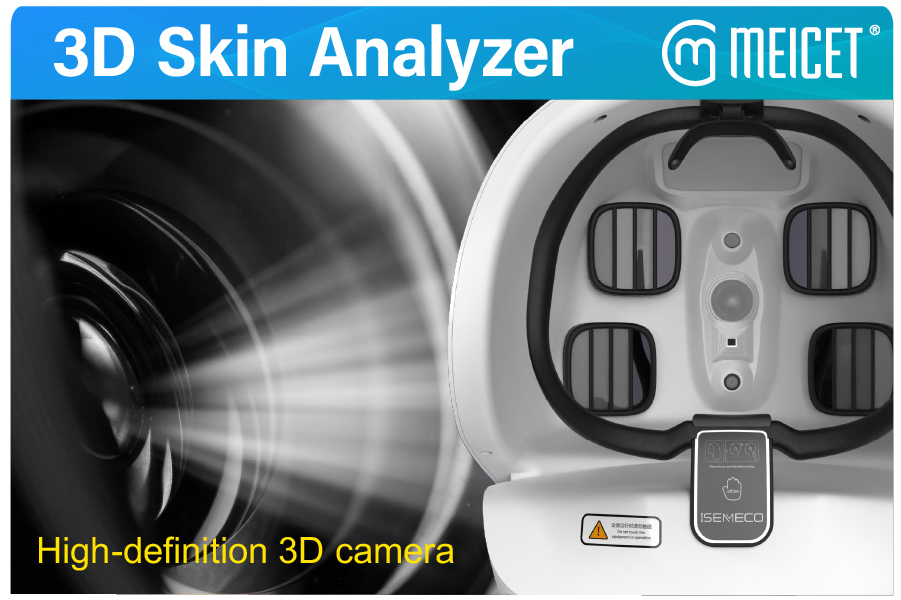
Among numerous brands and models, the MEICET Skin Analyzer serves as a specific case for observing technological application in the industry. Its MC10 model is a professional-grade skin analysis instrument.
The device integrates a high-definition imaging system with advanced optical technology, designed to accurately capture fine details on the skin’s surface. It can not only assess superficial skin issues but also evaluate deeper conditions—such as skin’s water-oil balance, pigmentation distribution, collagen status, and potential sensitive areas—through technologies like multispectral analysis.
In application, the MEICET Skin Analyzer embodies the dual attributes of a “professional tool”: in the clinical medical field, it assists doctors in diagnosing and monitoring skin conditions like acne and eczema; in the aesthetic beauty field, it provides a scientific basis for formulating personalized skincare and anti-aging regimens. Its relatively simple operation suits various service scenarios, reflecting the current trend where skin analysis devices balance “specialization” with “universality.”
Future Prospects and Challenges
Looking ahead, the penetration of skin analyzers in China is expected to continue deepening. Driving factors include the sustained growth of the “appearance economy,” deeper consumer education, and the cost reduction and functional enhancements brought by technological iteration. Products integrating AI, big data, and portable designs are expected to further enter households, becoming part of individuals’ daily health management.
However, widespread market use also brings challenges. These include variations in device accuracy and standardization, data privacy and security concerns, and avoiding excessive marketing that leads to mismatched consumer expectations. The healthy development of the industry requires the synergy of technology, regulation, and business ethics.
In conclusion, skin analyzers have achieved widespread adoption and integration in the Chinese market. They are not merely a popular product under consumption upgrading but also a vivid example of technology empowering the health industry and driving skincare from an experience-based practice toward a science. From professional analyzers like MEICET to personal AI skin detectors, this tool is redefining how Chinese people manage their skin health.
By Irina
Post time: Nov-04-2025


