


Quick Answer
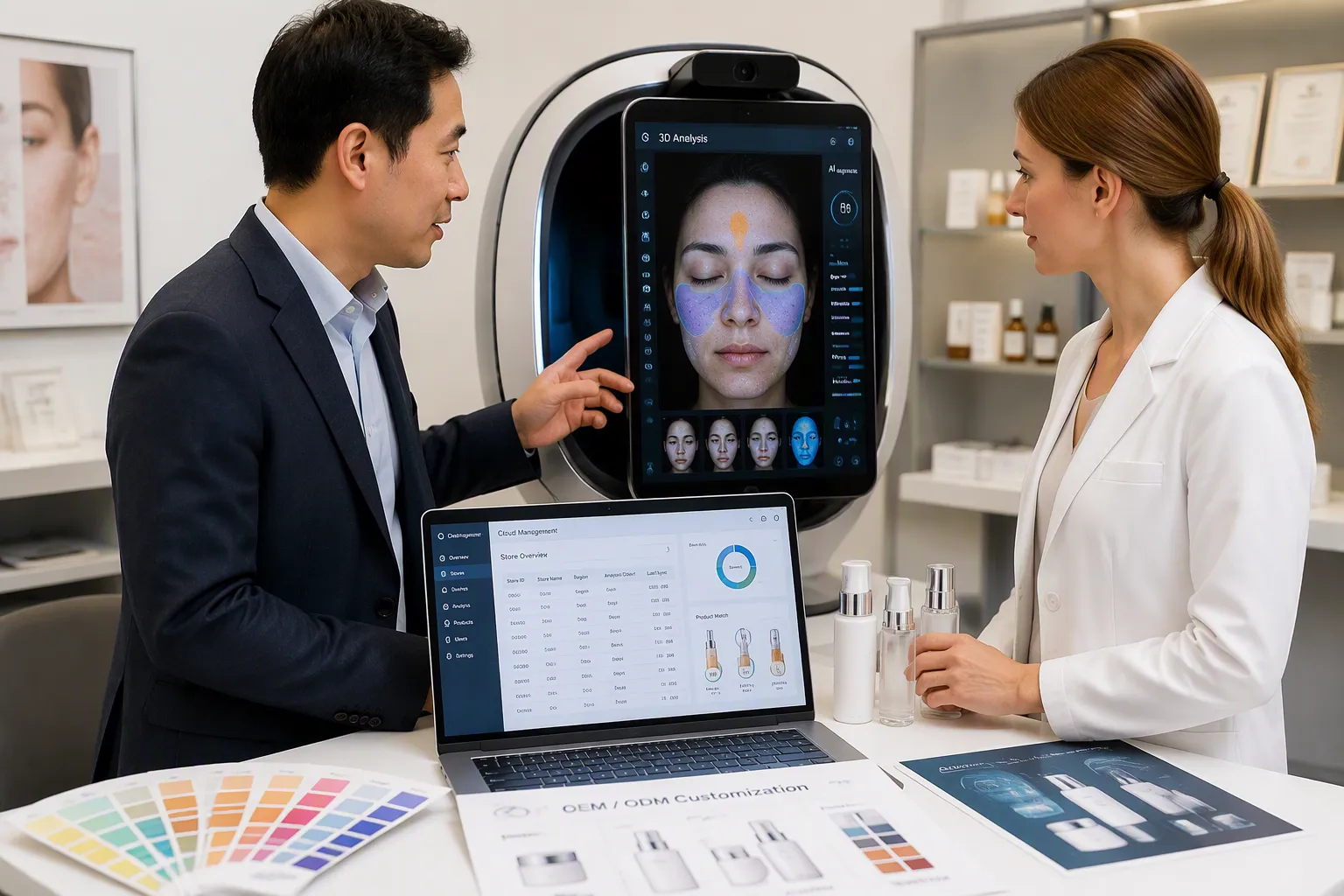
3D skin analysis is gaining global popularity because it replaces subjective visual assessment with objective, data-driven skin diagnostics. Systems like the MEICET 3D D9 Skin Analyzer capture 36 million data points per scan at 0.1mm resolution, using multispectral imaging (RGB, cross-polarized, parallel-polarized, and UV) to reveal subsurface skin conditions invisible to the naked eye. The global beauty devices market is projected to reach $129.12 billion by 2030, growing at a 16.5% CAGR, with skin analysis systems representing one of the fastest-growing segments. Clinics adopting 3D analysis report 40% improvement in treatment adherence as patients engage with visual, quantified skin data.
Key Takeaways
●3D imaging captures what 2D cameras miss: Depth measurements, volumetric changes, and subsurface pigment distribution require true 3D modeling.
●AI-powered analysis standardizes skin assessment: Systems achieve 92–96% F1-scores for skin type and condition classification, reducing diagnostic variability.
●Multispectral imaging reveals invisible concerns: UV and cross-polarized light expose sun damage, porphyrins, and dermal pigmentation before they surface.
●Market growth reflects clinical demand: Beauty device market growing at 16.5% CAGR through 2030; multifunctional skin detectors expanding across dermatology and aesthetics.
●Patient communication drives conversion: Visual 3D comparisons increase treatment acceptance and adherence by up to 40%
1. The Shift from Subjective Assessment to Objective Measurement
The fundamental driver behind 3D skin analysis adoption is the industry‘s move away from subjective visual grading toward reproducible, quantitative diagnostics. For decades, skin consultations relied on a practitioner’s visual inspection and verbal description. This approach suffers from inherent variability: different practitioners reach different conclusions from the same skin; the same practitioner may assess differently on different days.
1.1 Why 2D Imaging Has Limitations
Standard 2D photography captures surface appearance but cannot measure depth, volume, or subsurface structure. A wrinkle photographed in 2D shows shadow and texture but provides no data on fold depth in millimeters. A pigmentation spot photographed in 2D appears as a dark patch but reveals nothing about whether the melanin resides in the epidermis or dermis—a distinction that determines whether topical treatments will work.
Clinical consequences of 2D-only assessment:
●Wrinkle severity graded by shadow perception rather than actual depth measurement
●Pigmentation treatments selected without knowing melanin depth
●Pore size estimated visually rather than measured in micrometers
●Treatment progress documented through inconsistent lighting and angles
1.2 What 3D Analysis Adds
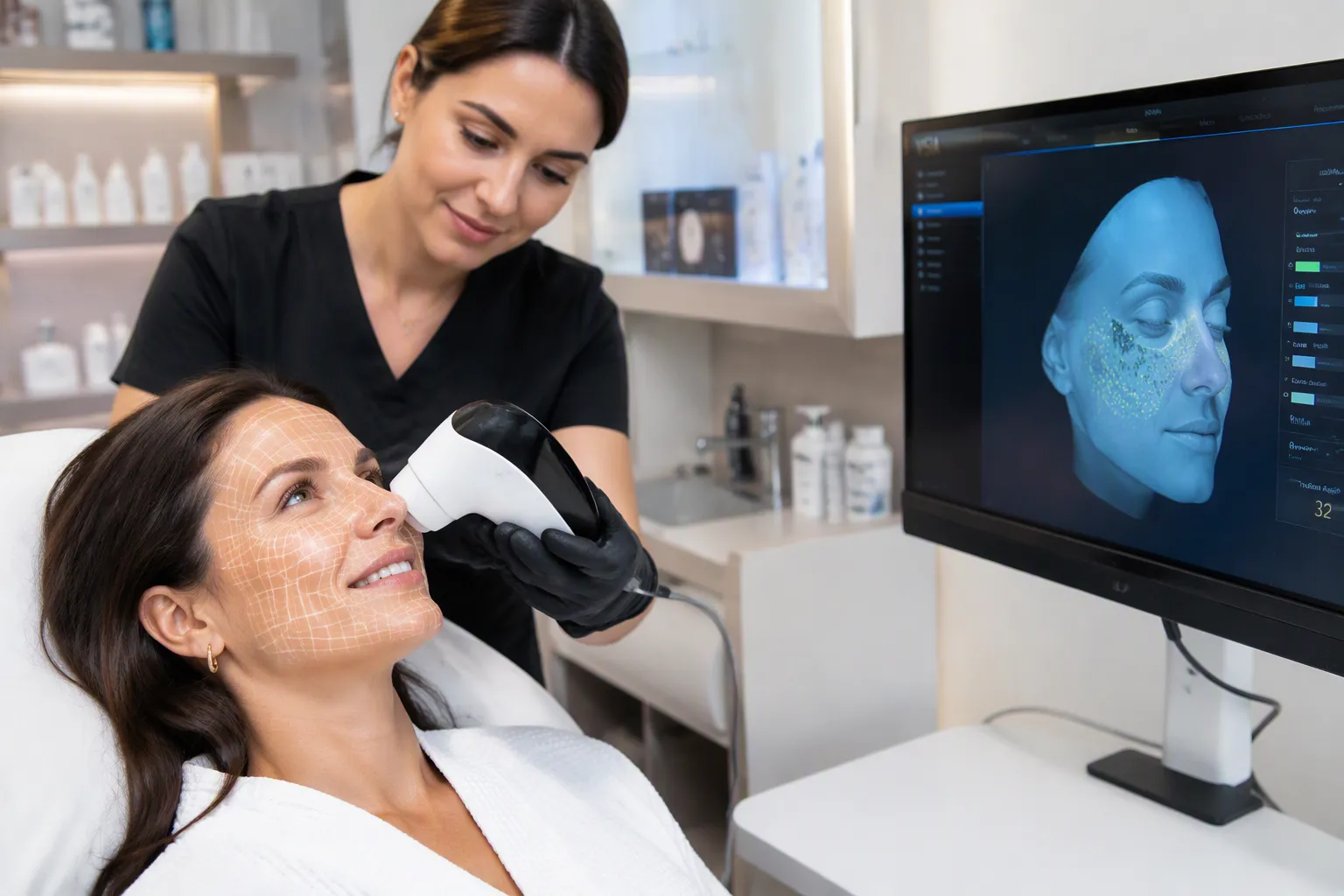
3D skin analysis captures facial topography as measurable spatial data, converting visual observations into quantifiable metrics. The MEICET 3D D9, for example, uses dual structured-light technology to capture 36 million data points per scan, achieving 0.1mm 3D mapping accuracy.
| Measurement Capability | 2D Assessment | 3D Analysis |
|---|---|---|
| Wrinkle depth | Visual grading (mild/moderate/severe) | Measured in millimeters |
| Pigment depth | Surface color only | Epidermal vs. dermal distinction |
| Pore volume | Visual size estimation | Computed volume and count |
| Skin firmness | Manual palpation | Volume displacement measurement |
| Treatment progress | Before/after photos (lighting-dependent) | Volumetric difference calculation |
Source: MEICET 3D D9 product specifications
2. The Technology Stack Behind 3D Skin Analysis
2.1 Multispectral Imaging: Seeing Beyond the Visible Spectrum
Multispectral imaging combines multiple light modes to reveal different skin layers and conditions simultaneously. Standard white-light photography shows only the skin surface. Advanced systems incorporate:
●RGB (standard daylight): Surface texture, visible pigmentation, and vascular patterns
●Cross-polarized light (CPL): Penetrates below the surface to reveal dermal melanin, deeper vascularity, and subsurface structures
●Parallel-polarized light: Enhances surface shine, pore visibility, and texture irregularities
●UV/Wood‘s light: Excites porphyrins (bacterial byproducts) and highlights epidermal melanin with high contrast
The MEICET 3D D9 captures 4 spectra and 9 high-definition 3D images in a single scan, providing layered diagnostic data in approximately 30 seconds.
2.2 AI-Powered Analysis: From Raw Images to Clinical Insights
Artificial intelligence transforms multispectral image data into structured diagnostic outputs. Deep learning models, particularly hybrid architectures combining CNNs and Transformers, achieve high accuracy in classifying skin conditions:
| Assessment Task | Model Performance | Source |
|---|---|---|
| Skin type classification (oily/dry/normal) | 95.8% F1-score | IEEE DermaRAG study |
| Severe condition detection (acne, hyperpigmentation) | 92.4% F1-score | IEEE DermaRAG study |
| Diagnostic accuracy improvement with AI assistance | 68.08% → 88.78% | EU clinical validation |
| Referral reduction (cases manageable without specialist) | 58.1% | EU clinical validation |
The DermaRAG-SkinCare framework demonstrates that AI can achieve 95.8% F1-score for skin type classification and 92.4% for more serious dermatological conditions, providing evidence-based, personalized skincare recommendations.
2.3 What the AI Actually Analyzes
Modern 3D skin analyzers simultaneously assess multiple skin parameters, creating a comprehensive diagnostic profile. The MEICET 3D D9 evaluates 30+ detection dimensions across four categories:
Sensitivity Analysis:
●Inflammation and redness distribution
●Acne and pustule severity
●Three-level grading (mild/moderate/severe) with area percentage
Pigmentation Analysis:
●Spot classification (freckles, age spots, melasma)
●Epidermal vs. dermal pigment depth
●Three-level severity grading with quantitative data
Skin Texture Analysis:
●Pore size classification (large/medium/small) with count and area
●Texture smoothness and roughness mapping
●Porphyrin detection via UV imaging
Anti-Aging Analysis:
●Wrinkle depth measurement (forehead, glabella, periocular, nasolabial, perioral)
●Aging grade assignment (0.0–8.0 scale, 81 levels)
●Aging factor weighting for treatment prioritization
3. The Global Market Momentum
3.1 Market Size and Growth Trajectory
The beauty device market, which includes skin analysis systems, is experiencing sustained double-digit growth. Current forecasts from multiple research sources converge on a similar trajectory:
| Market Metric | Value | Source |
|---|---|---|
| 2026 Beauty Device Market | $69.99 billion | Research and Markets |
| 2030 Forecast Market Size | $129.12 billion | Research and Markets |
| CAGR (2026–2030) | 16.5% | Research and Markets |
| 2032 Forecast (broader beauty devices) | $271.25 billion | QY Research |
The multifunctional skin detector market specifically emphasizes that growth depends less on feature quantity and more on measurement quality, inclusive performance, clinical use-case clarity, and privacy protection.
3.2 Regional Adoption Drivers
Different regions adopt 3D skin analysis for distinct reasons, reflecting local market conditions.
Middle East (Dubai, UAE):
The medical aesthetics market in the Middle East is forecast to grow at 12.8% CAGR through 2027, driven by demand for non-invasive treatments and technology-advanced skincare solutions. Dubai has positioned itself as a global center for aesthetic excellence, attracting 25,000+ professionals to events like DUBAI DERMA.
Europe:
European adoption is accelerated by EU MDR regulatory pressure. The MEICET 3D D9 and pro-A systems recently received Class IIb certification, making them among the first AI diagnostic tools to comply with new European medical device standards. Cosmoprof Worldwide Bologna, the global beauty industry standard, featured MEICET‘s 3D SKIN ANALYZER in 2026.
Asia-Pacific:
The skin analysis systems market identifies growing demand for personalized skincare, increased use in aesthetic clinics, and expansion of non-invasive diagnostic tools as primary growth drivers. Portable skin analysis devices represent a particularly fast-growing sub-segment.
4. Clinical Evidence: What the Data Shows
4.1 Diagnostic Accuracy Improvement
Clinical validation studies demonstrate that AI-assisted skin analysis significantly improves diagnostic accuracy across practitioner skill levels. A prospective, observational study conducted in Spain evaluated 16 healthcare professionals (10 primary care practitioners, 6 dermatologists) assessing 29 validated images covering 13 distinct pathologies.
| Practitioner Group | Accuracy Without AI | Accuracy With AI | Improvement |
|---|---|---|---|
| Primary Care | 62.90% | 89.92% | +27.02% |
| Dermatologists | 76.47% | 86.93% | +10.46% |
| Overall | 68.08% | 88.78% | +20.70% |
Source: EU clinical validation study, Legit.Health Plus device
The study also found that 58.1% of cases could be managed without specialist referral, and 55.11% could be handled remotely, demonstrating the technology’s potential for triage and telemedicine applications.
4.2 Predictive Capabilities
Beyond current-state assessment, 3D systems now offer predictive aging simulation. The MEICET 3D D9 includes predictive intelligence that projects personalized aging trajectories using 8 aging parameters with validated 9-point grading scales. This allows clinicians to:
●Simulate patient-specific aging progression over 5–10 years
●Quantify treatment efficacy through 0.1ml volume difference calculations
●Prioritize interventions based on weighted aging factor analysis
4.3 Industry Recognition
3D skin analysis technology is receiving formal regulatory and professional recognition. The MEICET D9 received FDA approval for acne scar assessment, rosacea classification, and cosmetic outcome documentation. European certification (Class IIb) positions the technology as compliant with the highest current medical device standards.
5. Why This Matters for Different Stakeholders
5.1 For Aesthetic Clinics
3D skin analysis transforms the consultation from subjective opinion to objective evidence. Clinics report that patients respond differently when they see quantified data about their skin condition—measured wrinkle depth in millimeters, pore volume in cubic millimeters, pigment distribution in layered images.
The clinical utility extends beyond diagnosis:
●Treatment planning: Objective baseline enables precise intervention selection
●Progress tracking: Volumetric comparisons document treatment efficacy
●Patient communication: Visual 3D comparisons increase treatment acceptance
●Conversion improvement: Anecdotal reports suggest treatment adherence improves by 40% when patients see quantified data
5.2 For Skincare Brands
Brands use 3D analysis to validate product efficacy claims with objective data. Rather than relying on consumer perception studies, brands can measure actual changes in wrinkle depth, pigmentation intensity, and skin texture parameters before and after product use.
5.3 For Dermatology and Medical Aesthetics
The technology bridges the gap between aesthetic and medical dermatology. AI-assisted analysis achieves diagnostic accuracy approaching dermatologist-level performance for many common conditions, while also screening for conditions that may require medical referral.
6. Implementation Considerations
6.1 System Selection Criteria
When evaluating 3D skin analysis systems, buyers should verify:
| Specification | Minimum Requirement | Premium Standard |
|---|---|---|
| 3D capture accuracy | 0.5mm | 0.1mm |
| Image resolution | 12 megapixels | 36–48 megapixels |
| Spectral modes | 2–3 | 4+ (RGB, CPL, PL, UV) |
| Analysis dimensions | 10–15 | 30+ |
| AI database size | 100,000+ cases | 5,000,000+ cases |
| Processing time | <60 seconds | <30 seconds |
| Certifications | CE, FDA | Class IIb, FDA cleared |
Source: MEICET 3D D9 specifications
6.2 Integration into Clinical Workflow
Successful 3D skin analysis adoption requires workflow integration beyond the technology itself. Key factors include:
●Standardized capture protocols: Consistent patient positioning, lighting control, makeup removal
●Staff training: Interpretation of AI outputs, patient communication
●Data management: Secure storage, consent management, before/after comparison tools
●Treatment library integration: Linking analysis findings to recommended treatments
FAQ
1. What is 3D skin analysis and how does it differ from regular skin scanners?
3D skin analysis uses structured-light or stereoscopic imaging to capture facial topography as measurable spatial data, creating a depth-mapped digital model. Regular 2D scanners capture flat images without depth information. This means 3D systems can measure wrinkle depth in millimeters, pore volume, and volumetric changes that 2D imaging cannot quantify.
2. How accurate are AI-powered skin analysis systems?
Clinical validation studies show AI-assisted analysis achieves 88.78% diagnostic accuracy overall, with 92–96% F1-scores for skin type and condition classification. However, accuracy varies by condition—performance is strongest for common concerns like pigmentation and wrinkles, and lower for complex or overlapping conditions.
3. Why is multispectral imaging important in 3D skin analysis?
Multispectral imaging (RGB, cross-polarized, parallel-polarized, UV) reveals different skin layers simultaneously. UV light exposes epidermal melanin and porphyrins; cross-polarized light penetrates to show dermal pigment and vascularity. Without multispectral capability, analysis is limited to surface appearance only.
4. How long does a 3D skin analysis scan take?
Modern systems capture and process scans in 30–60 seconds. The MEICET 3D D9 generates a complete analysis report in approximately 30 seconds after a single scan.
5. Is 3D skin analysis technology FDA-cleared and safe?
Many professional systems have FDA clearance or CE certification. The MEICET D9 received FDA approval for specific clinical applications and Class IIb European certification. The technology uses non-ionizing light (LED illumination) and is non-invasive, posing no known health risks when used as intended.
6. Can 3D skin analysis predict how my skin will age?
Yes. Advanced systems like the MEICET 3D D9 include predictive aging simulation that projects personalized aging trajectories over 5–10 years using 8 aging parameters and validated grading scales. This allows clinicians to design proactive, long-term treatment plans.
7. Why is the global beauty market adopting 3D skin analysis so rapidly?
Three converging factors drive adoption: regulatory recognition (FDA/CE clearances for clinical applications), clinical validation (published studies demonstrating diagnostic accuracy improvement), and patient engagement (visual, quantified data improves treatment adherence and satisfaction). Market growth of 16.5% CAGR reflects this multi-stakeholder demand
Post time: Oct-09-2026


