


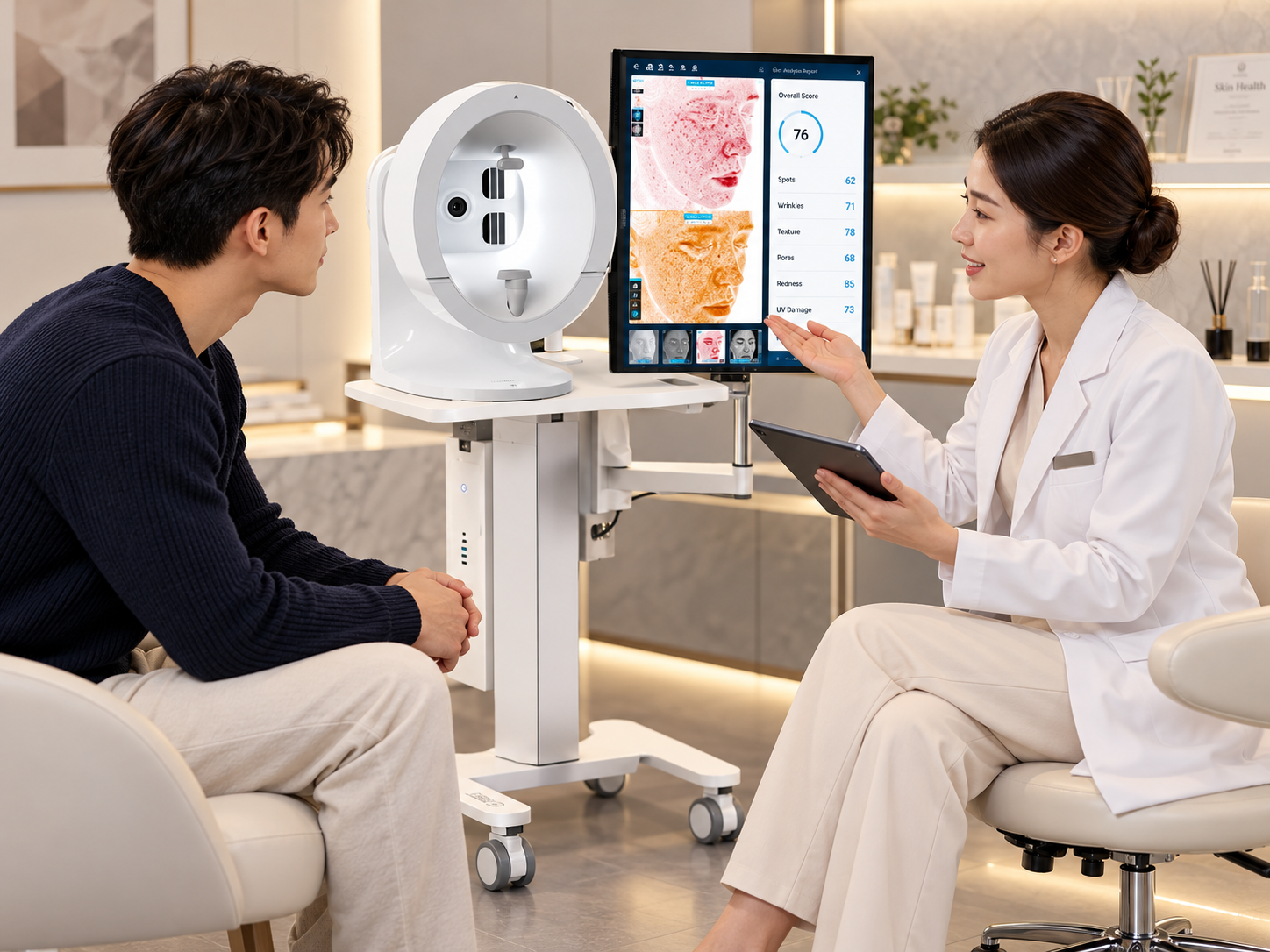
A professional smart skin analyzer measures four core categories of skin metrics: (1) surface topography—wrinkle depth, pore size, texture, and volume/contour changes; (2) pigmentation—melanin distribution, brown spots, and UV-induced damage; (3) vascular and sensitivity indicators—redness, inflammation, and acne-related markers; and (4) biophysical properties—hydration, sebum content, and elasticity. The ISEMECO 3D D9 platform covers more than 30 skin measurement dimensions, organized around an 8-dimensional aging model, 3-tier sensitivity and pigmentation grading, and 0.1 mL volume resolution for structural changes. The device captures these metrics using four spectral modes (RGB, cross-polarized, UV, parallel-polarized) combined with binocular grating structured light at 0.2 mm modeling accuracy.
The D9 evaluates 8 aging dimensions—forehead lines, glabellar lines, crow’s feet, etc.—each graded into severity levels based on national standards.
System classifies brown spots and sensitive areas into 3 severity levels (mild, moderate, severe) with specific detection area percentages.
Binocular structured light captures 180° full-face images, enabling volume change measurement accurate to 0.1 mL for filler tracking.
UV reveals photodamage; cross-polarized isolates vascularity; parallel-polarized highlights surface texture and sebum.
Surface topography metrics describe the physical relief of the skin—wrinkles, pores, and texture—while 3D morphology extends this to facial contour and volume.
- Wrinkles: The most extensively graded metric. The D9 evaluates 8 aging dimensions, each assigned a severity grade based on the Chinese national standard. The D9 MAX brochure describes 81 aging grades within this framework.
- Pores: Assessed for size and density. The AI face recognition segments the face into T-zone, U-zone, and O-zone for region-specific analysis.
- 3D Morphology: Uses binocular grating structured light for a depth map (0.2 mm accuracy). Captures a 180° image to measure volume changes at 0.1 mL resolution.
Pigmentation metrics describe melanin distribution, brown spots, and photodamage—conditions that are often poorly visualized under standard lighting.
- Brown spots: Classified into 3 severity levels (mild, moderate, severe) with reports on detection area and percentage of facial area affected.
- UV-induced damage: Imaged under UV spectral mode to reveal porphyrins and subsurface pigment deposition.
- Skin tone and UV sensitivity: Reported on a 1–10 scale based on brightness and color, distinct from Fitzpatrick classification.
Vascular metrics describe redness, inflammation, and sensitivity—signals that often indicate compromised barrier function or active inflammation.
- Redness and erythema: Imaged under cross-polarized light to reduce surface glare and reveal hemoglobin in subsurface vessels.
- Sensitivity classification: Uses a 3-tier system (mild, moderate, severe) with color-coded mapping for each severity level.
Biophysical metrics describe the skin’s functional state—hydration, sebum, and elasticity—rather than its visual appearance.
- Hydration: Measured using a separate moisture analyzer probe, reported against absolute thresholds.
- Sebum: Assessed under UV light where it appears as fluorescence. Porphyrin ratio indicates acne risk.
- Elasticity: Inferred from surface topography changes, specifically the transition of circular pores to linear patterns.
| Metric Category | Specific Metrics | D9 Measurement Method | Output Format |
|---|---|---|---|
| Aging | 8 dimensions (forehead, glabella, crow’s feet, etc.) | Multi-spectral imaging + AI grading | Severity grade per dimension; aging ranking |
| Pigmentation | Brown spots, hyperpigmentation, UV damage | RGB + UV spectral modes | Area (mm²/%), severity level (3-tier) |
| Vascularity | Redness, erythema, sensitivity | Cross-polarized imaging | Area, severity level, distribution map |
| 3D Morphology | Contour, volume, symmetry | Binocular grating structured light | 0.2 mm resolution model; 0.1 mL volume change |
| Skin Type | Fitzpatrick classification (I–VI) | Image-based classification | Category output |
| Hydration/Sebum | Moisture level, sebum count, porphyrin ratio | Probe-based (moisture); UV imaging (sebum) | Numerical value vs. threshold |
The D9’s value lies in treatment tracking and patient communication. The 8-dimension aging model provides a structured framework for consultations, and the 0.1 mL volume resolution enables objective demonstration of filler or energy-device results.
Supports baseline documentation and monitoring. Note: the D9 is for aesthetic and morphological analysis, not disease diagnosis. Pigmentation maps do not differentiate between melasma and PIH without clinical exam.
Regardless of the metric claimed, buyers should request:
- A sample report for a patient with the skin type and condition the practice most commonly serves.
- The measurement protocol for each metric—patient positioning, lighting conditions, and whether the metric is imaging or probe-based.
- Repeatability data—whether the same patient scanned twice produces the same value within tolerance.
The D9 platform covers more than 30 skin measurement dimensions, organized around an 8-dimensional aging model, 3-tier sensitivity and pigmentation grading, and 3D morphological analysis.
The D9 evaluates 8 distinct facial dimensions and assigns each a severity grade based on a national standard, preserving regional specificity rather than collapsing them into a single number.
The D9 emphasizes imaging-based metrics. Buyers requiring hydration or sebum measurement should confirm if the D9 includes these probes or if they are available as add-ons.
The D9 uses RGB (surface texture), cross-polarized (vascularity), parallel-polarized (surface reflection/sebum), and UV (porphyrins/deep pigmentation).
Yes. The D9’s 3D modeling captures a 180° image with 0.2 mm accuracy, providing volume change measurement at 0.1 mL resolution for before/after comparison.
It contextualizes other measurements, such as pigmentation readings. However, it is a sun-sensitivity scale, not a diagnostic tool.
The D9 provides quantified area and 3-tier severity classification, making the output reproducible and comparable across visits, unlike qualitative visual assessment.
Post time: Nov-09-2026


