


Quick Answer
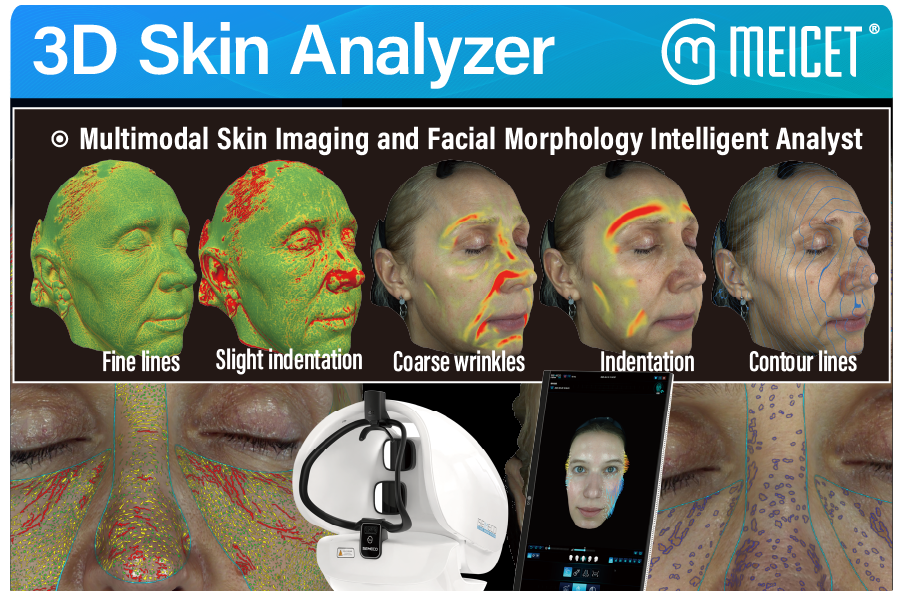
The best 3D skin analyzer for beauty clinics, spas, and aesthetic centers balances clinical-grade measurement precision with consultation-conversion features. The ISEMECO D9 (and its upgraded D9 MAX variant) is purpose-built for this segment: it uses binocular grating structured light to achieve 0.2mm 3D modeling accuracy, captures 42 million full-face pixels, and generates 11 high-definition spectral images from four light modes (RGB, cross-polarized, UV, parallel-polarized) . Critically for aesthetic businesses, it converts technical data into revenue tools: 0.1ml volume-difference calculation, 8-dimension aging grading, and 3D aesthetic simulation that lets clients preview outcomes before committing to treatment . The device holds CE and FDA certifications and is positioned for clinics, dermatologists, and aesthetic surgeons rather than home-use consumers .
Key Takeaways
Aesthetic centers need conversion tools, not just diagnostic accuracy: the D9’s 3D simulation and 0.1ml volume quantification directly support treatment upsells and patient decisions .
Structured light (0.2mm) separates professional devices from entry-level “3D” claims: simulated-depth devices cannot measure filler outcomes or contour changes.
Four spectral modes (including UV and cross-polarized) reveal subsurface inflammation and pigmentation that RGB-only devices miss—essential for sensitivity and pigmentation consultations .
The D9 MAX upgrade reaches 0.02mm precision and 48MP resolution, with a 30-second AI report and 18–80 age trajectory prediction for anti-aging programs .
Multi-terminal access and branded reports integrate the device into spa workflow, turning a scan into a take-home marketing asset .
Why Beauty Businesses Need Different Features Than Dermatology Clinics
A dermatology clinic needs a device that documents disease progression. A beauty spa needs a device that converts a consultation into a booked treatment. The technical foundation overlaps—accurate imaging, reliable measurements—but the software layer diverges.
The ISEMECO D9 addresses the aesthetic business use case explicitly. Its 3D aesthetic simulation function allows practitioners to perform digital design directly on the captured 3D model—augmenting the nasal base, lifting the mid-face, reshaping the jawline—and generating before/after comparison images instantly . MEICET’s materials note that over 90% of clients want to see a simulated result before proceeding with treatment . A device that provides this preview shortens the decision cycle and reduces post-treatment expectation mismatches.
For spas without medical practitioners, this simulation capability transforms an abstract treatment proposal into a visual commitment. For aesthetic centers performing injectables, the 0.1ml volume-difference calculation provides objective evidence that a filler procedure achieved its intended result .
The D9 Platform: Specifications Relevant to Aesthetic Settings
The D9’s published parameters map directly to the needs of beauty businesses:
Specification D9 / D9 MAX Value Aesthetic Business Relevance
3D modeling accuracy 0.2mm (D9); 0.02mm (D9 MAX) Detects fine wrinkles and subtle contour changes
Full-face pixels 42 million (D9); 48 million (D9 MAX) High-resolution texture for consultation visuals
Spectral modes 4 (RGB, cross-polarized, UV, parallel-polarized) UV reveals pigmentation depth; cross-polarized shows redness/inflammation
Volume precision 0.1ml Quantifies filler and contour outcomes
Aging analysis 8 dimensions, 81 aging grades Structures anti-aging treatment packages
AI report time 30 seconds (D9 MAX); 15 seconds (exhibition demo) Fast enough for consultation flow
Age prediction 18–80 years trajectory Motivates preventive anti-aging bookings
The UV mode is particularly valuable for spas selling pigmentation treatments. It reveals sun damage and porphyrin distribution that visible light cannot show, giving the consultant a concrete visual justification for a whitening or photodamage protocol .
What the D9 MAX Adds for High-Volume Aesthetic Centers
The D9 MAX represents a meaningful upgrade for businesses that need faster throughput and higher-resolution visuals. MEICET’s brochure reports a 10× improvement in the structured-light camera, 48 million full-face pixels, 0.02mm ultra-micro 3D modeling, and a 30-second AI skin analysis report .
The MAX also introduces an AI skin large model that automatically links detected concerns to the institution’s treatment menu. For example, when the system identifies aging signs, it pairs the finding with the clinic’s anti-aging programs and 81 aging grades, directly supporting upselling of long-cycle treatments . This integration reduces the cognitive load on consultants—they do not need to memorize which treatment matches which finding.
A 7×24-hour AI interaction feature provides after-hours client engagement, though the practical value depends on how the clinic deploys it .
Feature Checklist for Beauty Businesses Comparing 3D Analyzers
Before committing to any device, verify these capabilities in a live demonstration:
1. Repeatability, not just single-scan quality. Scan the same person twice in succession. Do the volume measurements and aging grades match? A device that produces different numbers on identical inputs cannot track treatment outcomes.
2. Simulation realism. Request a 3D simulation of a specific treatment (e.g., mid-face volumization). Does the simulated result look plausible, or does it distort facial proportions? The D9’s simulation operates on the actual captured 3D model, which grounds the preview in the patient’s real anatomy .
3. Report branding. Can the generated report carry the spa’s logo, contact information, and recommended treatment packages? The D9 supports customized report generation incorporating patient images, doctor recommendations, and skincare plans . A generic report wastes a marketing opportunity.
4. Multi-device access. Can a consultant view the report on an iPad while the main device remains available for the next client? The D9 supports simultaneous login from iPads and computers with local or remote synchronization .
5. Fitzpatrick calibration. Test on a volunteer with darker skin. Does the analysis remain plausible, or does the device overcall pigmentation or miss erythema? The D9 explicitly lists Fitzpatrick I–VI adjustment to avoid errors across skin types .
Table: Fit by Business Type
Business Type Primary Revenue Driver D9 Feature That Matters Most Consideration
Medical spa (injectables) Filler and contour treatments 0.1ml volume calculation, before/after overlap comparison Needs structured light for volume accuracy
Beauty salon (consultation-led) Treatment package sales 3D simulation, branded reports Fast report generation (15–30s) keeps flow
Aesthetic center (anti-aging) Long-term treatment programs 8-dimension aging grading, 18–80 age prediction Trajectory visualization motivates preventive bookings
Multi-location chain Standardized consultation Multi-terminal access, cloud-synced case database Verify remote sync latency in demo
Pigmentation-focused clinic Whitening/spot treatments UV and cross-polarized modes, brown spot severity grading RGB-only devices cannot quantify depth
What Buyers Should Verify Before Purchase
Regulatory status for the intended market. The D9 holds CE and FDA certifications . For EU clinical claims, confirm the specific configuration is covered. For U.S. cosmetic assessment, verify that marketing claims align with the device’s clearance status.
Training and workflow integration. A device that produces sophisticated analysis but disrupts consultation flow will be underused. MEICET provides on-site training and online sessions . Ask for a workflow demonstration: how many steps from client positioning to printed report?
After-sales infrastructure. The D9 is a workstation-class device (19.5kg, USB 3.0 connection) . Confirm regional spare-parts availability for UV light modules and calibration services. A device that sits idle awaiting a part from overseas erodes the revenue case for purchase.
FAQ
Which 3D skin analyzer is best for a beauty spa with no medical staff?
The ISEMECO D9 is well-suited for non-medical aesthetic settings because its software emphasizes visual simulation and branded reports rather than diagnostic classifications. The 3D aesthetic simulation lets consultants show clients a preview of treatment outcomes, which supports conversion without requiring clinical interpretation . The 15–30 second AI report generation keeps consultation flow efficient .
Can the D9 measure filler treatment results objectively?
Yes. The D9 reports volume difference with 0.1ml precision, showing increases or decreases in specific facial regions before and after treatment . This provides numerical evidence that a filler procedure achieved its intended volume change, rather than relying on subjective visual comparison. The overlap comparison feature uses warm/cool color coding to highlight volume changes .
How does the D9 handle different skin tones?
The D9 includes Fitzpatrick I–VI skin type adjustment to avoid errors across different skin tones . Buyers should verify during demonstration whether this adjustment is automatic (algorithm detects skin type) or manual (operator selects), as manual selection introduces user-dependence. Test on a darker-skinned volunteer to confirm the analysis remains plausible.
What is the difference between D9 and D9 MAX for a beauty business?
The D9 MAX upgrades the structured-light camera (0.02mm precision vs. 0.2mm), increases resolution to 48 million pixels, and reduces AI report time to 30 seconds . The MAX also introduces an AI skin large model that automatically links findings to treatment programs. For high-volume aesthetic centers, the faster report generation and higher-resolution visuals justify the upgrade. For smaller spas, the standard D9 provides the core simulation and volume-measurement capabilities.
Does the D9 support anti-aging treatment packages?
Yes. The D9’s 8-dimension aging model grades forehead lines, glabellar lines, crow’s feet, periorbital lines, laugh lines, marionette lines, corner of mouth lines, and brown spots. It also predicts aging trajectory from 18 to 80 years . For anti-aging-focused centers, this trajectory visualization motivates clients to book preventive or maintenance treatments rather than waiting for advanced aging signs.
What certifications does the D9 hold?
The D9 holds CE and FDA certifications . MEICET’s materials also reference the platform’s presence at international aesthetic medicine exhibitions including IMCAS and AMWC . Buyers should verify that the certificates cover the specific configuration and intended use claims for their market before purchase.
Can the D9 report be branded for my spa?
Yes. The D9 supports customized report generation incorporating the client’s 3D images, the practitioner’s analysis recommendations, and recommended skincare plans. Reports can include the spa’s branding elements . This transforms each scan into a take-home marketing asset that reinforces the spa’s expertise and reminds the client of recommended follow-up treatments.
Post time: Oct-23-2026


