


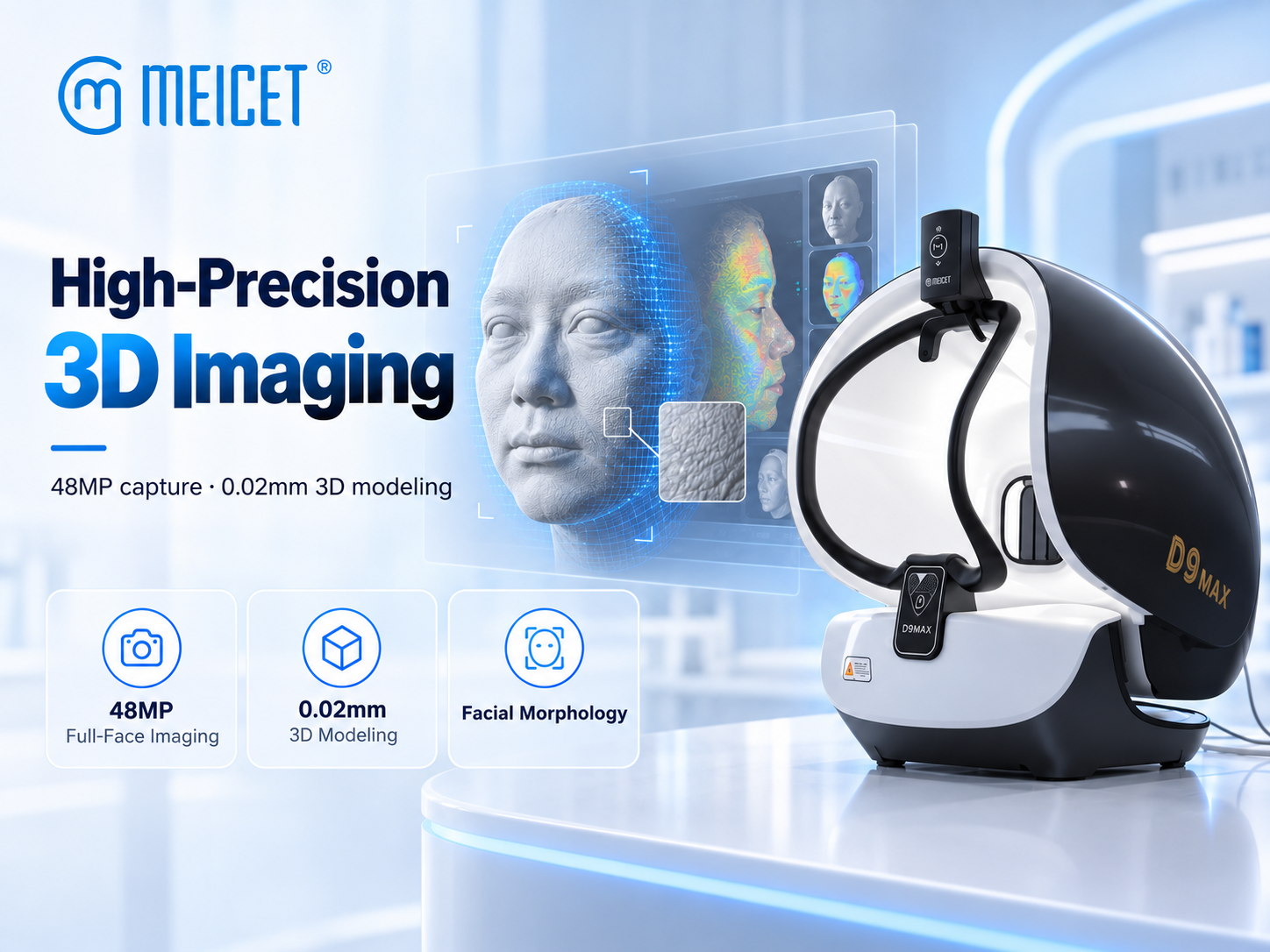
A professional skin analyzer supplier should offer a written, enforceable after-sales framework, not verbal assurances. For a clinical-grade device like the ISEMECO 3D D9, the minimum acceptable package includes: a 12-month host machine warranty that explicitly covers the optical module (structured-light projector, cameras, and calibration components), a written Service Level Agreement (SLA) with measurable response and resolution targets, a defined spare parts availability commitment for the device’s expected 5–7 year service life, and free software updates on a predictable schedule. MEICET’s published policy states a one-year host warranty, 3-month coverage for handles and parts, 7×24 support with a 1-hour repair response and 24-hour solution commitment, and free software updates every 3–6 months . The critical procurement action is to convert these claims into contractual obligations with escalation paths and remedies.
Key Takeaways
Warranty must cover the optical path: A 12-month warranty that excludes the structured-light projector or cameras leaves the most clinically critical component unprotected.
Response time matters more: A 12-month warranty on a device that takes 8 weeks to repair is 8 weeks of lost revenue; the SLA is the operative document.
Spare parts availability: For a device with a 5–7 year clinical lifespan, the supplier should commit to parts availability for at least that period.
Software updates are not optional: AI models improve over time; a supplier that charges for updates converts improvement into unpredictable recurring cost.
⚠ 90% of buyer complaints stem from after-sales failures, not hardware defects: The supplier’s support infrastructure determines whether the instrument remains a revenue-generating asset.
Why After-Sales Support Determines the True Cost of Ownership
A skin analyzer’s purchase price represents only 40–60% of its three-year total cost of ownership . The remaining cost—calibration, software renewals, spare parts, and downtime—is governed by the supplier’s after-sales framework. A clinic that selects a supplier based on hardware specifications alone may discover that the device’s clinical value erodes within the first year if calibration cannot be performed, software updates are withheld, or a failed component takes months to replace.
The asymmetry of after-sales risk is stark. A clinic director in Southeast Asia reported that an 18-month-old skin analyzer with a failed UV module sat idle for 11 weeks because the supplier had no regional spare parts and no authorized technician. The estimated lost consultation revenue was $18,000—far exceeding the price difference between the lowest bidder and a supplier with local support infrastructure . This case illustrates why the warranty and support framework deserves the same scrutiny as the device specifications.
Warranty Structure: What Should Be Covered and What Should Not
A professional 3D skin analyzer warranty should cover the host machine, the optical module, the light sources, and the control electronics for a minimum of 12 months from delivery or installation. MEICET’s published policy states a one-year warranty on the host machine and a three-month free replacement warranty for handles, treatment heads, and parts . This structure reflects the typical failure profile of the device: the host—including the camera module and structured-light projector—is the high-value, low-failure-rate component; the handles and wear items are lower-cost but higher-failure-rate.
The procurement distinction is between a warranty that covers the chassis and a warranty that covers the measurement system. The D9’s clinical value depends on the optical path—the binocular grating structured-light projector, the 1-inch CMOS sensor, and the calibration between them. A warranty that excludes the optical module leaves the most expensive and most clinically critical component unprotected. MEICET’s service documentation for its professional line specifies that warranty coverage should explicitly include optical modules, sensors, and calibration components, not just the enclosure .
What the warranty should not cover is equally important: consumables, damage from misuse or unauthorized modification, and cosmetic wear. These exclusions are standard, but the buyer should confirm them in writing so that a dispute over a failed component is resolved by the contract, not by post-hoc negotiation.
| Warranty Element | MEICET Published Policy | Professional Baseline Expectation | Procurement Question |
|---|---|---|---|
| Host machine | 12 months | 12 months minimum | “Does the host warranty cover the structured-light projector and cameras?” |
| Handles and heads | 3 months replacement | 3–6 months | “What is the cost of replacement after the warranty period?” |
| Parts | 3 months | Component-dependent | “Which parts are classified as wear items?” |
| Software | Free updates 3–6 months | Included, not separately priced | “Are AI model updates included in the update policy?” |
| Response time | 1-hour response / 24-hour solution | Written SLA with targets | “What is the escalation path if the target is missed?” |
Service Level Agreement: The Document That Converts Promises into Obligations
A warranty is only as valuable as the supplier’s ability to act on it. A 12-month warranty on a device that takes eight weeks to repair is eight weeks of lost revenue. The relevant service metric is not the warranty duration but the response time and resolution path.
MEICET’s published service standard for its professional skin analyzer line includes 7×24 standby support, a one-hour repair response commitment, and a 24-hour solution commitment. For routine technical issues, support is available via telephone, webcam, and online chat . The D9’s multi-terminal architecture—which allows remote report viewing on iPads and computers—also enables the supplier’s technical team to diagnose software and data issues remotely, without dispatching a technician to the clinic.
The procurement action is to request the SLA in writing and to ask two specific questions:
- What is the escalation path if the 24-hour solution target is not met?
- What is the spare parts availability commitment for the device’s expected service life?
A written SLA should also address calibration. Multispectral systems like the D9 require periodic calibration to maintain accuracy; UV light sources decay faster than visible LEDs. The SLA should specify calibration intervals, the cost of calibration service (if not included in the warranty), and the turnaround time for calibration .
Spare Parts and Regional Support Infrastructure
Spare parts availability is a separate commitment from warranty coverage, and it determines how quickly a failed unit returns to service. A supplier that stocks parts only at the factory imposes shipping time and customs clearance on every repair. A supplier with regional parts inventory can reduce downtime from weeks to days.
The procurement question is not simply “do you have spare parts?” but “where are they stored, and what is the typical delivery time to my location?” . For a clinic in Europe or North America purchasing from a Chinese manufacturer, the answer may involve a regional distributor or service partner. The supplier should provide the name and location of the regional support entity and confirm that the entity is authorized to perform warranty repairs and calibration.
Software Updates: Included or Escalating Cost
AI-based skin analysis is not a static product. Aging models, Fitzpatrick classification algorithms, and report generation logic improve over time as the training dataset grows. A supplier that charges for each software update converts a product improvement into a recurring cost that the clinic cannot predict at purchase.
MEICET’s published policy states that free software updates are provided every 3–6 months . The procurement question is what those updates contain: bug fixes only, or algorithm improvements and new features. A supplier that provides only bug fixes under the “free update” label may charge separately for meaningful improvements. The update policy should specify frequency, scope, and rollback procedures.
Training and Knowledge Transfer
Training is part of the after-sales package, and its adequacy determines whether the clinic can use the device’s full capabilities. The D9’s software includes 30+ detection dimensions, overlap comparison, 3D before-after generation, and customized report building. The purchase agreement should specify the number of sessions, format, and cost of additional training.
Contractual Protections: What to Put in Writing
Frequently Asked Questions
Q: What warranty period should a skin analyzer supplier offer?
A minimum of 12 months on the host machine, explicitly covering the optical module, structured-light projector, cameras, and calibration components.
Q: Is a longer warranty always better?
Not necessarily. A 12-month warranty from a supplier with a 24-hour response commitment and regional spare parts is more valuable than a 24-month warranty with slow turnaround.
Q: What should a Service Level Agreement include?
Measurable response and resolution targets, an escalation path, defined spare parts availability, calibration intervals, and remedies for downtime.
Q: How can I verify the supplier’s after-sales claims?
Request the written SLA, ask for contact information of existing regional customers, and confirm specific regional spare parts locations.
Post time: Nov-16-2026


