


Quick Answer:
Comparing face analysis machine suppliers requires looking beyond hardware specifications to five verifiable dimensions: regulatory documentation for your target market, demonstrated imaging accuracy, software workflow integration capability, post-sale support structure, and data privacy compliance. A supplier that presents impressive resolution numbers but cannot produce a verifiable FDA 510(k) number or CE certificate under EU MDR for the exact model being offered has not cleared the first qualification gate . The ISEMECO 3D D9MAX, for example, publishes specific technical claims including 0.02 mm 3D resolution and 48 MP imaging, but buyers must independently verify that the device carries the certifications required for their specific destination market before comparing anything else.
✓ Key Takeaways:
Why the Comparison Framework Should Start with Regulatory Fit
The most common supplier comparison error is evaluating features before confirming that the device can legally be sold in the destination market. A face analysis machine marketed for cosmetic imaging occupies a different regulatory category than one marketed for diagnostic assessment. In the European Union, medical devices require CE marking under Regulation (EU) 2017/745, with classification based on intended purpose and risk . In the United States, devices meeting the definition of a medical device require FDA clearance or registration depending on classification. The supplier’s ability to provide the specific certificate number for the exact model being purchased—not a general ISO certificate or a logo on a brochure—is the minimum evidence of regulatory fitness.
For buyers in markets that accept existing approvals as supporting documentation, the relevant question is whether the supplier has completed the pathway in a reference market and can provide the supporting technical file. A supplier that cannot explain which regulatory pathway applies to its product, or that treats FDA registration and FDA clearance as interchangeable, has demonstrated a gap in regulatory competence that will become a problem during importation or registration .
What Imaging Specifications Actually Matter
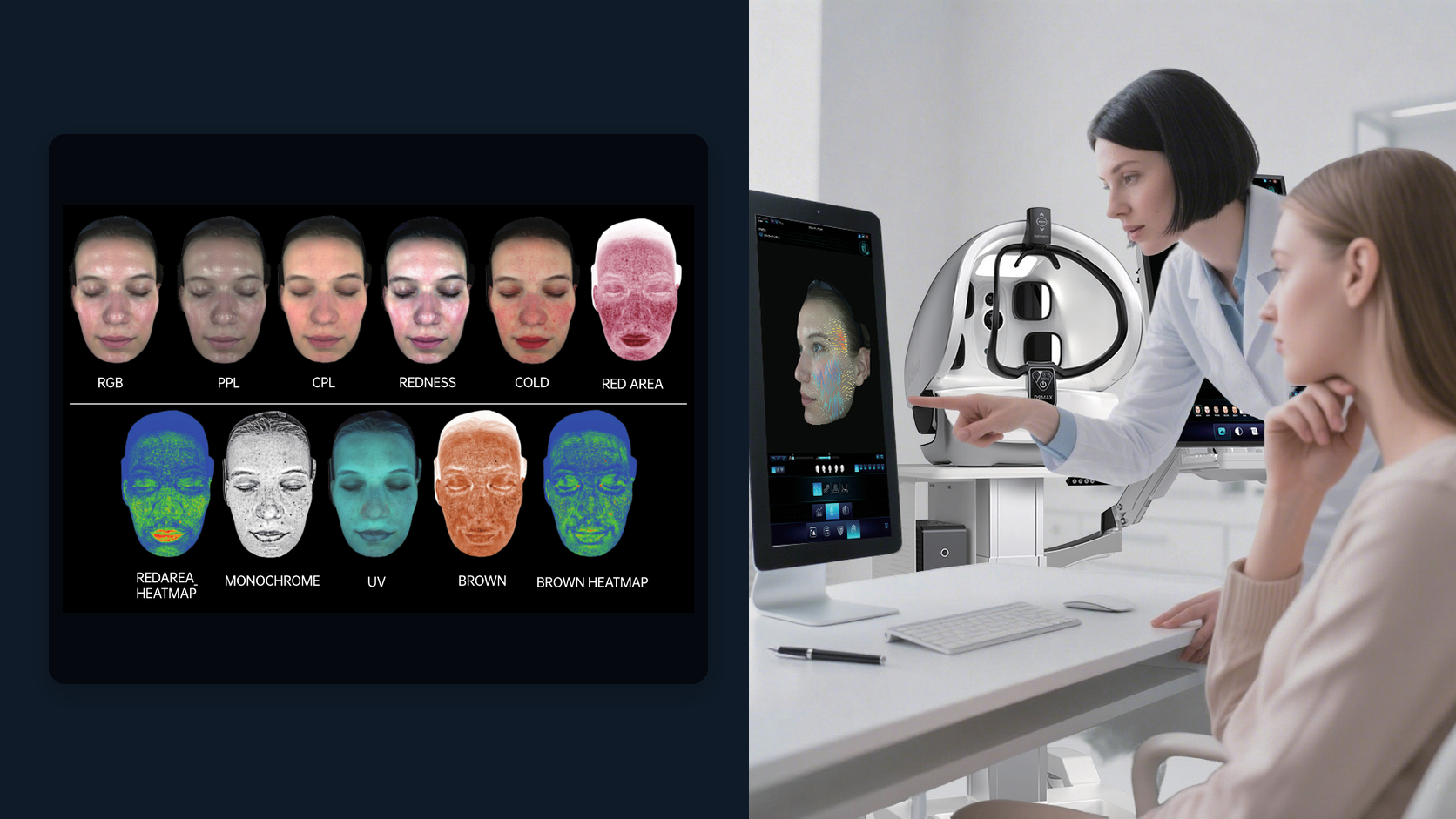
Resolution and depth accuracy are the two imaging specifications that most directly affect clinical or aesthetic utility, and both should be demonstrable rather than merely stated. The ISEMECO 3D D9MAX publishes a 3D resolution of 0.02 mm and a 48 MP camera system, with four spectral capture modes including cross-polarized and UV lighting. These specifications support the device’s claimed ability to visualize fine lines, pigmentation patterns, and surface texture from multiple perspectives.
The comparison question for buyers is not which supplier claims the highest number, but whether the supplier can demonstrate the measurement on a known reference object. A 3D system that reports a groove depth or lesion elevation as a physical measurement, not merely a visual simulation, has crossed a meaningful threshold from visualization to measurement . Suppliers should be asked to perform a live demonstration against a reference standard during the evaluation, not just to provide sample images that may have been selected for favorable conditions.
| Imaging Specification | Why It Matters | Verification Method |
|---|---|---|
| 3D depth accuracy (e.g., 0.02 mm) | Determines whether volume changes can be tracked quantitatively | Live measurement against reference object |
| Spectral modes (RGB, UV, etc.) | Reveals subsurface features not visible in standard light | Demonstration of each mode on same subject |
| Camera resolution (e.g., 48 MP) | Affects ability to examine fine texture and document detail | Sample file inspection at full resolution |
| Calibration documentation | Ensures consistency across units and over time | Review calibration procedure and records |
The Software Integration Question That Separates Suppliers
A face analysis machine that cannot connect to the buyer’s existing workflow will be used less frequently than one that integrates seamlessly. The relevant integration dimensions are: report export formats, compatibility with the clinic’s patient record system or CRM, multi-terminal access for consultation rooms and front desk, and remote viewing capability for follow-up discussions.
The ISEMECO 3D D9MAX supports remote report viewing on iPads and computers, and its connected workflow description emphasizes shared access across multiple terminals for clinic teams to coordinate consultations and review visit histories. For a multi-location clinic chain, the ability to view a patient’s analysis history from any authorized terminal—not just the machine itself—determines whether the device becomes a shared clinical resource or a single-room tool. Buyers comparing suppliers should request a demonstration of the export process and a sample export file, then verify that the file opens in the software the clinic already uses .
Post-Sale Support: What to Request Before Signing
Post-sale support terms are frequently discussed in generalities during sales conversations and then found to be inadequate after installation. The elements that should be documented in the purchase agreement include: warranty duration and coverage scope, response time commitments for technical issues, spare parts availability and lead time, training scope and format, and software update policy. A supplier that offers a multi-year warranty without specifying what constitutes a covered defect, or that promises “training” without defining the number of sessions and whether follow-up training is available, has provided terms that will not resolve disputes when they arise.
For a clinic chain or distributor planning multi-site deployment, the support structure should be scalable. Remote diagnostics capability, whether the supplier can resolve configuration issues without an on-site visit, and whether preventive maintenance is included or optional are questions that affect total cost of ownership. These should be answered with specific terms, not general assurances .
Data Privacy and Compliance: A Non-Negotiable Comparison Item
Facial images are biometric data in most jurisdictions, and the supplier’s data handling practices should be verified before a single scan is captured. For clinical settings in the United States, HIPAA compliance is relevant. For any operation serving European customers, GDPR alignment is required. The practical questions are: Where are images stored? How long are they retained? Can a patient request deletion, and what is the process? Does the supplier have third-party security certification?
These questions are often omitted from supplier comparisons because they do not appear on the specification sheet, but the legal and reputational exposure from a data breach involving facial images is disproportionate to the cost of asking the question during evaluation. A supplier that cannot describe its data storage architecture and deletion process in specific terms has not prioritized this area, and the buyer inherits the risk .
A Supplier Comparison Checklist
- 01. Request the exact-model regulatory documentation for your destination market. Verify certificate numbers independently.
- 02. Request a live imaging demonstration against a reference object, not a gallery of sample images.
- 03. Request a sample export file and test it in your existing software environment.
- 04. Request the warranty and support terms in writing, including response time commitments and training scope.
- 05. Request the data handling policy in writing, covering storage location, retention period, and deletion process.
- 06. Request two references from buyers who have deployed the model in a similar market and use case.
- 07. Conduct a live video walkthrough of the production facility focusing on calibration records and quality control.
FAQ
What is the first thing I should verify when comparing face analysis machine suppliers?
Verify that the exact model being offered has the regulatory documentation required for your destination market. A supplier that cannot provide a specific certificate number for that model—not a general company certification—has not cleared the first qualification gate .
Does a higher camera resolution always mean better analysis?
No. Resolution affects the detail visible in captured images, but analysis quality depends on the algorithms, calibration, and spectral capture capabilities. A device with modest resolution but rigorous calibration and appropriate spectral modes may produce more reliable assessments than a higher-resolution device without those supporting capabilities.
How can I verify that a supplier’s 3D measurement claims are accurate?
Ask the supplier to perform a live measurement against a known reference object during the evaluation. A device that reports a physical depth or volume measurement, not just a visual simulation, has demonstrated the capability .
What software integration questions should I ask?
Ask for a sample export file and test it in your existing software. Ask whether multiple terminals can access reports simultaneously and whether remote viewing is supported. Ask what happens if the clinic’s CRM or patient record system is updated—will the analyzer software remain compatible?
What support terms should be in the contract?
The contract should specify warranty duration and coverage scope, response time for technical issues, spare parts lead time, training format and follow-up availability, and software update policy. Verbal assurances that are not documented will not resolve disputes .
Is data privacy something I need to verify, or is it the supplier’s responsibility?
Both. The supplier is responsible for implementing compliant data handling, but the buyer is responsible for verifying that the supplier’s practices meet the legal requirements of the markets served. Facial images are biometric data, and the buyer shares liability for non-compliance .
How many supplier references should I request?
Request at least two references from buyers who have used the specific model in a similar market and application. Ask about the supplier’s response time when issues arose, not just about product satisfaction. A reference who reports a minor problem that was resolved promptly is more credible than one who reports no problems at all.
Post time: Nov-23-2026


