


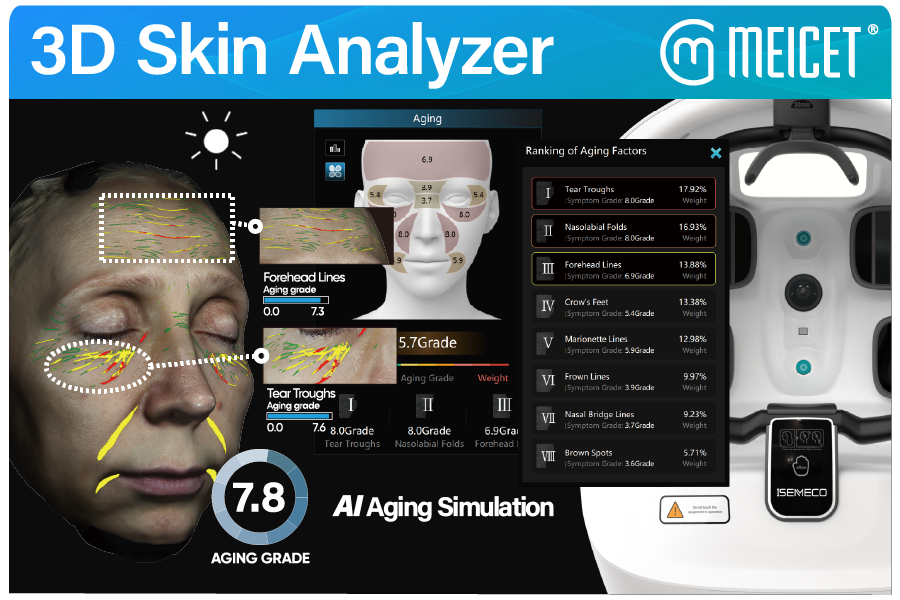
When choosing a professional 3D skin analyzer, buyers should prioritize five verifiable capabilities over marketing claims: true structured-light depth capture with published precision (the ISEMECO D9 reports 0.2mm modeling accuracy), multi-spectral imaging covering RGB, cross-polarized, and UV modes, quantified clinical outputs (volume changes to 0.1ml, structured aging grading across 8 dimensions), workflow software that integrates into consultation practice, and regulatory credentials appropriate to the intended market. The decisive question is not how many features the device lists, but whether each feature produces data a clinician can use and defend. The D9 platform, presented at Cosmoprof Bologna and AMWC, exemplifies the professional tier with 42 million full-face pixels and Fitzpatrick I–VI calibration.
Separates measurement from visualization: the D9 uses binocular grating structured light at 0.2mm accuracy, enabling volume tracking that simulated-depth devices cannot deliver.
Determines clinical depth: four modes (RGB, cross-polarized, parallel-polarized, UV) reveal subsurface vascular patterns and pigmentation depth.
Enable treatment documentation: 0.1ml volume precision and 8-dimension aging grading support objective before/after claims.
Determines daily usability: multi-terminal access, case databases, and branded reports integrate the device into practice operations.
Must match intended use claims: verify CE and FDA documentation covers the specific configuration for your market.
The foundational requirement is depth measurement, not depth visualization. A professional analyzer must reconstruct facial topography with published geometric accuracy.
The ISEMECO D9 uses binocular grating structured light—projecting a known pattern and calculating depth from its deformation across two camera viewpoints. The platform reports 0.2mm modeling accuracy, enabling detection of fine wrinkles and subtle contour changes. This is the technical prerequisite for any volumetric claim: without structured light, a device cannot measure the physical volume of a cheek or the depth of a nasolabial fold.
Verification question: Ask the supplier to demonstrate a measurement on a known reference object. A device that cannot report a physical measurement (e.g., “this groove is 0.8mm deep”) is not performing true 3D measurement.
Surface photography cannot assess conditions beneath the stratum corneum. A professional analyzer must capture multiple spectral modes to reveal vascular patterns, pigmentation depth, and bacterial activity.
The D9 captures four spectral modes: RGB (visible surface), cross-polarized (subsurface vascular and redness), parallel-polarized (surface shine and sebum), and UV (porphyrins and pigmentation depth). MEICET’s materials note that the UV light technology “can reveal hidden skin problems, such as sun damage and bacterial infections, that are invisible to the naked eye”.
Verification question: Request a demonstration of the same patient under each spectral mode. If the supplier can only show RGB, the device cannot assess subsurface conditions.
A professional device must produce numbers a clinician can use, not just visual comparisons. The D9 provides:
- ● Volume difference calculation with 0.1ml precision.
- ● 8-dimension aging grading (forehead lines, crow’s feet, etc.) on a defined scale.
- ● Symptom severity classification (mild/moderate/severe) with quantified area.
- ● Fitzpatrick I–VI skin type calibration to avoid errors across melanin levels.
A device that produces excellent analysis but disrupts workflow will be underused. The D9 provides:
- Multi-terminal access: Simultaneous login from iPads and computers.
- Case database: Organized by symptom and procedure for rapid retrieval.
- Customized reports: Branded documents with images and skincare plans.
- Data Center: For analyzing consultation and visitor information.
MEICET reports holding CE and FDA certifications. The D9 and pro-A systems received EU MDR Class IIb certification, positioning them among AI diagnostic tools compliant with current European medical device standards. Class IIb is the medium-high risk classification for devices whose software informs clinical decisions.
- Request the ISO 13485 certificate naming the manufacturing entity.
- Confirm the CE certificate covers the specific device configuration.
- Verify that the FDA status applies to the intended use claims.
| Feature Category | Specific Requirement | D9 Reported Specification | What to Verify |
|---|---|---|---|
| 3D capture | Structured light with defined precision | Binocular grating, 0.2mm accuracy | Demonstration on reference object |
| Spectral modes | RGB, cross-polarized, UV minimum | 4 modes (RGB, CPL, PPL, UV) | Same patient under each mode |
| Volume measurement | Physical unit precision | 0.1ml precision | Before/after demonstration |
| Aging analysis | Structured, multi-dimensional grading | 8 dimensions, defined grading scale | Report showing grades and weights |
| Skin type calibration | Fitzpatrick I–VI | Explicitly listed | Test on darker-skinned volunteer |
| Workflow software | Multi-terminal, case database | iPad/computer access | Workflow demonstration |
| Regulatory status | Certification for intended market | EU MDR Class IIb, CE, FDA | Certificate verification |
True structured-light 3D capture with defined precision. The D9’s 0.2mm modeling accuracy and 0.1ml volume precision enable clinical-grade measurement. Without structured light, “3D” devices produce visualization but not measurement.
At least three: RGB for surface documentation, cross-polarized for subsurface vascular assessment, and UV for pigmentation depth. The D9 captures all four including parallel-polarized.
Class IIb is the medium-high risk classification under European medical device regulations, applied to devices whose software informs clinical decisions. MEICET’s D9 received Class IIb certification, indicating compliance for AI diagnostic tools.
Multi-terminal access, organized case databases, and branded report generation. The D9 supports simultaneous login from iPads and computers, and archives cases by symptom and procedure.
Yes. The 0.1ml volume precision enables quantification of filler and contour changes. The 8-dimension aging grading allows tracking of specific aging signs over time with objective outcomes documentation.
The D9 includes Fitzpatrick I–VI skin type adjustment to avoid errors across different skin tones. Test on a darker-skinned volunteer during demonstration to confirm the analysis remains plausible.
Three things: repeatability (scan the same person twice), Fitzpatrick calibration (test on a darker-skinned volunteer), and report output (does it contain the specific numbers your clinic needs?).
Post time: Oct-23-2026


