


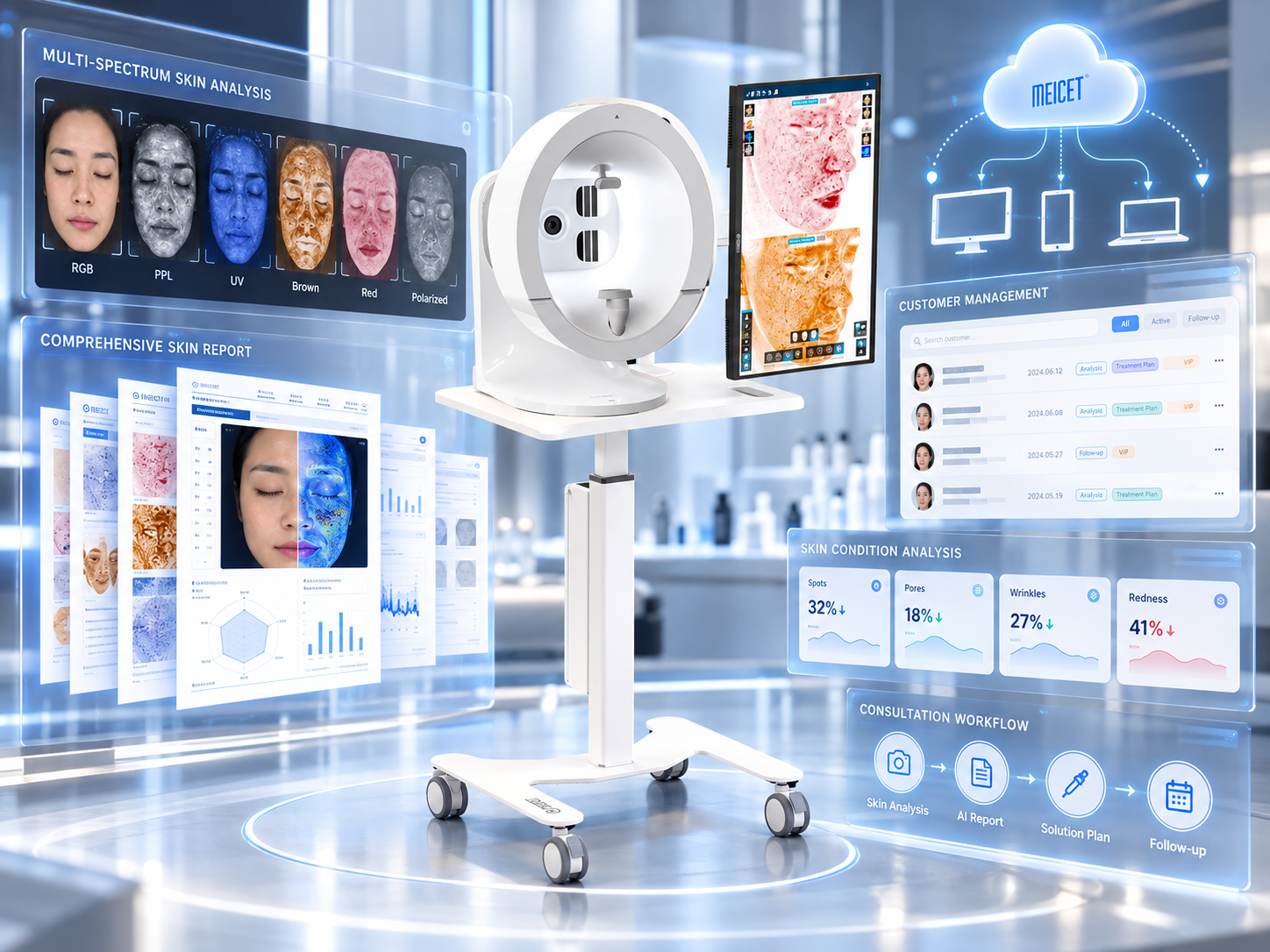
Before upgrading to a new 3D skin analyzer, businesses should evaluate four dimensions that determine whether the upgrade generates measurable clinical or commercial value: whether the current device’s measurement limitations actually constrain the business (surface-only 2D imaging versus volumetric 3D depth), whether the new device’s analytical outputs integrate into the existing treatment workflow, the total cost of ownership across the device’s 5–7 year service life (calibration, software updates, spare parts), and regulatory and data continuity (certification scope, patient data migration, and export capability). MEICET’s product architecture—spanning the clinical ISEMECO 3D D9 platform and the newer 3D MD300—offers a concrete reference point for evaluating whether an upgrade addresses a genuine capability gap or merely replaces a functioning device with a newer model.
Upgrade decisions should be driven by a documented capability gap, not by device age. Clinics using 2D may not need 3D unless offering injectable treatments.
The global 3D skin analysis market was valued at $114 million in 2025, growing at 8.3% CAGR toward $142 million by 2032.
Integration determines ROI. Detailed images without automated reporting add workflow burden rather than reducing it.
A clinic director evaluating a 3D skin analyzer upgrade typically begins with a comparison of specifications: the new device has higher resolution, more spectral modes, or a faster AI report. These are visible differences. The upgrade decision that matters, however, is whether those differences translate into a capability the clinic’s current device cannot deliver and a workflow the clinic’s staff can actually use. The ISEMECO 3D D9, with its 0.2mm structured-light modeling and 0.1ml volume precision, represents the clinical end of MEICET’s lineup; the MD300, launched globally at Cosmoprof Asia 2025, integrates high-precision 3D modeling with multi-spectral analysis. Neither device is an automatic upgrade—each is a tool whose value depends on what the clinic does with it.
The first upgrade question is not “what does the new device offer” but “what clinical or commercial outcome is my current device preventing.” A 2D skin analyzer captures surface pigmentation, pores, texture, and UV damage—capabilities that are sufficient for many consultation workflows. A 3D analyzer adds volumetric measurement: wrinkle depth, facial volume loss, and contour changes that 2D imaging cannot quantify.
The practical distinction appears in treatment categories. A clinic that primarily offers facials, superficial peels, and topical skincare may find a 2D analyzer adequate for its consultation needs. A clinic that offers dermal fillers, botulinum toxin, or energy-based lifting treatments needs volumetric data to demonstrate outcomes—a 0.5ml filler result that is invisible to the naked eye requires 3D measurement to be clinically documented. The D9′s volume difference calculation at 0.1ml precision is designed for this use case.
| Current Device Limitation | Clinical Consequence | Whether 3D Upgrade Addresses It |
|---|---|---|
| Surface-only imaging (2D) | Cannot quantify volume loss or filler outcomes | Yes—3D structured light measures depth |
| Manual report generation | Consultation time burden; inconsistent patient communication | Depends on new device’s AI/report automation |
| Limited spectral modes | Cannot assess sub-surface pigmentation or vascular features | Depends on new device’s spectral configuration |
A 3D skin analyzer’s value is realized in the consultation workflow, not in the specification sheet. The D9′s published workflow feature—”scan-consultation separation”—allows the patient to complete the scan and leave the device while the clinician reviews results on a tablet or computer. This is a workflow design decision that affects patient throughput: the device remains available for the next scan rather than being occupied during the consultation.
The purchase price of a 3D skin analyzer is the entry point to a multi-year cost structure that includes calibration, software updates, spare parts, and training. An upgrade decision that compares only the purchase prices of the old and new devices omits the costs that determine whether the upgrade generates a positive return.
| Cost Category | What the Quote May Omit | Procurement Action |
|---|---|---|
| Calibration | Interval, cost, turnaround, loaner availability | Request written calibration service terms |
| Software | Update frequency, AI updates included? | Confirm update policy in purchase agreement |
An upgrade that replaces a certified device with an uncertified one transfers regulatory risk to the clinic. The D9 and Pro A platforms are described in MEICET’s exhibition materials as holding CE and FDA certifications, with the D9 and Pro A receiving Class IIb certification under EU MDR.
| Evaluation Area | Acceptable Evidence | Red Flag |
|---|---|---|
| Capability gap | Documented use case | “Newer is better” claim |
| Data continuity | Written import specification | No import pathway |
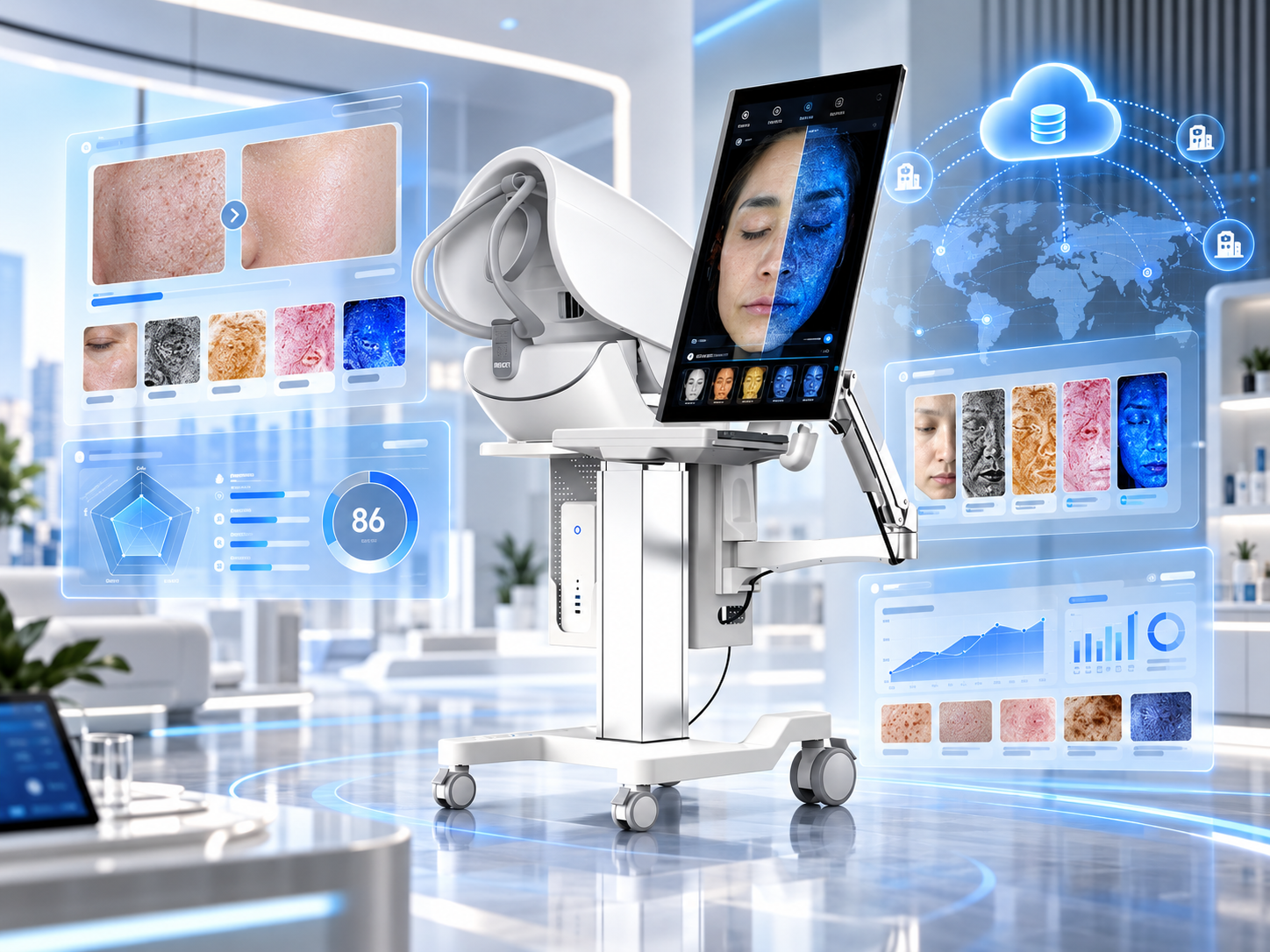
The upgrade is justified if the clinic offers treatments that produce volume changes—dermal fillers, fat grafting, or energy-based lifting—and needs to quantify those changes for treatment planning or patient communication.
The D9 is positioned for clinical problem-skin management with depth analysis on microcirculation. The MD300 integrates high-precision 3D modeling with multi-spectral analysis as a flagship platform.
This depends on the data export capability of the current device and the import capability of the new device. Procurement should include a data migration test.
No. Certification is model-specific and site-specific. Verify that the specific model holds the required certifications (e.g., EU MDR Class IIb).
Include calibration, software updates, spare parts, and training. A 5-year total cost of ownership is more diagnostic than purchase price.
Ask the supplier to demonstrate AI analysis on a patient image. Check if it matches your treatment menu and clinical vocabulary.
The biggest risk is replacing a device staff understand with one that requires workflow changes and training that hasn’t been planned for.
Post time: Nov-04-2026


