


 Quick Answer
Before placing an order for a 3D skin analyzer, buyers should ask questions across five verification domains: 3D capture technology and precision (the ISEMECO D9 uses binocular grating structured light with reported modeling accuracy ranging from 0.2mm to 0.02mm depending on model ), regulatory and quality system credentials (ISO 13485 scope, CE/FDA status for the specific configuration), software validation and data governance (algorithm training data, update policy, cybersecurity), quantified output specifications (volume precision, aging grading scales), and after-sales infrastructure (spare parts, training, response times). The decisive question is not “what features does it have?” but “can you demonstrate this capability on a reference object and provide documentation I can verify independently?” A supplier confident in its product will welcome this scrutiny; one that deflects it has revealed a risk before purchase.
Key Takeaways
Ask for a live measurement demonstration: request a scan of a known reference object to verify the claimed 0.2mm or 0.02mm modeling accuracy is real, not theoretical .
Verify ISO 13485 certificate names the manufacturing entity: a certificate for a trading company or parent entity does not qualify the factory producing your device .
Request the CE/FDA documentation for the specific configuration: a generic certificate may not cover the private-label or regional variant you are purchasing.
Ask about software update and cybersecurity governance: FDA guidance emphasizes that connected medical devices require documented cybersecurity controls and lifecycle management .
Demand contactable references from comparable markets: testimonials are marketing; references who can speak to year-two support quality are evidence.
Category 1: 3D Capture Technology and Precision
The foundational question determines whether the device performs true measurement or simulated visualization.
“What is the exact 3D capture method, and can you demonstrate a measurement on a reference object?”
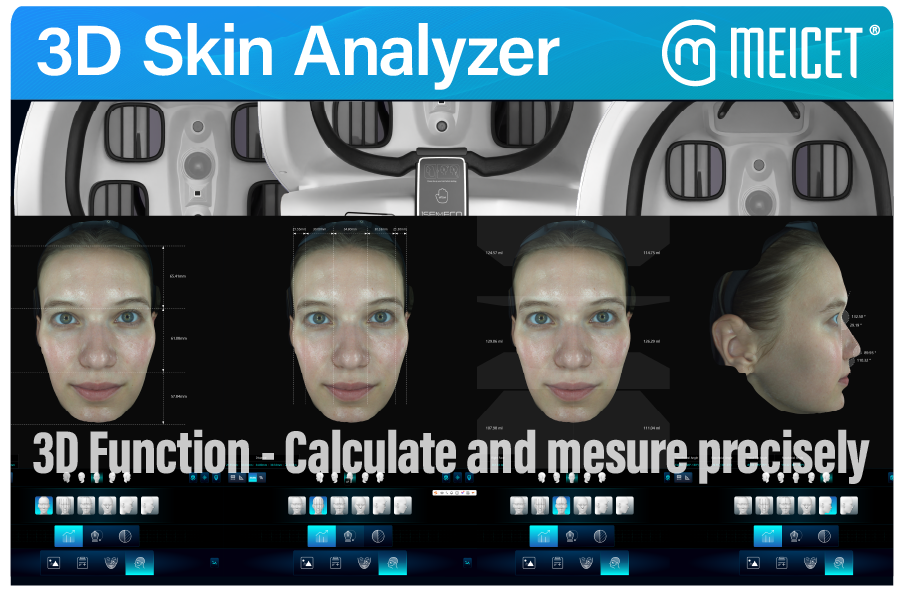
The ISEMECO D9 uses binocular grating structured light—projecting a known pattern and calculating depth from its deformation across two camera viewpoints . The standard D9 reports 0.2mm modeling accuracy with 42 million full-face pixels, while the D9 MAX reports 0.02mm precision and 48 million pixels . These are geometric specifications, not clinical validation claims. A demonstration on a reference object (a calibration block, a coin, a machined groove) reveals whether the claimed precision is operational.
Follow-up: “Does the device use stereo vision or software-simulated depth?” If the answer is yes, the device cannot perform volumetric measurement. The D9’s volume difference calculation reports changes with 0.1ml precision , a capability that requires true structured-light depth data.
Category 2: Regulatory and Quality System Credentials
A 3D skin analyzer used in clinical or aesthetic practice inherits regulatory obligations. The supplier’s quality system must support the buyer’s market access.
“Can you provide an ISO 13485 certificate that names the specific manufacturing entity?”
ISO 13485:2016 specifies quality management system requirements for medical device organizations, covering design, development, production, and servicing . The certificate must correspond to the actual factory producing the device, not a sales office or holding company. Singapore’s HSA guidance explicitly requires manufacturers of Class B–D devices to hold ISO 13485 certification from an accredited body .
“What is the CE and FDA status for the specific configuration I am purchasing?”
MEICET reports holding CE and FDA certifications for its products. For buyers in regulated markets, the critical verification is whether the certificate covers the specific model and intended use claims you plan to make. A CE certificate for a cosmetic assessment device may not cover diagnostic claims.
Category 3: Software Validation and Data Governance
Software determines whether captured data becomes defensible clinical information—or an opaque score.
“What is the training dataset composition, and can you provide performance data disaggregated by Fitzpatrick skin type?”
The D9 includes Fitzpatrick I–VI adjustment to avoid errors across skin tones . The critical question is whether this adjustment is automatic (algorithm detects skin type) or manual (operator selects), and whether the manufacturer has performance data demonstrating consistent accuracy across types. A device that performs well on lighter skin but has never been validated on darker skin represents a clinical and commercial risk.
“What is your software update policy, and how do you handle cybersecurity?”
FDA guidance on cybersecurity in medical devices emphasizes that connected devices require documented controls, vulnerability management, and premarket submission of cybersecurity information . For a device that stores patient images and may connect to clinic networks, ask:
How are software updates validated before release?
Can updates be rolled back if performance degrades?
What data encryption and access controls are implemented?
Category 4: Quantified Output Specifications
A professional device must produce numbers a clinician can use, not just visual comparisons.
“What is the precision of your volume measurement, and how is it calculated?”
The D9 reports 0.1ml volume difference precision . Ask the supplier to explain the calculation method and demonstrate it on a before/after pair. A vague answer (“the software calculates it automatically”) is insufficient.
“What is the aging grading scale, and what does each grade mean?”
The D9’s 8-dimension aging model covers forehead lines, glabellar lines, crow’s feet, periorbital lines, laugh lines, marionette lines, corner of mouth lines, and brown spots, with grades assigned on a defined scale . Ask for the reference population used to establish the grades—an aging model built primarily on one demographic may not generalize to your patient population.
Category 5: After-Sales Infrastructure and Reference Verification
The device’s useful life depends on support quality in year two and beyond.
“What is your documented response time for technical issues, and where are spare parts stocked?”
A supplier that cannot define response times in hours (rather than “as soon as possible”) has not institutionalized after-sales service. Ask specifically about UV light module and optical sensor availability—these are the components most likely to require replacement and the most expensive to source from the factory.
“Can you provide three contactable references from customers who have used the device for at least 12 months?”
Ask the references:
How quickly did the supplier respond to your most recent issue?
Have software updates ever degraded performance?
Would you purchase from this supplier again?
Table: Pre-Order Question Checklist
Verification Area Critical Question What a Good Answer Looks Like Red Flag
3D capture What is the capture method? Can you demonstrate on a reference object? Structured light; live measurement demo “It’s 3D” without method detail
Precision What is the modeling accuracy? 0.2mm (D9) or 0.02mm (D9 MAX) Unspecified or “high precision”
Quality system Does your ISO 13485 certificate name the manufacturing site? Certificate entity matches factory Certificate for trading company
Regulatory Does CE/FDA cover this configuration? Specific model and claims covered “We have CE” without scope
Algorithm fairness Do you have performance data by Fitzpatrick type? Disaggregated data available “Works on all skin types” without data
Software governance How are updates validated and rolled back? Documented change control “Updates are automatic”
Volume precision How is volume calculated, and what is the precision? 0.1ml, method explained Vague or unavailable
After-sales What is your response time SLA? Defined in hours “We respond quickly”
FAQ
What is the most important question to ask a 3D skin analyzer supplier?
“Can you demonstrate a measurement on a reference object?” This single request separates devices that perform true structured-light measurement from those that simulate depth. The ISEMECO D9’s 0.2mm modeling accuracy and 0.1ml volume precision are verifiable claims—a supplier confident in them will welcome the demonstration .
How do I verify the claimed 3D precision is real?
Ask for a live demonstration on a known object (a calibration block, a coin, a machined groove). A device that reports “this groove is 0.8mm deep” when the actual depth is 0.8mm has demonstrated measurement capability. A device that produces only visual comparisons has not.
What regulatory documents should I request?
Request the ISO 13485 certificate naming the manufacturing entity (not a trading affiliate), the CE certificate for the specific configuration, and any FDA clearance documentation if diagnostic claims are planned. Verify that the intended use statement matches your clinical workflow .
How do I evaluate the AI’s fairness across skin tones?
Ask for performance data disaggregated by Fitzpatrick type (I–II, III–IV, V–VI). The D9 includes Fitzpatrick I–VI adjustment , but the critical verification is whether this adjustment is automatic and whether the manufacturer has data demonstrating consistent accuracy. Test on a darker-skinned volunteer during demonstration.
What software governance questions should I ask?
Ask: How are algorithm updates validated before release? Can updates be rolled back? What cybersecurity controls are implemented? FDA guidance emphasizes that connected medical devices require documented cybersecurity and lifecycle management . A supplier without documented software governance cannot credibly support the device over a multi-year partnership.
What after-sales commitments should be in writing?
Response time in hours, spare parts availability for 5–7 years, training scope (operation and clinical interpretation), and software update policy (included or separately priced). A supplier that resists written commitments is signaling that after-sales is not a managed process.
What should I ask reference customers?
Ask about response times to actual issues, whether software updates ever degraded performance, and whether they would purchase again. References who can speak to year-two support quality are evidence; testimonials on a website are marketing.
Post time: Oct-23-2026


