


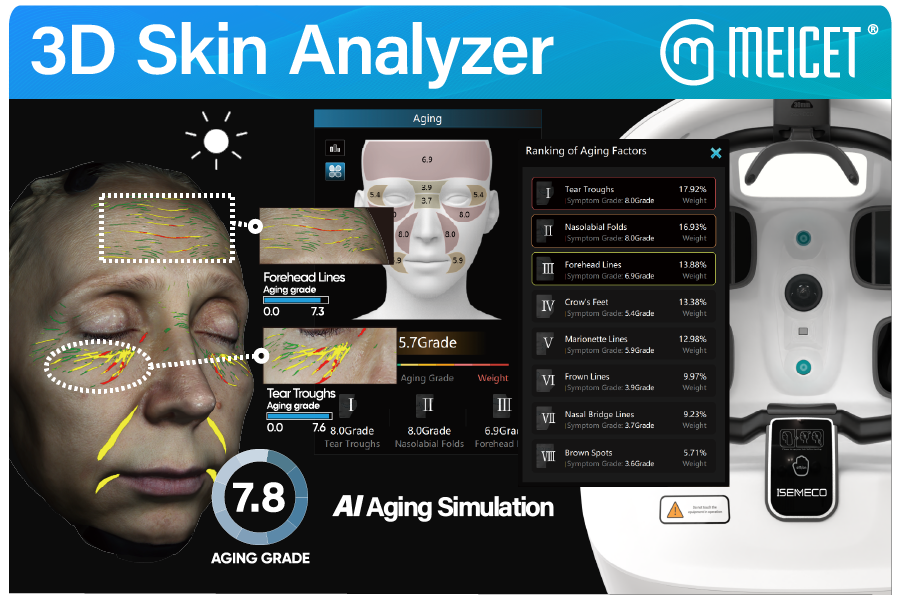
The gap between entry-level and professional 3D skin analyzers is defined by four measurable capabilities: 3D modeling precision (entry-level often lacks true structured-light depth capture, while professional systems achieve 0.2mm accuracy), spectral modality count (entry-level may offer 1–2 modes, professional systems deliver 4+ modes including UV and cross-polarized), quantified clinical outputs (professional systems report volume changes to 0.1ml precision, while entry-level devices provide qualitative scores), and software ecosystem depth (multi-terminal access, case databases, and CRM integration). The ISEMECO D9 MAX exemplifies the professional tier with 48 million pixels, 0.02mm modeling precision, 30-second AI analysis, and 8-dimension aging grading. Entry-level 3D devices typically cost a fraction of professional systems but often deliver “3D-like” visualization rather than true depth measurement.
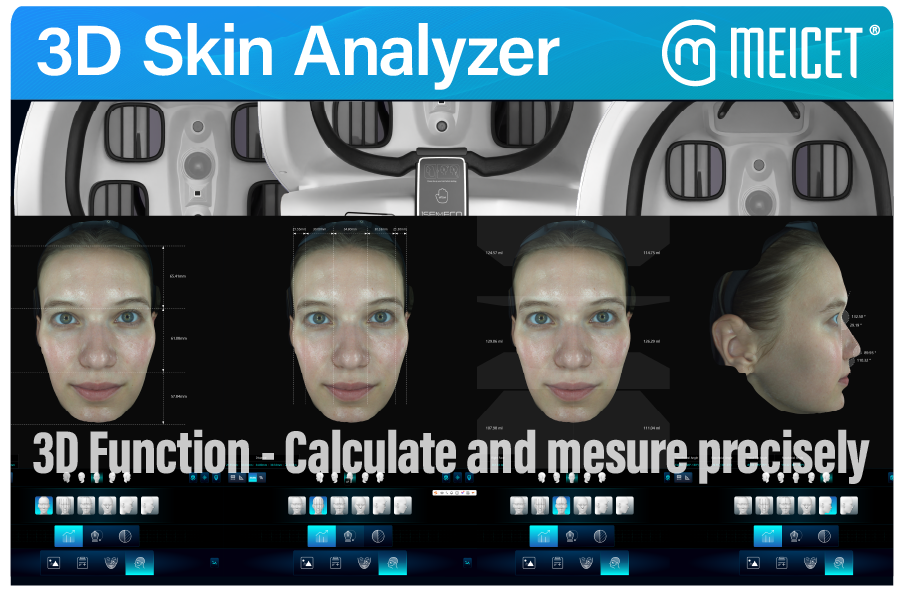
Professional systems use binocular grating structured light to reconstruct depth; entry-level “3D” devices may only simulate depth from 2D images.
The D9 MAX achieves 0.02mm precision with 48 million pixels, enabling detection of fine wrinkles and subtle contour changes.
Professional systems capture RGB, cross-polarized, parallel-polarized, and UV images, revealing subsurface vascular patterns and pigmentation depth.
Professional systems report volume changes to 0.1ml and aging grades (0–8 scale); entry-level devices often provide only visual comparisons.
The Core Technical Divide: True Structured Light vs. Simulated Depth
The most fundamental difference between entry-level and professional 3D skin analyzers is how depth is captured.
A professional 3D analyzer like the ISEMECO D9 uses binocular grating structured light—a technique that projects a known pattern onto the face and captures its deformation from two viewpoints. The D9 MAX reports 0.02mm modeling precision with this approach, enabling true geometric reconstruction of facial topography.
An entry-level device marketed as “3D” may use one of several compromises:
- Stereo vision from two RGB cameras: Depth is estimated from parallax, but accuracy degrades on smooth surfaces where texture is uniform.
- Software-simulated 3D from a single 2D image: The device captures a flat photograph and generates a “3D-like” rendering. This is visualization, not measurement.
- Reduced structured-light resolution: A lower-density grating pattern produces coarser depth data, insufficient for detecting subtle wrinkles.
For a clinic performing filler treatments, the difference is consequential: a professional system can report that a cheek gained 0.8ml of volume after treatment; an entry-level device can only show a side-by-side photograph.
Precision and Resolution: What the Numbers Mean
Professional 3D systems publish specifications that entry-level devices often omit or describe vaguely. The ISEMECO D9 MAX’s published parameters illustrate the professional tier:
| Specification | D9 MAX (Professional) | Typical Entry-Level 3D Device |
|---|---|---|
| 3D modeling precision | 0.02mm | Often unspecified or “3D visualization” |
| Full-face pixels | 48 million | 8–20 million (often interpolated) |
| Structured light | Binocular grating | Stereo vision or simulated depth |
| Spectral modes | 4 (RGB, CPL, PPL, UV) | 1–2 (RGB, possibly one polarized) |
| Volume precision | 0.1ml | Not reported |
The 0.02mm precision specification matters because it describes the smallest geometric change the system can reliably detect. A wrinkle that is 0.05mm deep may be invisible to a device with 0.2mm precision but detectable by a 0.02mm system.
Spectral Capability: What Each Mode Reveals
Professional 3D analyzers capture images under multiple spectral conditions, each interrogating different tissue depths.
- RGB (visible light): Captures surface color and texture—useful for documentation.
- Cross-polarized light: Filters surface glare and reveals subsurface vascular patterns, redness, and inflammation.
- Parallel-polarized light: Preserves surface reflections, useful for assessing sebum distribution and surface shine.
- UV light: Excites porphyrins and highlights pigmentation depth—sun damage beneath the surface.
Software Outputs: From Scores to Quantified Measurements
Professional Tier
Quantified, Structured, Trackable:
- Volume difference calculation (0.1ml precision)
- Aging grades (0–8 scale) for 8 dimensions
- Symptom severity classification (Mild/Moderate/Severe)
- Aging trajectory prediction (18 to 80 years)
Entry-Level Tier
Visual Comparison and Basic Scoring:
- Side-by-side or overlay photographs
- Simple scores without defined physical units
- Basic skin type categorization
- Insufficient for clinical outcomes documentation
Software Ecosystem: Multi-Terminal, Case Database, CRM
Professional systems include infrastructure features that entry-level devices omit. The D9 MAX provides:
- Multi-terminal access: Simultaneous login from iPads and computers.
- Case database: Organized by symptom and procedure for rapid retrieval.
- Customized report generation: Incorporating patient images and skincare plans.
- DATA CENTER: For analyzing consultation and visitor information.
Table: Entry-Level vs. Professional 3D Skin Analyzer Comparison
| Capability | Entry-Level 3D | Professional 3D (D9 MAX) | Clinical Relevance |
|---|---|---|---|
| Depth capture | Stereo/Simulated | Binocular Structured Light | Measurement vs. Estimation |
| Modeling precision | Unspecified | 0.02mm | Detecting fine texture changes |
| Spectral modes | 1–2 modes | 4 modes (11 images) | Subsurface assessment |
| Volume tracking | Not available | 0.1ml precision | Filler/Contour monitoring |
What is the most important difference between entry-level and professional 3D skin analyzers?
The depth capture method. Professional systems use binocular grating structured light to measure facial topography with 0.02mm precision. Entry-level devices often use stereo vision or simulated 3D.
Can an entry-level 3D device measure volume changes?
Generally no. Volume measurement requires calibrated 3D reconstruction. The D9 MAX reports 0.1ml precision; entry-level devices typically do not report volume at all.
How many spectral modes does a professional 3D skin analyzer need?
At least four: RGB, cross-polarized, parallel-polarized, and UV. The D9 MAX captures all four and generates 11 derived images.
What does “0.02mm modeling precision” mean in practice?
It means the 3D reconstruction is accurate to approximately one-fifth the thickness of a human hair, enabling detection of fine wrinkle depth changes.
Is the price difference justified?
For treatment planning, outcomes documentation, and clinical decision-making, the professional tier’s quantified outputs are necessary. The price reflects hardware and algorithm investment.
Post time: Oct-23-2026


