


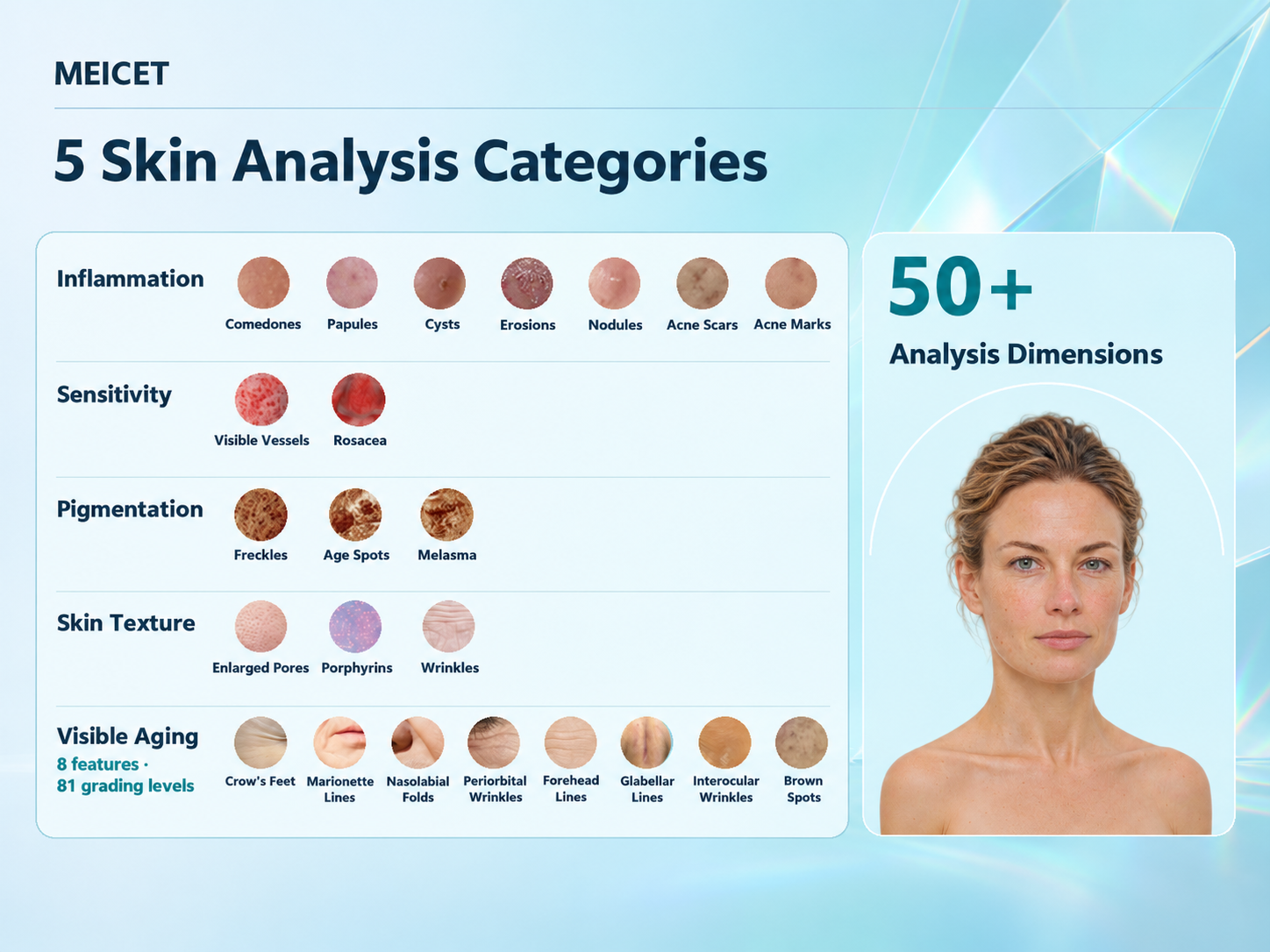
Quick Answer: A skin analyzer and a face analysis machine overlap in function but differ in scope and depth. A skin analyzer typically focuses on surface and subsurface skin conditions—pigmentation, hydration, pores, texture, and wrinkles—using multi-spectral imaging. A face analysis machine adds a third dimension: it reconstructs the face as a measurable 3D surface, quantifying volume, contour, asymmetry, and structural proportions alongside skin features. In practice, the boundary is blurring: professional systems like the ISEMECO 3D D9MAX combine both capabilities, performing comprehensive skin assessment and 3D facial morphology analysis in a single device. The distinction matters most when evaluating specifications and matching equipment to clinical needs.
Key Takeaways
Scope Difference: Skin analyzers prioritize cutaneous parameters (pigment, pores, texture); face analysis machines add structural parameters (volume, contour, asymmetry, proportions).
Technology Marker: True 3D reconstruction (measured in millimeters, e.g., 0.02 mm resolution) is the defining capability that separates a face analysis machine from a conventional skin analyzer.
Market Convergence: The global skin analysis systems market now segments 3D skin imaging as a distinct technology category alongside AI-based and multi-spectral systems, reflecting the growing demand for structural assessment .
Procurement Implication: Clinics offering injectables or structural treatments need 3D measurement capabilities; skin-care-focused practices may find a multi-spectral skin analyzer sufficient.
What Does a Skin Analyzer Measure?
A skin analyzer measures cutaneous parameters: pigmentation, vascularity, texture, pores, wrinkles, hydration, and sebum. The device captures images under controlled lighting—typically RGB, UV, and polarized light—and applies algorithms to detect and grade surface and subsurface conditions.
The core measurement domains of a professional skin analyzer include:
Pigmentation: Melanin distribution, sun damage, and post-inflammatory hyperpigmentation, differentiated by depth where multi-spectral imaging allows.
Vascular features: Redness, inflammation, and microcirculation patterns visible under cross-polarized light.
Texture and topography: Pore size and density, skin roughness, and fine lines, assessed through high-resolution surface imaging.
Hydration and sebum: Often measured via separate probes or inferred from spectral reflectance patterns, depending on the system.
Research on multi-spectral facial analysis systems confirms that these platforms generate quantitative data on pigmentation, vascularization, hydration, texture, porosity, and wrinkles, replacing subjective visual inspection with reproducible metrics . A well-equipped skin analyzer produces structured reports that support treatment planning and longitudinal tracking.
The limitation of a conventional skin analyzer is that it treats the face as a two-dimensional canvas. It can detect that a wrinkle exists and grade its severity, but it cannot measure the wrinkle’s depth in millimeters. It can observe that facial contours appear asymmetrical, but it cannot quantify the difference in cubic volume between the left and right midface.
What Does a Face Analysis Machine Add?
A face analysis machine adds three-dimensional structural measurement to the skin assessment foundation. The critical addition is depth: the system reconstructs the face as a point cloud and surface model, enabling measurements that 2D imaging cannot provide.
The structural parameters a face analysis machine quantifies include:
Wrinkle depth: Measured in millimeters rather than graded on a visual scale. A wrinkle that appears “moderate” in a photograph may measure 0.4 mm or 1.1 mm in depth—a difference that changes treatment selection between superficial resurfacing and volume restoration.
Facial volume: Quantified differences in cheek, temple, and jawline volume, often expressed in milliliters or cubic millimeters. High-end systems achieve volume difference precision of 0.1 mL, supporting filler planning and outcome verification.
Contour and proportion: Facial angles, distances, and symmetry ratios measured in three dimensions, supporting structural treatment planning for injectables and energy-based devices.
Lifting vectors: Some systems visualize and measure lifting effects from thread lifts or energy treatments, providing objective documentation of structural change .
The ISEMECO 3D D9MAX exemplifies this category. Its 0.02 mm 3D resolution and dense point cloud capture reconstruct facial surface details at a level sufficient to detect fine textural changes and measure structural features. The system explicitly separates its 3D facial aesthetic analysis module—covering proportions, angles, contours, and volume simulations—from its comprehensive 3D skin assessment module.
Table 1: Skin Analyzer vs. Face Analysis Machine — Capability Comparison
Capability Conventional Skin Analyzer Face Analysis Machine (3D)
Pigmentation depth Yes (multi-spectral) Yes (multi-spectral + 3D overlay)
Vascular redness Yes Yes
Pore density Yes Yes
Wrinkle presence/grade Yes Yes
Wrinkle depth (mm) No Yes (0.02 mm resolution)
Facial volume (mL) No Yes (0.1 mL precision on high-end systems)
Contour angles/proportions No Yes
Asymmetry quantification Limited Yes
Treatment simulation (volume) No Yes
Why Does the Distinction Matter for Clinic Buyers?
The distinction matters because the two device categories serve different clinical workflows and treatment mixes. A clinic purchasing equipment must match capabilities to the services it actually delivers.
A skin-care-focused practice—one offering facials, chemical peels, topical regimens, and light-based rejuvenation—derives value primarily from surface and subsurface skin analysis. The ability to show a patient their UV damage, pore density, and hydration levels supports product recommendations and treatment planning within that service mix. A high-quality multi-spectral skin analyzer meets these needs without the cost and complexity of 3D structural measurement.
A clinic offering injectables, thread lifts, energy-based tightening, or surgical planning requires structural data. The ability to measure midface volume loss, quantify nasolabial fold depth, and document lifting vectors directly supports treatment selection, dosing decisions, and outcome verification. A skin analyzer that grades wrinkles as “moderate” provides insufficient data for these decisions; a face analysis machine that measures the fold at 1.2 mm depth provides actionable information.
The market reflects this segmentation. Industry reports now distinguish 3D skin imaging systems from optical imaging and AI-based skin analysis systems as separate technology categories, indicating that buyers and vendors recognize structural assessment as a distinct capability set . The broader aesthetic devices market, valued at approximately $16.2 billion in 2024 and projected to reach $31.85 billion by 2033, is driven partly by demand for technologies that support personalized, evidence-based treatment planning .
Where Do the Categories Overlap or Converge?
The categories converge in professional-grade systems that integrate multi-spectral skin analysis with 3D structural modeling. The distinction described above reflects entry-level and mid-range product positioning; at the high end, the two capabilities coexist in a single device.
The ISEMECO 3D D9MAX is representative of this convergence. Its specifications include:
Four-spectrum imaging (RGB, cross-polarized, UV, parallel-polarized) generating 16 analysis views for skin assessment.
48 MP full-face imaging with a 1-inch CMOS sensor for high-resolution surface capture.
0.02 mm 3D resolution with dense point cloud reconstruction for structural measurement.
AI-assisted aging assessment with regional wrinkle grading and illustrative aging simulations.
A buyer evaluating the D9MAX is not choosing between a “skin analyzer” and a “face analysis machine.” The buyer is evaluating whether the integrated system’s skin analysis depth and 3D measurement precision meet the clinic’s requirements. The relevant comparison is against other integrated systems and against single-capability devices at lower price points.
Clinical validation research supports the value of integrated systems. A 2026 study on AI-assisted multi-spectral facial analysis found that the technology enhanced patient understanding of skin conditions through objective visualization, improved diagnostic confidence, and increased patient willingness to initiate treatment . The study’s authors note that systems generating structured photographic documentation, comparative maps, and quantitative reports strengthen both clinical records and patient communication—benefits that apply whether the system is marketed as a skin analyzer or a face analysis machine.
How Should Buyers Evaluate Specifications Across Categories?
Buyers should evaluate specifications by asking what the device measures, at what precision, and whether those measurements support the clinic’s treatment decisions. Marketing terminology (“analyzer” vs. “machine”) is less informative than concrete capability data.
Questions That Reveal the Real Category
“Does the system produce 3D point cloud data, and at what resolution?”
A system that generates 3D visualizations from 2D images is not a true 3D face analysis machine. Demand a resolution specification in millimeters. The D9MAX’s 0.02 mm is a verifiable 3D capability claim.
“Can the system measure wrinkle depth, or only grade wrinkle severity?”
Grading (mild/moderate/severe) is a skin analyzer function. Depth measurement in millimeters is a face analysis machine function. Both are useful; they serve different clinical purposes.
“Does the system quantify facial volume, and with what precision?”
Volume measurement enables filler planning and outcome documentation. A system that displays volume changes visually without numerical precision is limited to qualitative communication.
“How many spectral modes does the system use, and which ones?”
Four modes (RGB, cross-polarized, parallel-polarized, UV) represent the professional baseline. Systems with fewer modes cannot assess subsurface vascular and pigment features reliably.
“Does the report separate skin findings from structural findings?”
An integrated system should present cutaneous assessment and structural measurement as distinct but connected modules, allowing the practitioner to address both dimensions in treatment planning.
Matching Device Type to Clinic Profile
Table 2: Clinic Profile and Recommended Device Capability
Clinic Service Mix Recommended Capability Rationale
Facials, peels, topical skincare Multi-spectral skin analyzer (2D) Surface/subsurface skin data supports product and peel selection
Light-based rejuvenation (IPL, lasers) Multi-spectral skin analyzer with depth differentiation Pigmentation depth guides wavelength and parameter selection
Injectables (filler, toxin) Face analysis machine with 3D volume and depth measurement Structural data supports dosing, placement, and outcome documentation
Energy-based tightening (RF, ultrasound) Face analysis machine with contour and vector measurement Structural change documentation validates treatment effect
Combined aesthetic practice Integrated system (skin + 3D) Single device supports full consultation workflow
Frequently Asked Questions
Is a face analysis machine just a skin analyzer with a 3D camera?
Not quite. A 3D camera alone does not make a face analysis machine. The defining capability is the software’s ability to reconstruct a measurable 3D surface—point cloud density, resolution specifications, and volume calculation algorithms all determine whether the system produces clinically useful structural data. A skin analyzer with a depth sensor but no volume measurement or contour analysis software remains a skin analyzer.
Can a skin analyzer measure facial volume?
Conventional 2D skin analyzers cannot measure facial volume. They may visualize shadow patterns that suggest volume loss, but they cannot quantify volume differences in milliliters or cubic millimeters. Volume measurement requires 3D reconstruction and comparison algorithms.
Do I need a 3D face analysis machine if I only offer skincare treatments?
Not necessarily. If your treatment menu consists of facials, chemical peels, and topical regimens, a high-quality multi-spectral skin analyzer provides the data you need: pigmentation depth, hydration, pore density, and texture. The 3D structural measurement capabilities of a face analysis machine add value primarily when structural interventions are part of the treatment plan.
What is the practical difference between a wrinkle grade and a wrinkle depth measurement?
A wrinkle grade (e.g., “moderate”) is a categorical assessment based on visual criteria. A wrinkle depth measurement (e.g., “0.8 mm”) is a quantitative value. Grades support general treatment planning and patient communication. Depth measurements support precise intervention selection—distinguishing between a wrinkle that may respond to resurfacing versus one that requires volume restoration—and enable objective tracking of treatment response.
Are integrated skin + 3D systems more expensive than single-capability devices?
Integrated systems typically carry higher capital costs than single-capability skin analyzers, reflecting the added hardware (structured light projectors, higher-resolution sensors) and software complexity. The ROI calculation depends on consultation volume and treatment mix. A clinic performing frequent injectable consultations may justify the cost through improved treatment planning and documentation; a skincare-focused practice may achieve sufficient ROI with a lower-cost skin analyzer.
How do I verify that a system’s 3D measurements are accurate?
Request a live demonstration using a known reference object or a volunteer with a measurable feature (e.g., a known asymmetric contour or a standardized test surface). Ask the vendor to demonstrate repeatability: scan the same subject twice and compare the measured values. A system that produces inconsistent measurements between scans has limited clinical utility for tracking changes over time.
Does a face analysis machine replace the practitioner’s clinical judgment?
No. A face analysis machine provides data; the practitioner provides interpretation and clinical judgment. The system detects and quantifies features, but treatment decisions require consideration of patient history, skin type, anatomic variations, and treatment goals. The device is a decision-support tool, not a diagnostic authority, and it does not diagnose skin disease.
Post time: Nov-17-2026


