


Quick Answer
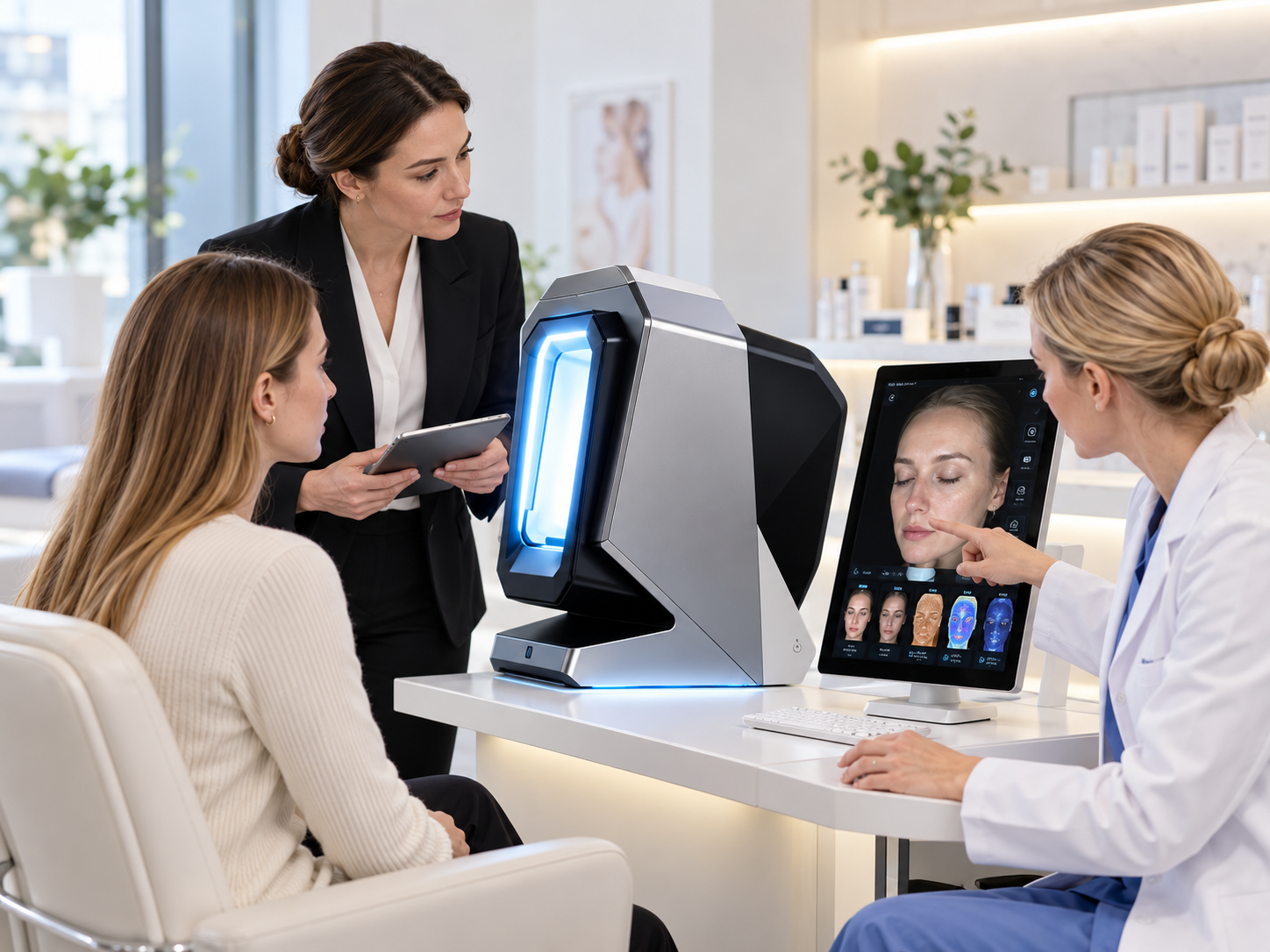
3D skin imaging and AI skin analysis are two distinct technologies that answer different questions. 3D skin imaging captures the physical topography of the face—depth, volume, and contour—using structured light to reconstruct geometry with measurable precision, such as the ISEMECO D9′s 0.2mm modeling accuracy and 0.1ml volume precision. AI skin analysis interprets the captured data—whether 2D or 3D—to classify conditions, grade severity, and predict outcomes, using trained algorithms to identify wrinkles, pigmentation, and vascular patterns. The critical distinction: 3D imaging is the measurement instrument; AI is the interpretation engine. A device can have excellent 3D imaging without useful AI, or sophisticated AI operating on insufficient 2D data. Professional systems like the D9 integrate both, but buyers should evaluate each capability independently rather than accepting “3D AI” as a single claim.
Key Takeaways
3D imaging measures geometry; AI classifies conditions: the D9′s structured light captures 0.2mm-accurate topography, while its AI assigns 8-dimension aging grades based on that data .
3D data enables volume tracking that 2D AI cannot deliver: 0.1ml precision for filler outcomes requires true depth measurement, not algorithmic estimation.
AI without adequate imaging data is limited: a 2D-CNN in a real-world melanoma study achieved 70% sensitivity and 40% specificity, while a 3D-CNN reached 90% sensitivity and 64.6% specificity .
The D9 integrates both layers: multispectral 3D capture feeds an AI skin large model that prioritizes the top 3 issues and links findings to treatment menus .
Buyers should ask two separate questions: “What is the 3D modeling accuracy?” and “What is the AI’s training data and validation?”
The Fundamental Distinction: Measurement vs. Interpretation
A 3D skin imaging system is a geometric instrument. It projects a known pattern (the D9 uses binocular grating structured light) onto the face and calculates depth from the pattern’s deformation. The output is a point cloud or mesh representing facial topography with a stated precision—0.2mm for the standard D9, 0.02mm for the D9 MAX .
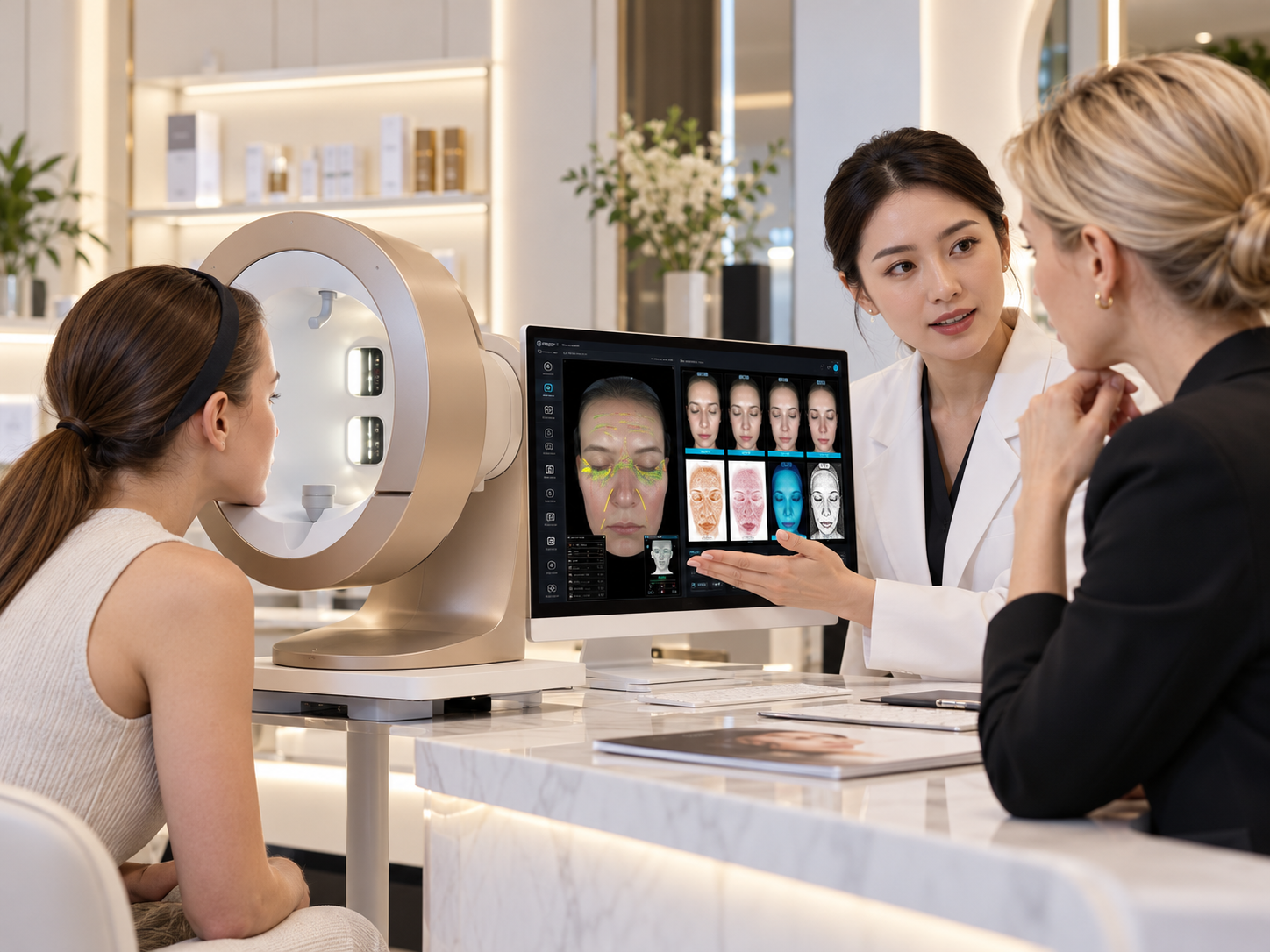
An AI skin analysis system is an interpretation engine. It takes data—images, topography, spectral reflectance—and assigns classifications: “moderate crow’s feet,” “brown spots covering 12% of the cheek,” “aging grade 5 on an 8-point scale.” The D9′s AI model was trained on 千万级皮肤影像数据 (tens of millions of skin images) to construct its aging index .
The two technologies are complementary but separable. A device can produce excellent 3D topography but have weak AI classification. A device can run sophisticated AI on 2D photographs but cannot measure volume. The ISEMECO D9 happens to integrate both—but the buyer’s evaluation should treat them as separate procurement decisions.
What 3D Imaging Delivers That AI Alone Cannot
The value of 3D imaging is physical measurement in defined units. This matters for specific clinical and commercial applications where “how much” is the question.
Volume tracking. The D9 reports volume changes with 0.1ml precision, showing increases or decreases in specific facial regions before and after treatment. An AI system operating on 2D images cannot produce this measurement because 2D images contain no depth data. The AI can classify “moderate nasolabial fold,” but it cannot state that the fold volume decreased by 0.3ml.
Contour and symmetry assessment. The D9′s Horizontal Thirds and Vertical Fifths functions and Contour Morphology Evaluation enable assessment of facial proportions and concavity issues. These are geometric evaluations that require 3D data.
Wrinkle depth in physical units. A 2D AI can grade a wrinkle as “severe” based on visual appearance. A 3D system can measure that the wrinkle is 0.4mm deep—and track whether it becomes 0.3mm after treatment.
What AI Analysis Delivers That Imaging Alone Cannot
The value of AI is structured interpretation at scale. A 3D image is a surface; the AI determines what that surface means.
Multi-condition classification. The D9′s AI assigns grades across 8 aging dimensions (forehead lines, glabellar lines, crow’s feet, periorbital lines, laugh lines, marionette lines, corner of mouth lines, brown spots) and classifies brown spots and sensitive areas as mild, moderate, or severe .
Prioritization. The D9 MAX’s AI report prioritizes the top 3 skin issues, which is an interpretive judgment that raw imaging cannot make. A surface scan shows all features equally; the AI determines which features matter most.
Treatment linkage. The AI report links identified issues to the institution’s treatment menu, creating an “analysis + solution” pathway . This is an interpretive function that connects findings to actions.
Clinical Evidence: 3D Data Improves AI Performance
Research in dermatology AI provides evidence that 3D data feeds better AI classification than 2D data—at least for certain tasks.
A prospective study of 1,690 melanocytic lesions compared a 3D-CNN (using 3D total body photography) against a 2D-CNN. Results:
Metric 2D-CNN 3D-CNN Dermatologist
Sensitivity 70% 90% 90%
Specificity 40% 64.6% 92.3%
ROC-AUC 0.68 0.92 0.91
The 3D-CNN achieved comparable sensitivity to dermatologists and substantially outperformed the 2D-CNN . The study also found the 3D-CNN had higher reproducibility for repeated measurements (R=0.89) than the 2D-CNN (R=0.79).
This evidence supports a practical principle: AI performance depends on the quality and dimensionality of the data it receives. A well-trained AI on 3D data can approach clinician-level sensitivity for some tasks; a 2D AI in the same study fell far short.
How the ISEMECO D9 Integrates Both Layers
The D9 platform is designed as an integrated system where 3D imaging and AI analysis are sequential stages of a single workflow.
Stage 1: Multispectral 3D capture. The D9 captures four spectral modes (RGB, cross-polarized, parallel-polarized, UV) and reconstructs topography with 0.2mm accuracy and 42 million full-face pixels .
Stage 2: AI interpretation. The AI skin large model analyzes the captured data, assigns grades across the 8-dimension aging model, classifies symptom severity, and generates a report in 30 seconds (D9 MAX) .
Stage 3: Clinical outputs. The software produces volume difference calculations (0.1ml), aging weight rankings, before/after overlap comparisons, and customized reports linking findings to treatment recommendations .
MEICET’s public materials describe this integration as “multimodal skin analysis” that combines “high-resolution 3D imaging, multispectral capture, and patented AI algorithms” to provide a “scientific and quantitative definition of skin aging” .
Table: 3D Imaging vs. AI Analysis—What Each Capability Answers
Buyer Question Answered By D9 Specification
“How deep is this wrinkle?” 3D imaging 0.2mm modeling accuracy
“How much volume did the filler add?” 3D imaging + volume calculation 0.1ml precision
“Is this pigmentation mild, moderate, or severe?” AI classification Mild/moderate/severe grading with area percentage
“Which of this patient’s aging signs should we treat first?” AI prioritization Top 3 issues identified, aging weight ranking
“How does this patient’s aging compare to a reference population?” AI + training data 8-dimension aging index with grade/ranking
“What will this patient look like in 5 years?” AI prediction Age trajectory prediction (18–80)
FAQ
What is the difference between 3D skin imaging and AI skin analysis in simple terms?
3D imaging measures the shape of the skin; AI interprets what the shape means. 3D imaging uses structured light to capture depth and volume—the ISEMECO D9 achieves 0.2mm modeling accuracy and 0.1ml volume precision. AI analysis takes that data (or 2D images) and classifies conditions, assigns grades, and prioritizes issues. A device can have one without the other; professional systems like the D9 integrate both.
Does a 3D skin analyzer always include AI?
No. Some 3D imaging systems produce topographic maps without AI classification. The user interprets the images. The ISEMECO D9 includes AI analysis as a distinct layer on top of 3D capture, but buyers should verify what the AI actually does—grading, prioritization, prediction—rather than assuming “3D” implies “AI.”
Can AI skin analysis work without 3D imaging?
Yes, but with limitations. Many AI skin analysis apps operate on 2D smartphone photographs. They can classify surface conditions (wrinkles, pigmentation) but cannot measure volume, depth, or contour. In the melanoma study, the 2D-CNN achieved only 70% sensitivity and 40% specificity, while the 3D-CNN reached 90% and 64.6% . For applications requiring volumetric measurement, 3D data is necessary.
Which is more important for a beauty clinic: 3D imaging or AI analysis?
It depends on the clinical service. For filler and contouring treatments, 3D imaging with volume precision is essential—AI alone cannot measure 0.6ml of volume change. For anti-aging consultations and treatment package recommendations, AI prioritization and grading provide the structured outputs that drive conversions. The D9 combines both, but a clinic should define which capability drives its revenue before choosing a device.
What does the ISEMECO D9′s AI actually measure?
The D9′s AI assigns grades across 8 aging dimensions (forehead lines, glabellar lines, crow’s feet, periorbital lines, laugh lines, marionette lines, corner of mouth lines, brown spots), classifies brown spots and sensitive areas as mild/moderate/severe with area percentages, prioritizes the top 3 issues, and predicts aging trajectory from 18 to 80 years . It also links findings to the institution’s treatment menu.
Post time: Oct-23-2026


