


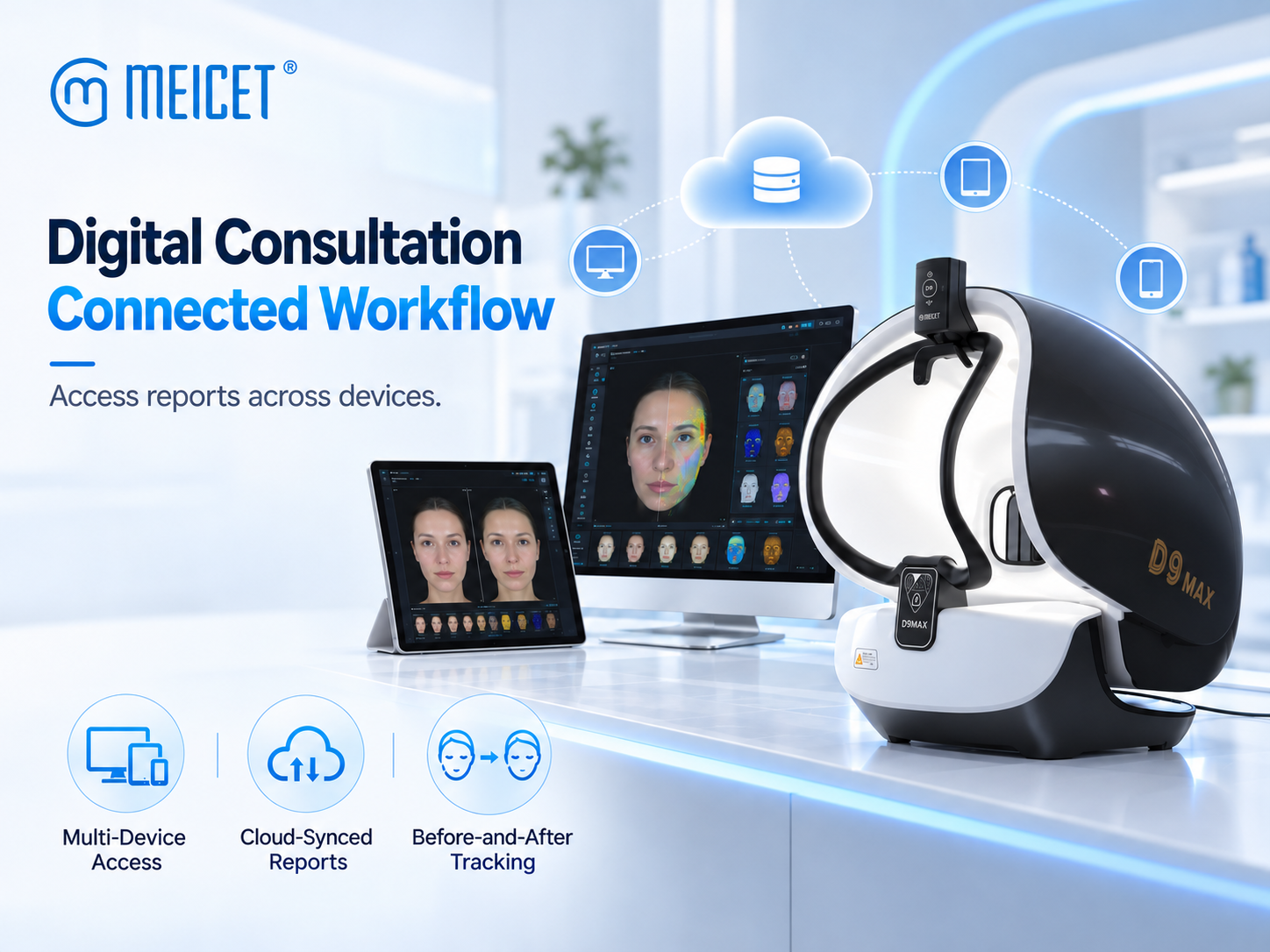
A face analysis machine is a professional imaging system that uses multi-spectral cameras, 3D modeling, and AI algorithms to quantify skin conditions and facial structures beyond human visual assessment. These devices capture visible and subsurface skin features, then generate objective data on wrinkles, pigmentation, texture, and facial volume. For clinics, the core value lies in converting subjective consultations into measurable, visual evidence that supports diagnosis, treatment planning, and patient communication. The global facial aesthetics market, valued at approximately $68.9 billion in 2024, is projected to reach $250.7 billion by 2031, reflecting growing demand for data-driven aesthetic decision-making.
Key Takeaways
What Problems Does a Face Analysis Machine Actually Solve?
A face analysis machine solves the fundamental problem of invisible or subjective skin assessment. Before these systems existed, aesthetic professionals relied on naked-eye inspection, patient self-reporting, and experience-based intuition. A client might complain of “dull skin” or “deep lines,” but neither party could precisely locate the issue, measure its severity, or prove whether a treatment worked.
The machine intervenes at three critical points:
- 01. Detection: It reveals subsurface conditions—UV-induced pigmentation, hidden inflammation, early textural changes—that are invisible under normal light.
- 02. Quantification: It assigns numerical values to features like wrinkle depth, pore area, or pigmentation density, creating a baseline.
- 03. Communication: It produces visual reports that align the practitioner’s findings with the client’s perception, reducing mismatched expectations.
For a clinic manager or practitioner evaluating a purchase, the question is not merely “does it take pictures?” but “does it produce actionable data that improves consultation conversion and treatment outcomes?” The answer depends on the system’s imaging fidelity, analytical depth, and workflow integration.
How Does a Face Analysis Machine Work Step by Step?
A face analysis machine operates through a four-stage pipeline: image capture, 3D reconstruction, AI analysis, and report generation.
Stage 1: Multi-Spectral Image Capture
The system illuminates the face under controlled lighting conditions and captures high-resolution images. Standard configurations include four spectral modes:
Higher-end systems like the ISEMECO D9MAX capture 48 MP across the full face using 1-inch CMOS sensors for improved light sensitivity.
Stage 2: 3D Surface Reconstruction
This separates a true face analysis machine from a simple camera. The system projects structured light patterns to calculate depth and facial topography.
3D resolution: The D9MAX achieves 0.02 mm resolution, sufficient to quantify fine wrinkles.
Point cloud density: “Million-level” capture ensures no region is under-sampled.
Capture speed: Fast enough to avoid motion artifacts from breathing.
Stage 3: AI Analysis
Deep learning models detect and grade conditions across four domains: Pigmentation, Vascularity, Texture, and Aging indicators. The D9MAX engine generates reports in ~30 seconds.
Stage 4: Report Generation
Visual reports for practitioner-client discussion featuring side-by-side comparisons, regional annotations, and treatment correlation with multi-terminal access.
Table 1: Core Technical Stages and What They Measure
| Stage | Key Technology | What It Quantifies | Practical Value |
|---|---|---|---|
| Image Capture | 48 MP CMOS, 4-spectrum LED | Surface and subsurface optical features | Reveals hidden pigmentation, vascularity |
| 3D Reconstruction | Structured light, 0.02 mm resolution | Depth, volume, contour, wrinkle severity | Enables millimeter-level planning |
| AI Analysis | Deep learning models | Condition classification, severity grading | Standardizes diagnosis, reduces bias |
| Report Generation | Visual overlay, simulation | Baseline documentation, outcome projection | Aligns expectations, supports tracking |
What Should Buyers Compare Before Purchasing?
Buyers should prioritize four specification categories: imaging fidelity, 3D capability, analytical depth, and workflow fit.
Imaging & Spectral
- Sensor size: Look for 1-inch CMOS for color accuracy.
- Spectral modes: 4 spectra is the professional baseline.
- Light stability: Solid-state LED arrays for consistent output.
3D Performance
- Resolution: Demand a number (0.02 mm is high-end).
- Volume precision: Essential for filler simulation (e.g., 0.1 mL).
Table 2: Buyer Selection Checklist
| Category | Minimum Acceptable | Preferred Spec | Why It Matters |
|---|---|---|---|
| Camera resolution | 24 MP | 48 MP | Resolves fine texture and small lesions |
| 3D resolution | 0.1 mm | 0.02 mm | Detects early changes and precise depth |
| Spectral modes | 3 (RGB+UV+1 Pol) | 4 (RGB+UV+2 Pol) | Complete subsurface assessment |
| AI report time | 60 seconds | ≤ 30 seconds | Fits within consultation workflow |
What Are the Limitations and Appropriate Use Boundaries?
A face analysis machine is a decision-support tool, not a diagnostic medical device for skin disease. Aesthetic face analysis machines generally fall outside the diagnostic framework; they are consultation tools, not substitutes for dermatological examination.
- Baseline documentation for planning
- Tracking changes over time
- Patient education
- Diagnosing skin cancer
- Medical-grade accuracy claims
- Sole basis for invasive decisions
How Does the ISEMECO D9MAX Fit the Current Market?
The ISEMECO 3D D9MAX represents a high-end configuration typical of current aesthetic analysis systems. With 0.02 mm 3D resolution and 48 MP imaging, it is positioned for clinics seeking comprehensive analysis rather than basic scanning.
The system reduces friction by connecting imaging, analysis, records, and reporting into a single workflow. The machine is only as useful as the frequency with which it is incorporated into routine consultations.
Frequently Asked Questions
What is the difference between a face analysis machine and a regular camera?
A regular camera captures a 2D image under uncontrolled lighting. A face analysis machine controls lighting spectra, reconstructs a 3D surface with depth measurements, and applies AI to quantify features. The output is structured data, not just a photograph.
How accurate is a 3D face analysis machine?
Accuracy depends on the system. High-end devices achieve 0.02 mm 3D resolution and 0.1 mL volume precision. However, no aesthetic analysis device should be treated as a medical diagnostic instrument.
What skin conditions can a face analysis machine detect?
Standard systems assess pigmentation, vascularity, pore size, skin texture, wrinkles, and volume changes. They do not diagnose skin cancer or inflammatory dermatoses.
How long does a face analysis session take?
Image capture takes seconds. AI analysis takes 30-60 seconds. Total consultation time is usually 10–15 minutes.
Can a face analysis machine predict how I will age?
Some systems offer aging simulation features that project changes over 5–10 years based on population data. These are illustrative tools for patient education, not precise individual predictions.
Post time: Nov-17-2026


