


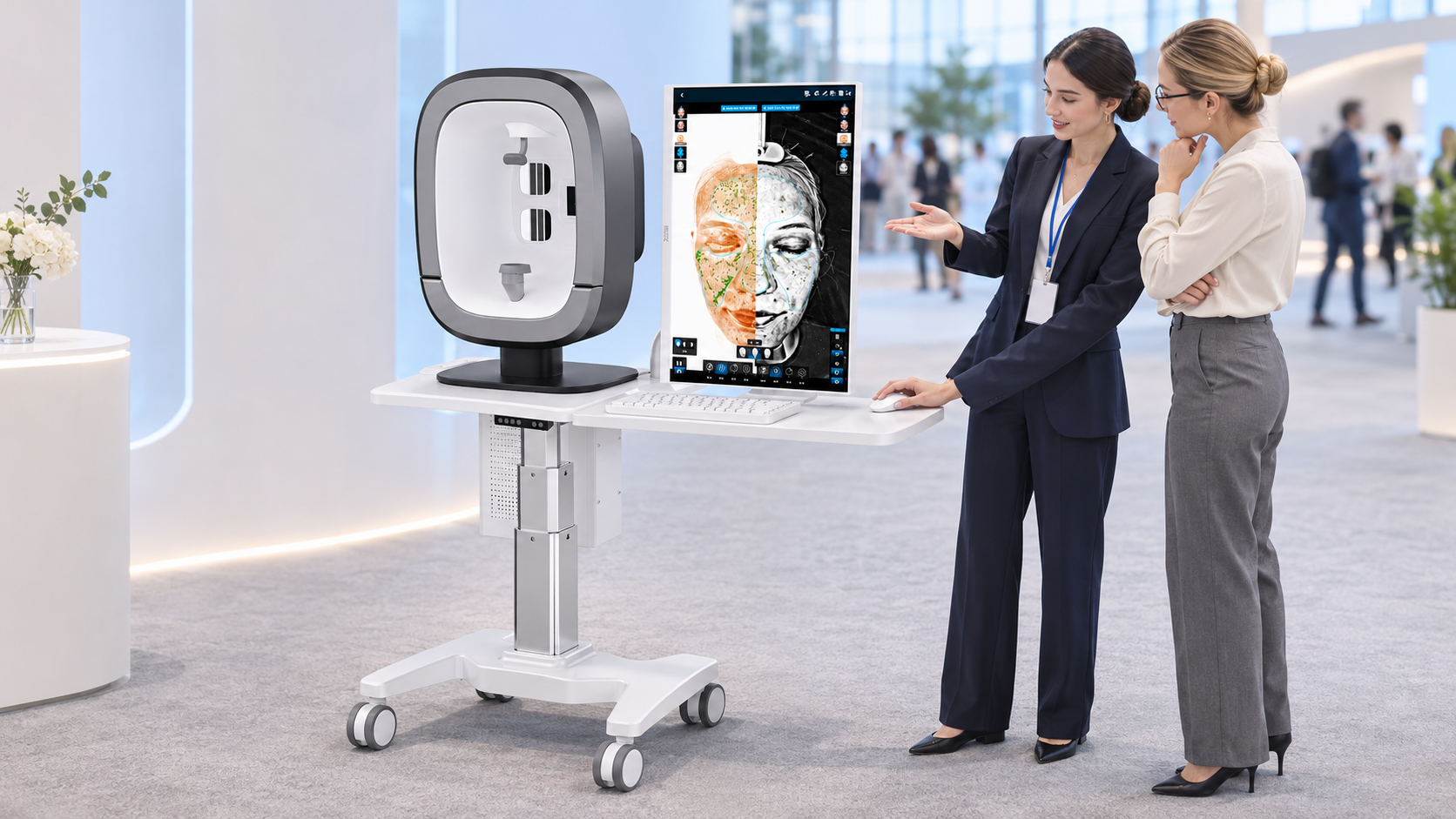
Face analysis machine pricing is driven by five core factors: imaging hardware specification (sensor resolution, spectral modes, lighting engineering), AI software depth (training dataset size and validation rigor), build configuration (portable vs. desktop vs. clinical floor-standing), regulatory compliance burden (medical device certification adds 20–40% to hardware cost), and distribution and service infrastructure (regional support, training, and warranty). Entry-level portable units range from $750 to $3,000, desktop professional workstations from $5,000 to $15,000+, and clinical-grade systems with full spectral coverage and hospital procurement documentation can exceed $50,000. The ISEMECO S7, with its 20MP sensor and four spectral modes, sits in the upper-mid professional tier where software capability and optical engineering—not just hardware—justify the price premium.
Sensor resolution alone does not determine price; spectral range (UV, CPL, PPL) and lighting calibration contribute more to diagnostic value.
AI training dataset size and demographic diversity are capital-intensive assets that directly affect analytical reliability.
Form factor dictates baseline cost: portable units prioritize miniaturization, while clinical systems absorb regulatory overhead.
European distributor pricing (e.g., Meicet S7 at €35,000) reflects local support and training rather than direct factory costs.
Buyers should separate hardware cost from software licensing and service to evaluate true total cost of ownership.
Imaging hardware specification is the single largest contributor to face analysis machine price. The optical path—sensor, lens, illumination sources, and filters—determines what diagnostic information the device can capture, and each component tier carries a distinct cost.
A 20-megapixel sensor, as used in the ISEMECO S7, captures finer skin structures than the 8–12MP sensors common in entry-level systems. However, pixel count alone is misleading. Optical quality—lens grinding precision, distortion control, and edge-to-edge sharpness—adds manufacturing cost that specifications rarely disclose.
Multi-spectral capability requires multiple illumination sources and optical filters. The ISEMECO S7 employs four spectral modes (RGB, CPL, PPL, UV) with 20 UV light sources imported from Japan and a light source layout designed by specialists from the Chinese Academy of Sciences, covering 95% of the facial area.
Portable handheld units ($750–$3,000) prioritize miniaturization. Desktop workstations integrate the imaging head with a dedicated processing unit; the ISEMECO S7 combines the imaging host with a high-resolution display and an optional motorized height-adjustment platform (700–1080mm range). Prices in this class range from $5,000 to $15,000+.
AI analytical capability separates devices that produce diagnostic-grade output from those that generate cosmetic visualizations. The price gap reflects the cost of building validated algorithms.
- • Training dataset size and curation: Professional systems invest in two expensive assets: training databases and validated algorithms. The ISEMECO platform uses a database of millions of skin samples, enabling more accurate analysis across different skin types.
- • Clinical validation and performance evidence: Vendors that invest in validation across representative populations (Fitzpatrick types I–VI) carry higher development costs reflected in pricing.
- • Software feature depth: The ISEMECO S7’s software supports 5–7 year skin aging simulation, multi-terminal access, and CRM integration—capabilities that justify premium pricing.
Regulatory certification and regional distribution infrastructure can add 20–40% to the base hardware cost. These costs are invisible in product specifications but appear in the final quotation.
Medical device certification: Clinical-grade systems may require FDA 510(k), CE marking, or NMPA registration. A 2026 hospital procurement record illustrates this: a skin imaging analyzer won a tender at ~$51,000, while a lower-tier unit was awarded at ~$13,000.
Regional distribution and support: A European distributor lists the Meicet S7 at approximately €35,000, reflecting local support and training. Buyers should clarify what the price includes: installation, calibration, and warranty.
Modular configuration: The ISEMECO S7 can be configured with a 21.5–31.5 inch display, allowing buyers to control cost by using existing hardware where specifications permit.
| Price Factor | Entry Tier ($750–$3,000) | Mid Tier ($5,000–$15,000) | Clinical Tier ($15,000+) |
|---|---|---|---|
| Sensor resolution | 8–12MP, basic optics | 15–24MP, improved optics | 20MP+, precision optics |
| Spectral modes | RGB + 1–2 modes | 4+ modes (RGB, CPL, PPL, UV) | Full spectral suite, calibrated |
| AI capability | Threshold-based or basic ML | Validated algorithms | Clinically validated, diverse data |
| Form factor | Portable/handheld | Desktop workstation | Floor-standing |
| Example | Generic handheld analyzers | ISEMECO S7 | Hospital-tender systems |
Imaging Hardware
- What is the sensor resolution and lens system?
- How many spectral modes are captured in one session?
- Is the lighting calibrated?
AI and Software
- What is the size of the training dataset?
- Has the AI been validated against clinical assessment?
- Does it support longitudinal comparison?
Differences in optical quality, AI training dataset size, software validation, build quality, and regional service infrastructure account for most price variation.
No. Accuracy depends on specific use cases. Match the device’s strengths to your actual consultation mix (e.g., diagnostic precision vs. client education).
Pricing varies. A European distributor lists the Meicet S7 at ~€35,000. Buyers should request an itemized quotation covering installation, training, and warranty.
Entry-level AI uses basic image processing. Professional AI uses validated machine learning models trained on large, curated datasets with dermatologist annotation.
It depends on the vendor. Some include updates for 12–24 months, while others use subscription models for cloud features. Clarify this before purchase.
Post time: Nov-19-2026


