


Quick Answer
The price of a 3D skin analysis machine is determined by five cost layers: 3D capture hardware (structured light modules vs. simulated depth), spectral imaging capability (each additional light mode adds hardware and calibration cost), AI algorithm investment (training database size and validation depth), software ecosystem (multi-terminal access, cloud infrastructure, CRM integration), and regulatory compliance (medical device certification adds 20–40% to base cost) . The global 3D skin analysis market shows an average selling price of $795 per unit, but this figure spans entry-level portables to clinical workstations . A professional system like the ISEMECO D9, with binocular grating structured light, 0.2mm modeling accuracy, and 42 million full-face pixels, sits at the higher end because each of these specifications carries a measurable manufacturing cost .
Key Takeaways
3D capture technology is the primary price lever: true structured light (binocular grating) costs significantly more than stereo vision or software-simulated depth.
Spectral modes multiply cost: each additional light mode (UV, cross-polarized, parallel-polarized) requires its own light source, filter, and calibration routine .
AI training database size correlates with price: platforms trained on millions of skin samples command premiums over devices using generic image processing .
Regulatory certification adds 20–40%: medical device registration (CE, FDA, NMPA) carries documentation and testing costs that flow into the final price .
Form factor determines the baseline: portable units range from $750–$3,000; desktop workstations reach $5,000–$15,000+ .
Factor 1 3D Capture Hardware and Modeling Precision
The foundational cost driver is how the device captures depth. A true 3D analyzer uses structured light—projecting a known pattern and calculating depth from its deformation—rather than estimating depth from stereo vision or simulating it from 2D images.
The ISEMECO D9 uses binocular grating structured light with 0.2mm modeling accuracy and a 1-inch CMOS sensor . The D9 MAX variant upgrades to 0.02mm precision with a 10× improvement in the structured-light camera . These specifications require precision optical assemblies, dual-camera synchronization, and factory calibration—costs that entry-level “3D” devices using software simulation do not carry.
A device claiming “3D” without publishing its modeling accuracy or capture method is likely using a lower-cost approach. The price difference between a $1,500 device and an $8,000 device often begins here.
Factor 2 Spectral Imaging Capability
Each spectral mode adds hardware cost and calibration burden. The D9 captures four modes: RGB (visible light), cross-polarized (subsurface vascular), parallel-polarized (surface shine), and UV (pigmentation depth and porphyrins) . The software generates 11 high-definition 3D images from these captures .
Why each mode costs money: UV LEDs require different semiconductor materials than visible LEDs. Polarizing filters must be precision-aligned. Each mode requires independent normalization to ensure consistent output across sessions . A device with only RGB captures surface appearance; it cannot assess subsurface inflammation or pigmentation depth. The D9’s UV and cross-polarized modes are what enable its red-zone imaging and near-infrared barrier assessment capabilities.
A device claiming “multi-spectral” without specifying the number of modes is a procurement red flag .
Factor 3 AI Algorithm and Training Database
AI capabilities range from basic image processing to clinically validated analysis. Price correlates with where a device sits on that spectrum.
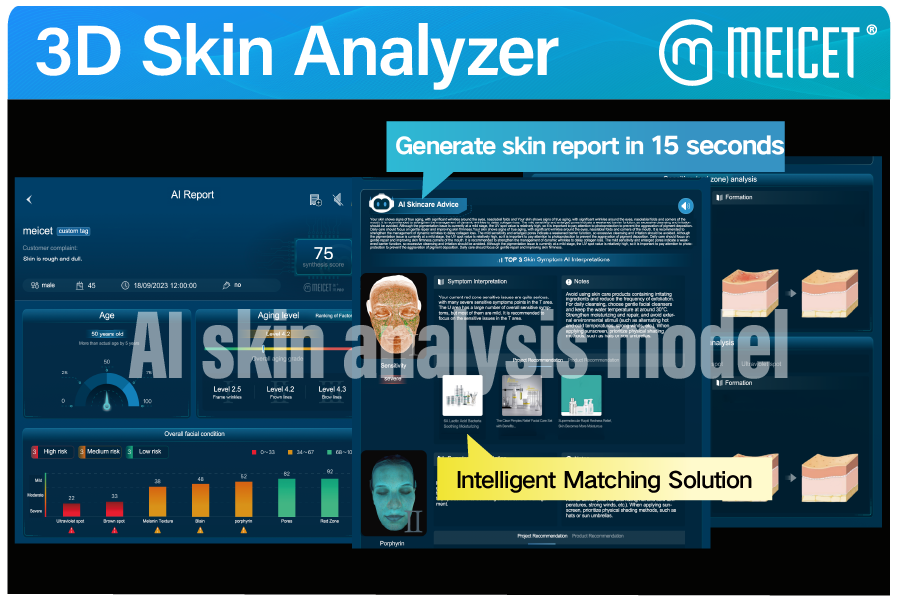
The ISEMECO D9 platform uses an AI skin large model trained on 千万级皮肤影像数据 (tens of millions of skin images) to construct its 8-dimension aging index . The D9 MAX generates an AI skin analysis report in 30 seconds, prioritizes the top 3 skin issues, and links findings to the institution’s product recommendations .
Building such a database requires years of standardized image collection across demographics, expert annotation by dermatologists, and ongoing curation. This is a capital-intensive asset that directly influences diagnostic reliability . Entry-level systems often implement basic contrast enhancement or template matching branded as “AI”—these add negligible cost because they require no training data.
Factor 4 Software Ecosystem and Workflow Features
Software features increasingly differentiate price tiers. Professional systems include:
- ✔ Multi-terminal access: simultaneous login from iPads and computers, with local or remote synchronization
- ✔ Case database organized by symptom and procedure
- ✔ Customized report generation with clinic branding
- ✔ CRM/SaaS integration for treatment history and follow-up scheduling
These features require cloud infrastructure, user authentication, and ongoing development. Vendors either absorb these costs (raising device price) or pass them through as subscription fees . A device without multi-terminal access or report customization is functionally a standalone camera with analysis software—adequate for basic consultation, insufficient for multi-location clinical workflow.
Factor 5 Regulatory Compliance and Market Access
Clinical/medical-grade systems add regulatory overhead that can increase base cost by 20–40% . This includes:
FDA 510(k) clearance for U.S. diagnostic claims | CE marking under EU MDR (Class IIb for devices informing clinical decisions) | NMPA registration for China market access
A 2026 hospital procurement record from China illustrates the gap: a skin imaging analyzer winning bid at 370,000 RMB (~$51,000)**, while a lower-tier unit in the same tender was awarded at **95,000 RMB (~$13,000). The price difference reflects not just hardware but regulatory documentation and validation burden .
For buyers in regulated markets, certification is not optional—it is the legal prerequisite for clinical use. The cost of certification is embedded in the device price.
Table: Price Drivers and Their Relative Impact
| Price Driver | Relative Impact | What Drives the Cost |
|---|---|---|
| Structured light vs. simulated depth | High | Precision optics, dual cameras, factory calibration |
| Modeling accuracy (0.2mm vs. 0.02mm) | High | Higher-precision optical assembly and processing |
| Spectral mode count (RGB only vs. 4 modes) | Medium–High | Light sources, filters, per-mode calibration |
| AI training database size | Medium–High | Data collection, annotation, algorithm development |
| Software ecosystem (multi-terminal, CRM) | Medium | Cloud infrastructure, development, maintenance |
| Regulatory certification | 20–40% premium | Testing, documentation, audit |
| Form factor (portable vs. workstation) | Variable | Display, processing unit, enclosure |
FAQ
What is the biggest factor affecting the price of a 3D skin analysis machine?
3D capture technology and modeling precision typically account for the largest price variation. True binocular grating structured light with 0.2mm accuracy (or 0.02mm for the D9 MAX) requires precision optical modules and factory calibration that simulated-depth devices do not carry .
Why do two “3D” skin analyzers have such different prices?
The capture method differs. A device using structured light (like the ISEMECO D9) measures depth; a device using stereo vision or software simulation estimates it. The price difference reflects hardware and calibration investment. Ask for the published modeling accuracy and a live measurement demonstration on a reference object.
How much does a professional 3D skin analyzer cost?
Market reference ranges place professional 3D workstations at $5,000–$15,000+, with clinical/medical-grade systems exceeding this range due to regulatory overhead . The ISEMECO D9, with 0.2mm precision and 42 million pixels, sits in the professional tier . Configuration, software licensing, and regional pricing affect the final quotation.
Do spectral modes significantly affect price?
Yes. Each additional mode (UV, cross-polarized, parallel-polarized) requires its own light source, filter, and calibration routine . A device with four modes (like the D9) costs more than an RGB-only device because it can assess subsurface conditions that visible light cannot reveal.
How does AI affect the price?
AI training database size and validation depth correlate with price. A platform trained on millions of skin samples commands a premium over a device using generic image processing . The D9’s AI skin large model and 8-dimension aging index reflect this investment .
Does regulatory certification affect the price?
Yes. Medical device registration (CE, FDA, NMPA) adds 20–40% to base hardware cost due to testing, documentation, and audit requirements . For clinical use, certification is a legal prerequisite, not an optional feature.
What auxiliary features add cost?
Heating/cooling jackets, liquid spray systems, and explosion-proof configurations add to the base price for industrial mixers—but for skin analyzers, the equivalent cost drivers are multi-terminal access, cloud infrastructure, CRM integration, and custom report generation . These features determine whether the device integrates into clinical workflow.
Post time: Oct-23-2026


