


When purchasing a 3D skin analyzer for clinical or medical aesthetics use, the minimum compliance file set includes ISO 13485 quality management system certification, EU CE MDR Class IIb certificate issued by a Notified Body (if claiming EU clinical use), US FDA 510(k) clearance or a written statement of non-applicability, IEC 60601-1 electrical safety and IEC 60601-1-2 EMC test reports, IEC 62471 photobiological safety assessment, and factory calibration certificates with performance verification data. A supplier claiming “CE and FDA” without verifiable certificate numbers and issuing body names has not provided compliance evidence—it has provided marketing language.
Without a valid ISO 13485 certificate covering the design and manufacture of skin imaging devices, every product certificate downstream loses credibility.
EU MDR requires Notified Body involvement for Class IIb non-implantable devices; a self-declared Declaration of Conformity does not satisfy this requirement.
For devices making clinical assessment claims, a 510(k) number is the evidence to request; registration is not clearance.
IEC 62471-7:2023 specifies the assessment framework for visible-spectrum light sources including blue light and UV hazards.
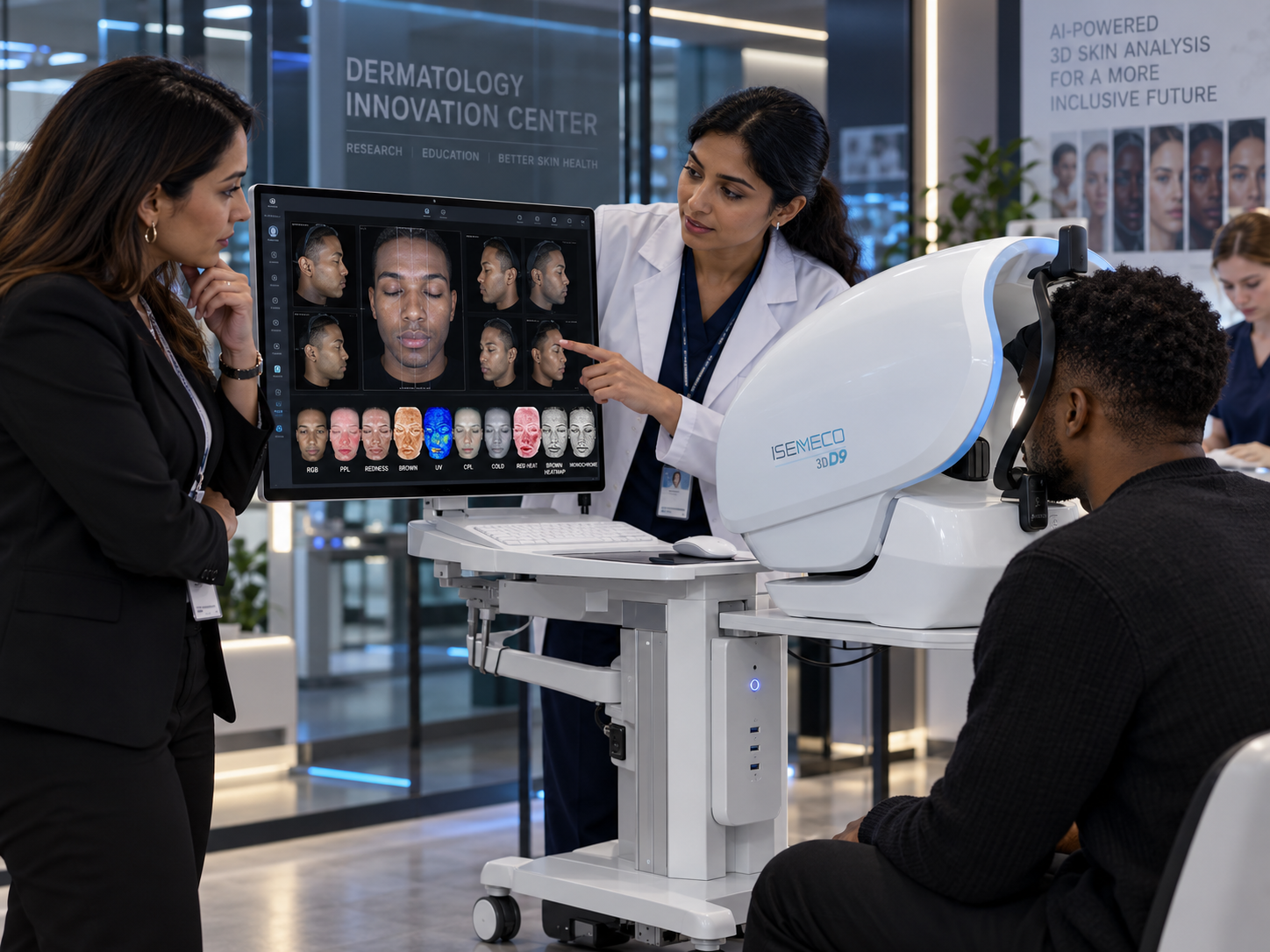
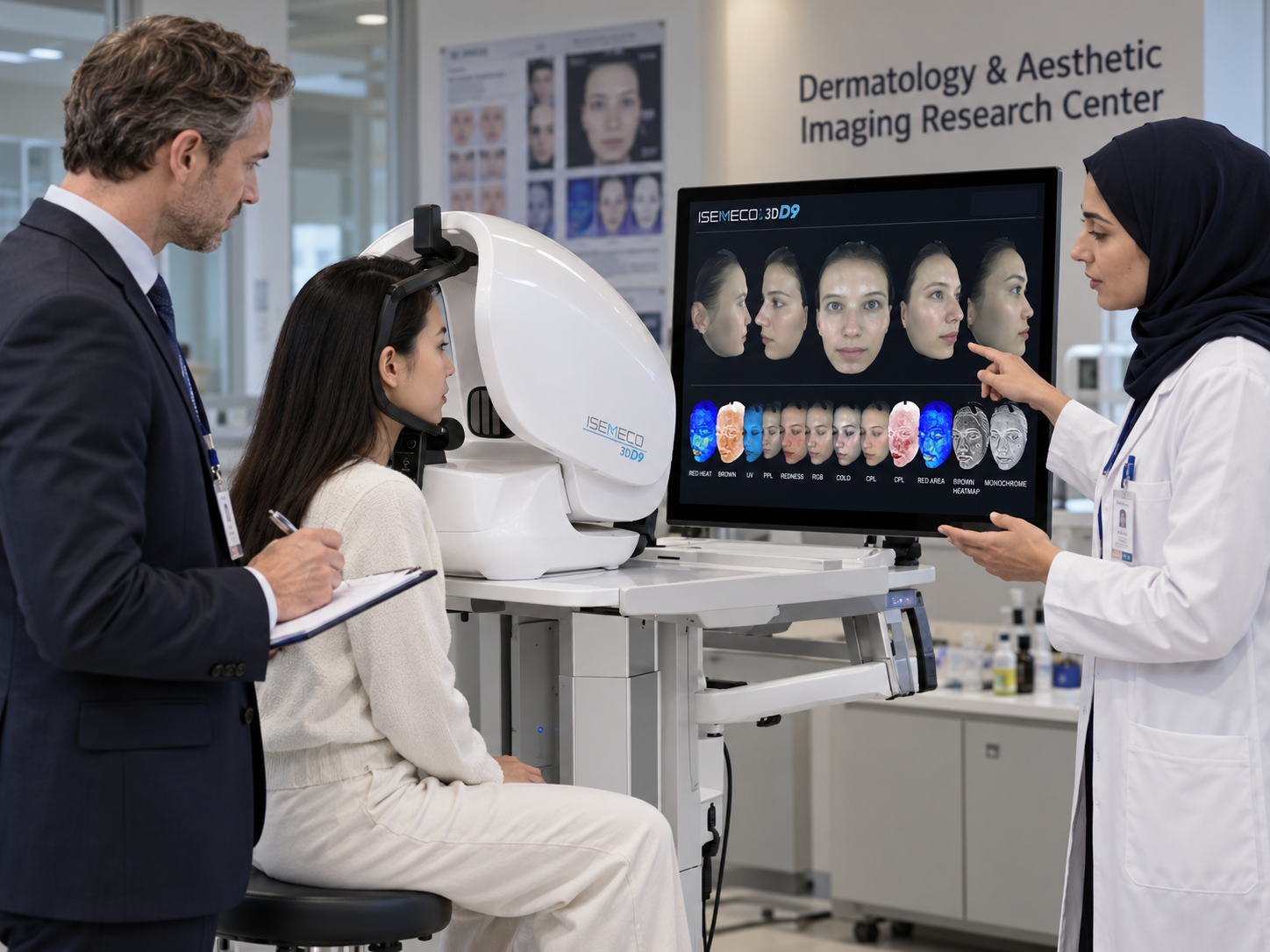
A 3D skin analyzer that outputs wrinkle grading, pigment analysis, and volumetric change measurement operates at the boundary between aesthetic imaging and clinical assessment. That boundary determines which certifications matter. The ISEMECO 3D D9, with its binocular structured light, 0.2mm modeling accuracy, and 0.1ml volume difference calculation, is marketed to dermatologists and cosmetic surgeons. For a clinic evaluating this device, the certification review is not a paperwork exercise—it is the legal and safety basis for using the device on patients.
1. Why 3D Skin Analyzer Certification Is More Complex Than a Standard Aesthetic Device
3D skin analyzers face a dual regulatory identity: they are often sold as aesthetic tools but functionally produce clinical-grade assessments. A device that only reports surface hydration or sebum levels sits in a lower regulatory tier. Once a device outputs aging severity classification, pigment lesion analysis, or treatment outcome quantification, it enters the territory of medical device regulation in most major markets.
Under EU MDR 2017/745, a device intended for “prediction, prevention, monitoring, treatment or alleviation of disease” is a medical device, and Class IIb status requires Notified Body assessment of both the quality system and technical documentation. In the United States, the FDA has cleared light-based imaging devices through the 510(k) pathway when they are intended as adjunctive tools in clinical decision-making—for example, the DeepX DermoSight Dermatoscope received 510(k) clearance K230448 under regulation 878.4580 as a “Light Based Imaging” device. The distinction matters: a device cleared as an adjunct does not replace biopsy, and the manufacturer’s intended use statement defines what the clinic may legally claim.
The procurement risk is asymmetric. A supplier without complete certifications bears reputational risk; the clinic that uses the device in patient care bears regulatory and liability risk.
2. The Core Document Checklist: Five Categories to Verify Before Purchase
Every document below should be requested as a certificate copy with a verifiable number, and independently checked against the issuing body’s database. Supplier-provided screenshots are not verification.
2.1 ISO 13485 Quality Management System Certificate
This is the single most diagnostic document. ISO 13485 specifies requirements for a quality management system covering the design, development, production, and distribution of medical devices. The certificate has a three-year validity and is maintained through annual surveillance audits. Two details require attention: the certification scope must explicitly include “skin imaging devices” or “medical imaging equipment” design and manufacture, and the certification body must be an accredited conformity assessment body (BSI, TÜV, SGS, or equivalent).
2.2 EU CE Certificate and MDR Classification Documentation
CE marking is a declaration; for Class IIb, the Notified Body certificate is the evidence. MEICET’s 2025 5CC exhibition material states that both the 3D D9 and Pro-A systems “have recently received Class IIb certification”. The procurement request should specify: the Notified Body CE certificate (showing MDR 2017/745, device class, and validity period) and the EU Declaration of Conformity listing the device’s intended purpose.
2.3 US FDA Status: 510(k) Clearance or Documented Non-Applicability
FDA establishment registration is not the same as device clearance. For a skin imaging device intended as an adjunct to clinical assessment, the evidence to request is a 510(k) clearance number verifiable in the FDA’s 510(k) database.
2.4 Electrical Safety and EMC Test Reports
IEC 60601-1 and IEC 60601-1-2 reports are the baseline safety documentation for any powered device used in a clinical environment. The reports must be issued by an accredited third-party laboratory and must reference the exact model being purchased.
2.5 Photobiological Safety Assessment (IEC 62471-7)
The D9 uses RGB, cross-polarized, UV, and parallel-polarized light sources. The UV and blue-light exposure pathways require assessment. IEC 62471-7:2023 specifies the photobiological safety assessment of electrical light sources and luminaires emitting radiation predominantly in the visible spectral range (380 nm to 780 nm).
3. The Documents Most Buyers Forget to Request
Calibration certificates and performance verification data convert specification claims into measurable evidence. The D9’s stated 0.2mm modeling accuracy and 0.1ml volume-difference precision are only meaningful if the measurement system itself is calibrated against a traceable standard. Request the factory calibration certificate with traceability to a national metrology institute.
Software and data security documentation is increasingly relevant for devices that store 3D facial images and support remote report viewing. If the device is used in the EU, GDPR compliance documentation for the image storage and remote access functions should be part of the file set.
4. Compliance Document Comparison Framework
5. Scenario-Based Verification: What to Ask When the Supplier Says “We Have CE and FDA”
Scenario 1: Supplier says “We have CE.”
Ask: “Please provide the Notified Body CE certificate number, the issuing body name, and the device classification listed in the EU Declaration of Conformity.”
Scenario 2: Supplier says “We are FDA registered.”
Ask: “Please provide the 510(k) clearance number, or a written statement that the device is not marketed for clinical assessment in the US.”
Scenario 3: Supplier says “0.2mm accuracy, industry-leading.”
Ask: “Please provide the calibration certificate’s test record for 3D modeling accuracy and the standard deviation from the repeatability study.”
6. Building a Compliance File Before Signing
The compliance file should be complete before the purchase order is issued, not after delivery. The file should contain: ISO 13485 certificate copy, Notified Body CE certificate and DoC, FDA 510(k) documentation or non-applicability statement, IEC 60601-1/1-2 reports, IEC 62471-7 report, calibration certificate, performance verification summary, and the manufacturer’s written commitment to file authenticity.
Not necessarily. The requirement depends on the device’s intended use claims. If the device produces wrinkle severity grading or pigment lesion analysis used in clinical assessment, the FDA generally expects 510(k) clearance.
The DoC is a manufacturer’s self-declaration. For Class IIb devices under MDR, a DoC alone is insufficient—a Notified Body-issued CE certificate is required.
Use the certification body’s official online database (BSI, TÜV, SGS) to search the certificate number and confirm it is active and covers the correct scope.
Because devices like the D9 use UV illumination and blue light. Without IEC 62471-7:2023 assessment, the cumulative exposure risk to operators and patients is unquantified.
Post time: Nov-04-2026


