


Quick Answer
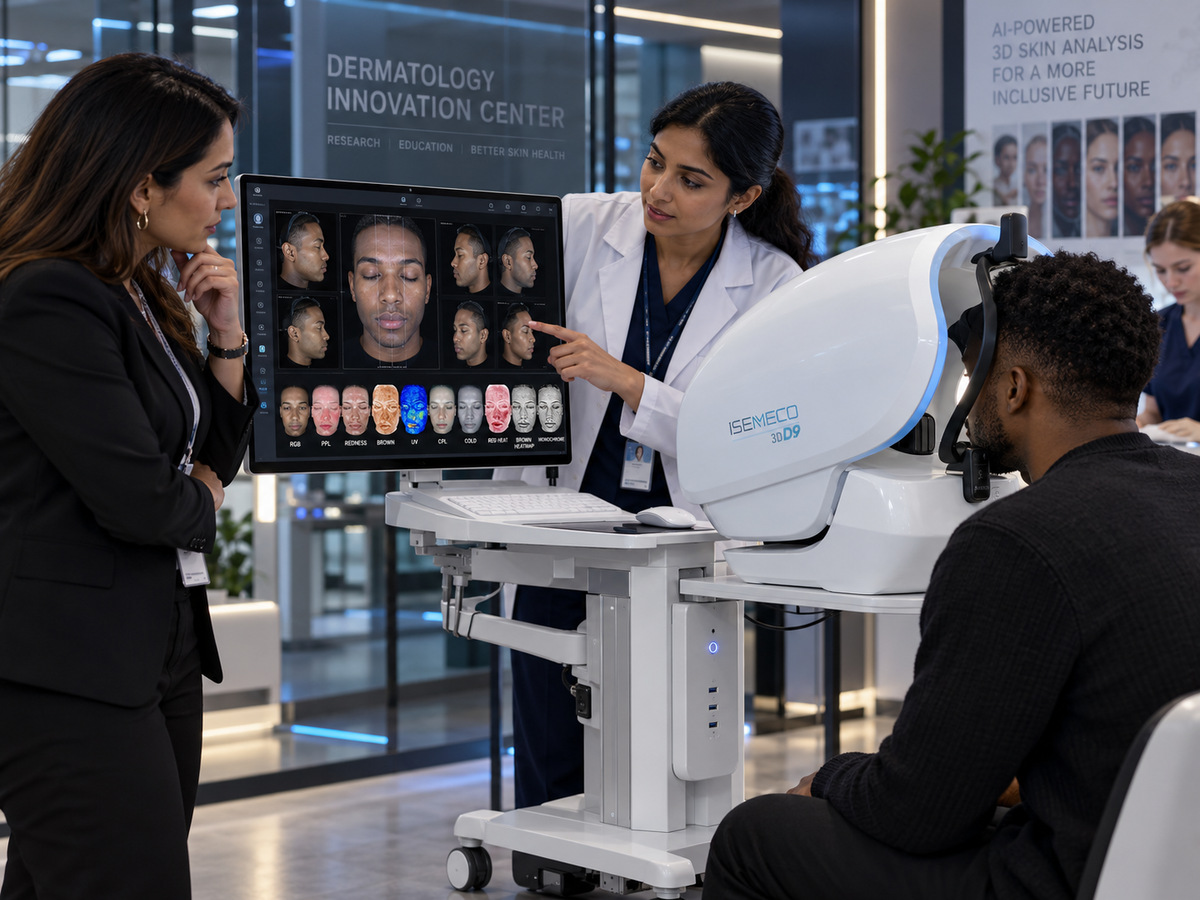
A smart skin analyzer is a multi-spectral imaging system that quantifies surface and subsurface skin conditions—wrinkles, pigmentation, pores, vascularity, and 3D morphology—using controlled illumination and AI-driven software. A handheld moisture tester is a single-purpose probe that measures one parameter: stratum corneum hydration, typically via capacitance or conductance. The core difference is breadth versus depth. A moisture tester answers “how hydrated is this patch of skin?” in seconds. A smart analyzer answers “what is the overall condition of this face, and how has it changed since the last visit?” The ISEMECO 3D D9, for example, captures a 180° 3D facial model at 0.2 mm accuracy and evaluates 8 aging dimensions plus pigmentation and sensitivity grading.
Key Takeaways
Moisture testers measure one thing well. Corneometers assess stratum corneum hydration at a depth of 10–20 μm using dielectric capacitance.
Smart analyzers measure many things at once. The D9 evaluates wrinkles, pigmentation, sensitivity, pores, and 3D volume via multiple spectral modes.
A moisture tester cannot track treatment outcomes that involve pigmentation or contour. Hydration is only one parameter among dozens.
Moisture testers support quick barrier assessment; smart analyzers support consultation, treatment planning, and longitudinal documentation.
What a Handheld Moisture Tester Actually Measures
The Principle: Capacitance of the Stratum Corneum
A handheld moisture tester—most commonly a corneometer—measures the dielectric constant of water in the outermost skin layer. The probe applies a high-frequency, low-power electromagnetic field to the skin surface and registers the reflected signal. Because water has a much higher dielectric constant than other skin components, the reading correlates with water content in the stratum corneum at a depth of approximately 10–20 μm.
This measurement is surface-specific by design. The shallow depth ensures that capillary blood flow and deeper tissue water do not influence the reading. Surface lipids (sebum) also do not interfere, though a dense layer of makeup or camouflage can block the signal.
What a Moisture Tester Cannot Tell You
- Pigmentation (melanin distribution, brown spots, UV damage)
- Wrinkles (depth, severity, regional distribution)
- Pores (size, density, distribution)
- Vascularity (redness, erythema, inflammation)
- 3D morphology (facial volume, contour, symmetry)
What a Smart Skin Analyzer Measures
The Principle: Multi-Spectral Imaging and AI Analysis
A smart skin analyzer like the ISEMECO 3D D9 captures the face under controlled illumination across multiple spectral modes—typically RGB, cross-polarized, parallel-polarized, and UV. Each mode reveals different skin structures: UV excites porphyrins and deep pigment, cross-polarized light isolates subsurface vascularity, and parallel-polarized light enhances surface texture.
| Analysis Category | What the D9 Reports |
|---|---|
| Aging | 8 dimensions (forehead lines, glabellar lines, crow’s feet, etc.) graded into severity levels |
| Pigmentation | Brown spot area and severity (3-tier: mild, moderate, severe) |
| Sensitivity | Red zone area and severity classification |
| 3D Morphology | 180° facial model at 0.2 mm accuracy; volume change at 0.1 mL resolution |
| Skin Type | Fitzpatrick classification (I–VI) |
The Imaging Advantage
The D9’s 36-megapixel full-face spectral imaging and binocular grating structured light system capture information that a probe contact cannot: the spatial distribution of pigmentation across the entire face, the depth of wrinkles relative to surrounding topography, and the volume change in specific facial zones after treatment.
Comparison Table: Tool Fit by Clinical Question
| Clinical Question | Handheld Moisture Tester | Smart Skin Analyzer (D9) |
|---|---|---|
| “Is skin barrier compromised?” | Yes—direct hydration reading | Indirectly (sensitivity/redness) |
| “How severe are wrinkles?” | No | Yes—8-dimension grading |
| “Has pigmentation improved?” | No | Yes—area/severity comparison |
| “Is the skin oily or dry?” | Hydration only | Sebum inferred from imaging |
| “Did filler change volume?” | No | Yes—0.1 mL resolution |
When Each Tool Belongs in a Practice
Moisture Tester
- Retail skincare consultations
- Pre-treatment barrier screening
- Post-procedure hydration recovery monitoring
Smart Skin Analyzer
- Comprehensive aesthetic consultations
- Treatment planning (Pigment/Aging)
- Before/after quantified documentation
FAQ
Can a moisture tester replace a smart skin analyzer?
No. A moisture tester measures one parameter (stratum corneum hydration) at one point. A smart skin analyzer measures dozens of parameters across the entire face using multi-spectral imaging.
Does the D9 measure skin moisture?
The D9 focuses on imaging-based metrics. While some materials mention moisture levels, the core technology is imaging. For precise hydration readings, a dedicated probe is recommended.
Is a handheld moisture tester accurate?
Corneometry is well-established for hydration assessment (10–20 μm depth). However, accuracy for hydration does not imply capability to assess other skin conditions.
What is the practical difference in workflow?
A moisture tester takes seconds. A smart analyzer requires subject positioning, multi-spectral sequences, and AI processing, typically taking several minutes.
Which tool is better for tracking anti-aging treatment results?
A smart skin analyzer. The D9’s 8-dimension aging model and 3D volume comparison provide the specific metrics relevant to anti-aging validation.
Post time: Nov-09-2026


