


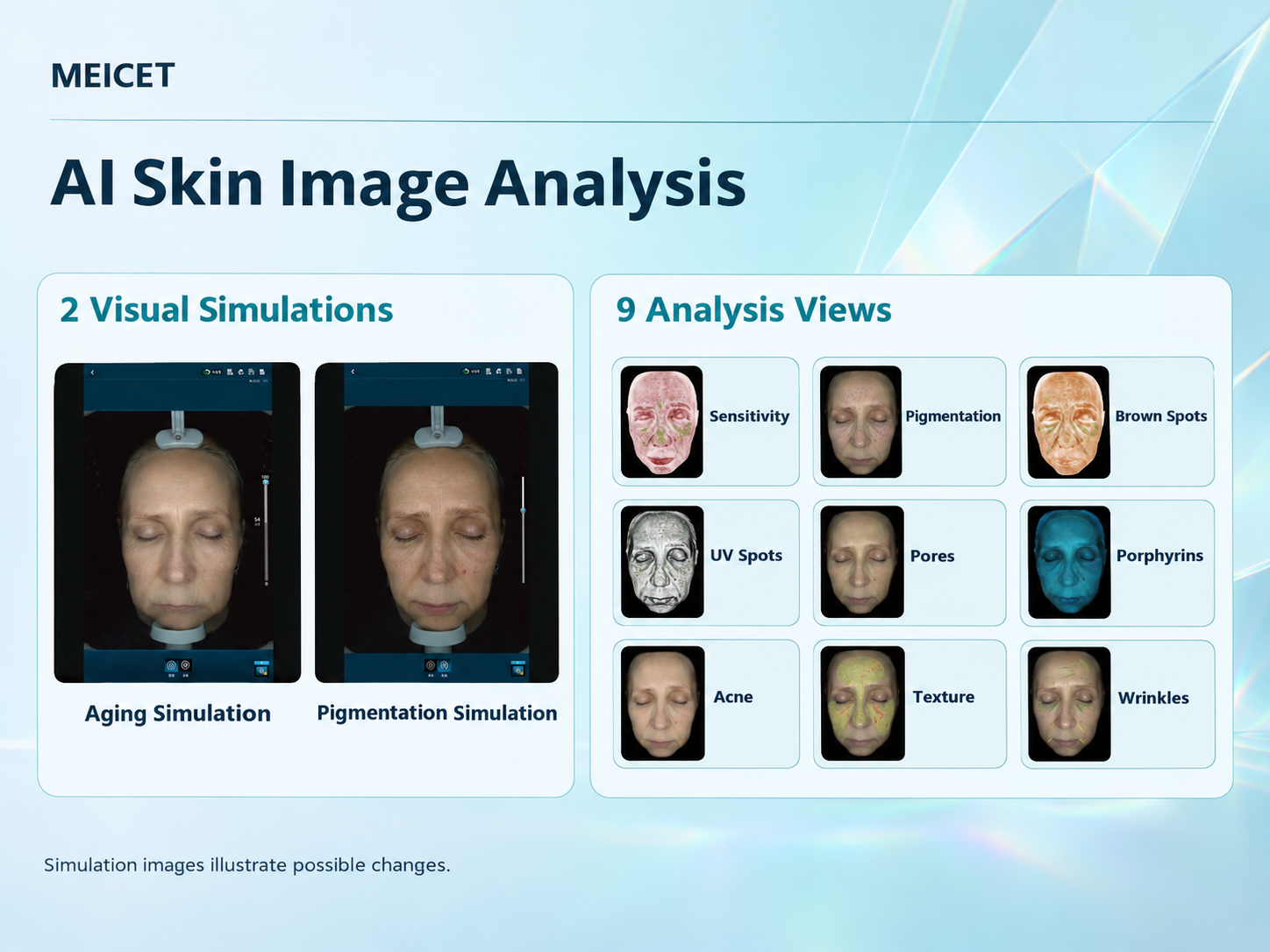
Choosing the right face analysis machine for a beauty salon or skin clinic requires matching imaging capability to your most frequent consultation type—not chasing the highest specification. A practical decision framework prioritizes spectral range (UV and cross-polarized imaging for pigmentation and vascularity), capture repeatability (fixed head positioning for longitudinal comparison), AI output actionability (reports that drive treatment and retail decisions), and total cost of ownership including training and calibration. Multi-spectral imaging stations typically range from approximately $2,700 to $18,000, while software-only AI solutions use subscription pricing. The global aesthetic devices market is projected to reach $10.23 billion by 2032, growing at 5.2% CAGR, with face care devices representing the largest product segment at over 25% share.
- 1 Match imaging technology to revenue model: skin-first practices need multi-spectral diagnostics; contour-focused clinics require true 3D depth sensing.
- 2 Repeatable head positioning (chin and forehead supports) is not a convenience feature—it determines whether before-and-after comparisons are clinically meaningful.
- 3 Verify data privacy compliance before purchase: facial scans constitute biometric data under GDPR and similar regulations.
- 4 AI output should drive a specific next action (treatment protocol, product recommendation, follow-up booking), not merely produce a visually impressive report.
- 5 The MEICET Pro-D offers 50+ skin dimensions with AI aging simulation and standardized capture, positioned for skin-focused salons and aesthetic clinics.
Start with Your Consultation Mix, Not the Spec Sheet
The most common buying mistake is selecting equipment based on technical specifications rather than the consultations your practice actually delivers. A skin clinic that performs 80% pigmentation and texture treatments does not need 3D volumetric mapping. A medical aesthetics practice that sells dermal fillers and thread lifts cannot rely solely on surface imaging to quantify structural change.
Before evaluating any device, document the last 50 consultations your practice conducted. Categorize each by primary concern: pigment and sun damage, acne and oiliness, texture and fine lines, sensitivity and redness, or facial contour and volume. The resulting distribution directly maps to technology requirements. A practice dominated by the first four categories should prioritize multi-spectral imaging depth. A practice with a substantial contouring component should evaluate true 3D acquisition, either as a primary system or as a complementary second device.
The MEICET Pro-D is engineered around the skin-first profile, offering 50+ skin analysis dimensions covering blemishes, sensitivity, pigmentation, texture, and visible aging. Its AI skin aging analysis maps fine lines across seven facial zones with 81 grading levels—output granularity suited to treatment planning for texture and aging concerns.
What Actually Matters in Daily Operation
Operational fit separates equipment that gets used from equipment that gathers dust. Three criteria determine whether a face analysis machine becomes a revenue-generating asset or a capital expense with a steep learning curve.
A scan that requires ten minutes of positioning and lighting adjustment disrupts consultation flow. Professional systems should complete a full multi-spectral capture in under two minutes. The MEICET Pro-D’s supports guide facial alignment, reducing repositioning time.
The report is a sales tool. If a client cannot understand their primary concern within 30 seconds, the equipment is underperforming. Effective reports use side-by-side imagery (visible light vs UV) to make invisible conditions visible.
A scan disconnected from your CRM creates manual work. Verify if the system exports records and if historical scores are accessible at follow-ups. Manual re-entry imposes hidden labor costs.
Cost Structure: Beyond the Sticker Price
| Cost Category | Typical Consideration | Buyer Action |
|---|---|---|
| Hardware acquisition | Multi-spectral stations: ~$2,700–$18,000; software subscriptions: per-scan or monthly | Request itemized quote including installation |
| Staff training | Initial training included; turnover requires retraining | Ask about training format and cost for additional sessions |
| Calibration & Maintenance | Frequency varies; some require annual service contracts | Confirm calibration schedule and vendor requirements |
| Software updates | AI models improve over time; update policy affects value | Verify if updates are included or subscription-based |
| Data storage | Cloud storage may carry recurring fees | Clarify storage location and backup responsibility |
The Evaluation Checklist: What to Test Before You Buy
A structured demo protocol reveals more about equipment suitability than any brochure.
Matching Vendor Capability to Practice Needs
The vendor relationship extends well beyond the initial sale. Key criteria include local service presence, training depth, software update cadence, and reference customers.
MEICET’s product ecosystem includes both the Pro-D (skin-focused multi-spectral analysis) and the 3D D9 (three-dimensional imaging with AI predictive modeling for aging conditions projected 5–10 years ahead using 12 clinical parameters). This allows buyers to match system capability to practice profile.
Frequently Asked Questions
Multi-spectral imaging stations typically range from $2,700 to $18,000. Entry-level systems below $2,000 often lack the spectral range needed for clinical assessment.
Not usually. 3D capability becomes relevant when the treatment menu includes contouring, lifting, or injectables where volume and symmetry quantification matter.
“3D simulation” morphs a 2D photograph. “3D scanning” captures actual depth data using hardware sensors. The two are not equivalent in accuracy.
Crucial for pigmentation, sun damage, and acne. UV reveals porphyrin activity and subsurface pigment patterns invisible to the naked eye.
Ask where images are stored, retention periods, and GDPR/HIPAA compliance. Facial scans are biometric data and require compliant handling.
Post time: Nov-19-2026


