


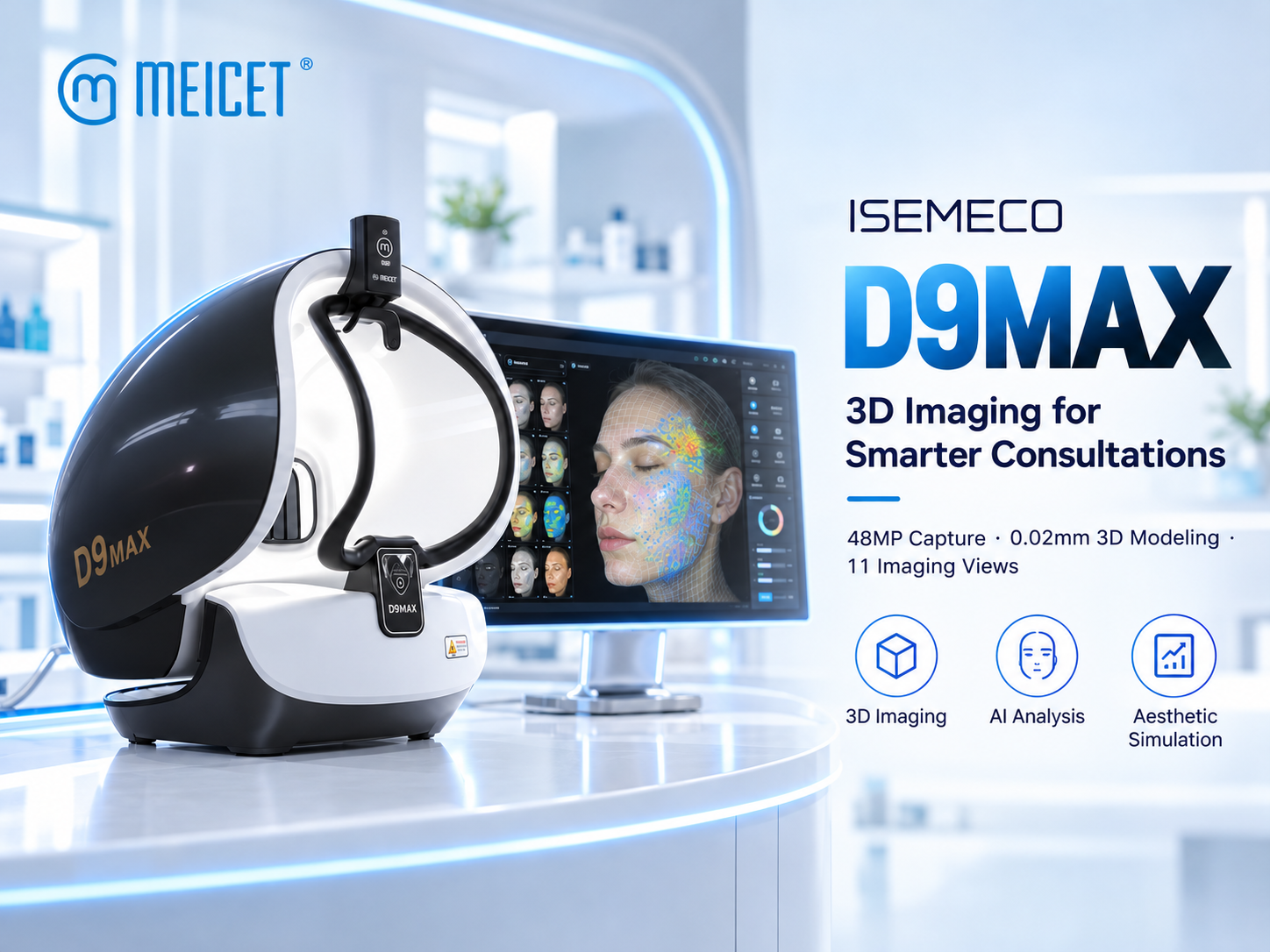
A professional 3D skin analyzer like the ISEMECO 3D D9 requires tiered calibration: daily or per-session quick checks by the clinic operator, monthly functional verification with traceable reference standards, and annual or semi-annual full calibration performed by the manufacturer, an authorized service partner, or an accredited laboratory. Industry practice for multispectral 3D systems places the formal calibration interval at 6–12 months, driven by UV light source degradation and sensor drift. The D9’s 0.2mm modeling accuracy and 0.1ml volume precision claims depend on maintaining optical alignment, which can drift during shipping and use. Calibration responsibility splits between the clinic (routine checks and log-keeping) and the supplier (formal recalibration, parts replacement, and certificate issuance).
Calibration frequency for a skin analyzer is not a single number; it is a schedule with three tiers, each serving a different function. The tiers differ in who performs them, what equipment is used, and what documentation is produced.
Before the first patient scan of the day, the operator verifies that the system powers on, the light sources illuminate correctly across all spectral modes (RGB, cross-polarized, UV, parallel-polarized), and the imaging software captures and displays an image without errors. A neutral reference patch or a standard test target confirms system stability after warm-up. This check takes minutes and does not require calibration equipment.
Monthly checks verify spectral response, light intensity consistency, and imaging geometry using traceable reference panels. For the D9, this includes confirming that the structured-light pattern projects cleanly, that the camera captures the full 40°×40° field of view without distortion, and that the Fitzpatrick skin type classification thresholds are functioning as expected.
Formal calibration addresses sensor drift, firmware baseline verification, and replacement of aging optical or light source components. For multispectral 3D systems, the standard interval is 6–12 months. This tier requires the supplier’s factory service, an authorized regional service partner, or an accredited calibration laboratory.
| Calibration Tier | Frequency | Performed By | What Is Checked | Documentation |
|---|---|---|---|---|
| Quick check | Daily / per session | Clinic operator | Power, light modes, image capture, warm-up stability | Internal log |
| Functional verification | Monthly | Clinic or trained technician | Spectral response, intensity, geometry, Fitzpatrick thresholds | Internal log with reference target results |
| Full calibration | 6–12 months | Supplier, authorized partner, or accredited lab | Sensor drift, firmware, optical alignment, light source replacement | Calibration certificate per serial number |
The clinic operator cannot perform full calibration of a structured-light 3D system. The D9’s 0.2mm modeling accuracy depends on the precise alignment of the binocular grating projector, the 1-inch CMOS sensor, and the 650nm laser band.
- Daily quick checks before patient use
- Monthly functional verification with reference targets
- Maintaining a calibration log (dates, names, results)
- Scheduling formal calibration before expiry
- Storing the device in a stable environment
- Reporting any observed drift to the supplier
- Providing initial calibration certificate at delivery
- Performing formal recalibration at specified intervals
- Supplying replacement parts (lights, optics)
- Issuing a new calibration certificate after service
- Providing technical support for clinic checks
The D9’s accuracy claims (0.2mm modeling, 0.1ml volume) are only valid while calibration is current. Without current calibration, measurements may no longer be traceable to a known standard. For bulk buyers, per-unit calibration certificates are non-negotiable. A 100-unit order requires 100 individual certificates referencing unique serial numbers.
Annual calibration and maintenance costs should be budgeted at 5–15% of the initial equipment cost ($500–$2,250 per year for D9-class devices). The D9’s three-year calibration cost is estimated at $1,500–$3,000.
The standard interval is 6–12 months. Clinic should confirm the specific interval with MEICET and schedule before the certificate expires.
Full calibration requires the supplier, an authorized partner, or an accredited lab. Clinic operators only perform daily and monthly verifications.
No. Adjusting the 0.2mm modeling accuracy requires specialized factory equipment and service firmware. The clinic’s role is verification only.
Measurements may no longer be traceable to standards, representing a quality risk. Missed calibration may also void warranty coverage.
Yes. Each D9 must have a certificate referencing its unique serial number. Batch certificates are insufficient for clinical claims.
Budget 5–15% of the initial equipment cost annually (approx. $500–$2,250 per year). Check for prepaid service contracts.
Confirm if the adjustment is automatic or manual. Request performance data disaggregated by Fitzpatrick group and verify across a range of skin tones during calibration.
Post time: Nov-16-2026


