


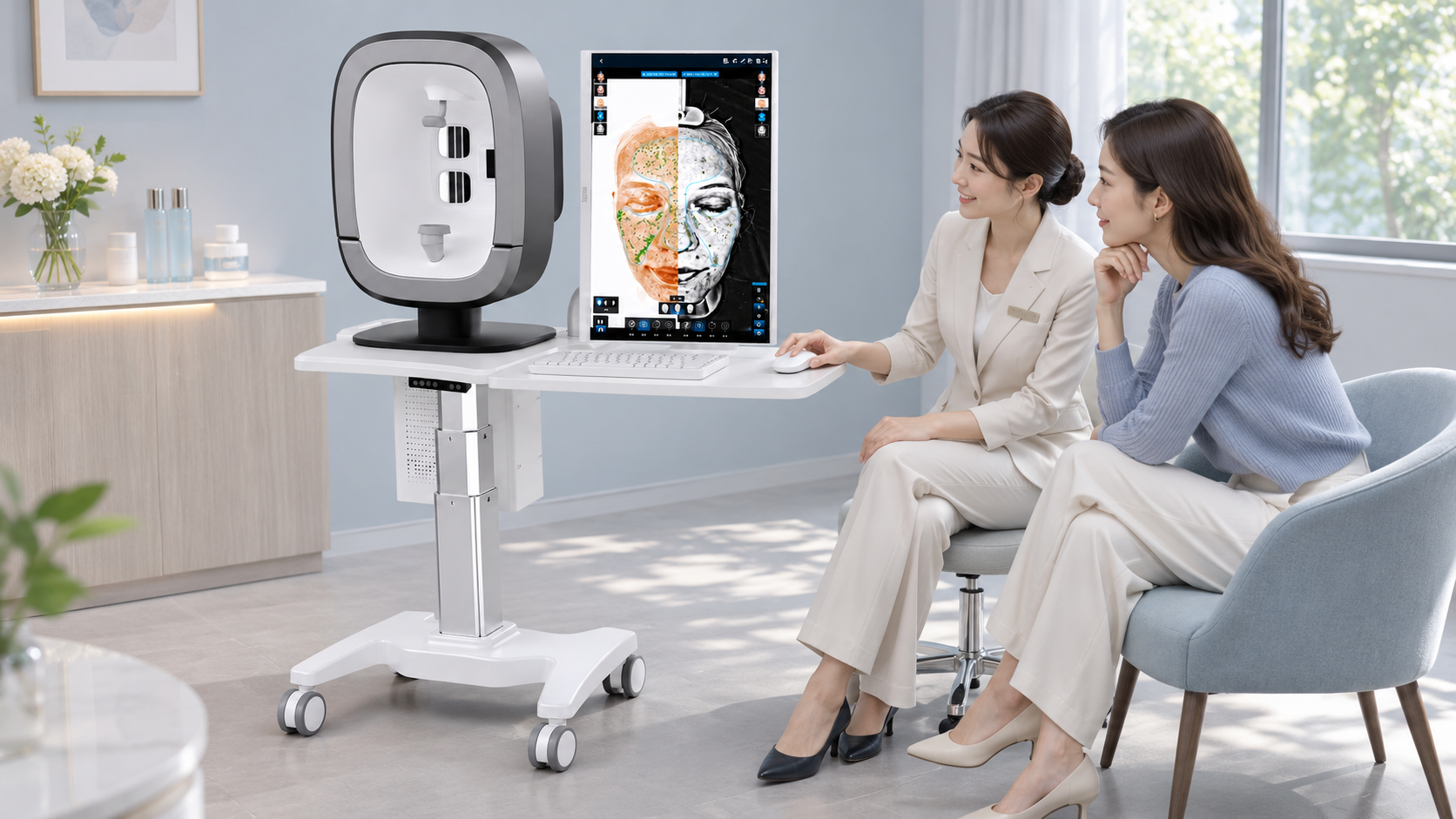
Professional face analysis machine pricing in 2027 spans a wide range driven by imaging capability, hardware build, and software depth. Entry-level AI skin analyzers with basic multi-spectral capture list between $800 and $1,650, while mid-tier systems with higher-resolution sensors and comparison workflows range from $1,650 to $3,500. Clinical-grade multi-spectral stations with UV, cross-polarized, and 3D texture mapping—such as the ISEMECO S7—typically sit in the $3,000 to $8,000+ bracket depending on configuration and regional distribution. True 3D depth-sensing systems command a further premium. The global AI skin analysis market is projected to grow from $2.3 billion in 2026 to $8.3 billion by 2034 at a 17.3% CAGR, reflecting sustained demand for data-backed consultations.
Key Takeaways:
- ✔ Hardware specification, not brand, is the primary cost driver: sensor resolution, spectral range (UV and polarized modes), and 3D capability separate price tiers.
- ✔ The $800–$1,650 range buys functional AI skin analysis suitable for salons; clinical documentation with repeatable capture and advanced comparison typically requires $2,500+.
- ✔ Total cost of ownership includes training, calibration, software updates, and potential cloud storage fees—budget 15–25% above sticker price for year one.
- ✔ The ISEMECO S7 offers 20MP full-face resolution, nine-image simultaneous display, and 3D texture visualization—specifications that position it in the professional clinical tier.
- ✔ Regional pricing varies significantly; direct-from-manufacturer procurement can reduce cost but shifts service responsibility to the buyer.
The 2027 Price Landscape: What Buyers Actually Face
Quoted prices for professional face analysis machines in 2027 reflect a market segmented by imaging fidelity and clinical workflow depth, not by brand prestige alone. The most visible price spread appears in B2B wholesale listings, where AI skin analyzers with “3D” marketing labels range from under $1,000 to over $3,500 for what appear to be similar form factors. The specification differences behind those prices determine whether the device produces diagnostic-grade data or cosmetic visualization.
Three distinct price tiers have stabilized in the professional market. The entry tier ($800 to $1,650) delivers basic multi-spectral imaging. The mid tier ($1,650 to $3,500) adds higher-resolution sensors and multi-image comparison. The clinical tier ($3,000 to $8,000+) provides the full diagnostic stack: high-megapixel optics, comprehensive spectral coverage, and longitudinal tracking.
The ISEMECO S7 sits firmly in the clinical tier. Its specifications include a 20-million-pixel full-face sensor, LED lighting technology, nine-image simultaneous display, and 3D surface visualization. The system’s weight of 120 kg and vertical footprint indicate a fixed-installation clinical device rather than a portable salon accessory.
What Drives the Price: A Component-Level Breakdown
1. Sensor and Optical Quality
The ISEMECO S7’s 20MP sensor is substantially above the 8–12MP range common in entry-level systems, providing meaningful diagnostic information.
2. Spectral Range
UV fluorescence and cross-polarized imaging require dedicated optical paths. Nine-image simultaneous display increases hardware cost but improves efficiency.
3. True 3D Capability
Hardware depth sensing adds substantially to cost compared to simple software visualization. The S7 visualizes surface topography for wrinkles and sagging.
4. Workflow Software
Integrated symptom annotation, measurement tools, and longitudinal tracking represent significant software development investment.
Total Cost of Ownership: What the Sticker Price Misses
| Cost Component | Typical Range | Notes |
|---|---|---|
| Hardware acquisition | $800–$8,000+ | Negotiable; direct-from-manufacturer may exclude service |
| Installation and setup | $0–$500 | Floor-standing units may require delivery and assembly |
| Staff training | $200–$800 | Turnover requires retraining; budget for annual refreshers |
| Calibration/Maintenance | $100–$500/year | Frequency varies by system stability |
| Software updates | $0–$300/year | AI models and reporting interfaces improve over time |
Is the Premium Tier Worth It? A Decision Framework
The clinical tier justifies its price when revenue depends on diagnostic credibility. Consider these three questions:
1. Does the practice sell treatments requiring quantified evidence?
2. Is the consultation itself a revenue driver or a cost center?
3. What is the competitive positioning?
For practices answering “yes” to all three, the clinical tier is infrastructure, not a luxury.
Frequently Asked Questions
How much does a professional face analysis machine cost in 2027?
Entry-level: $800–$1,650. Mid-tier: $1,650–$3,500. Clinical-grade (e.g., ISEMECO S7): $3,000–$8,000+.
Why do some “3D” skin analyzers cost under $1,000 while others cost over $5,000?
Low-priced devices use software for 3D-like rendering; high-priced systems use hardware depth sensing or advanced computational reconstruction.
What specifications should I prioritize at each price tier?
Entry: Spectral range over resolution. Mid: Repeatable positioning and comparison workflows. Clinical: Optical quality and calibration stability.
Does the ISEMECO S7 require special installation or power?
Operates on 24V/5A DC (50W-70W) via USB 3.0 Type-B. Requires stable space for its 120 kg weight and 1070mm × 890mm footprint.
How does the ISEMECO S7 compare to the MEICET Pro-D for salon use?
The S7 is optimized for clinical documentation (20MP, 3D visualization) for medical aesthetics. The Pro-D is aligned with beauty salons prioritizing consultative workflow and AI aging analysis.
Post time: Nov-19-2026


