


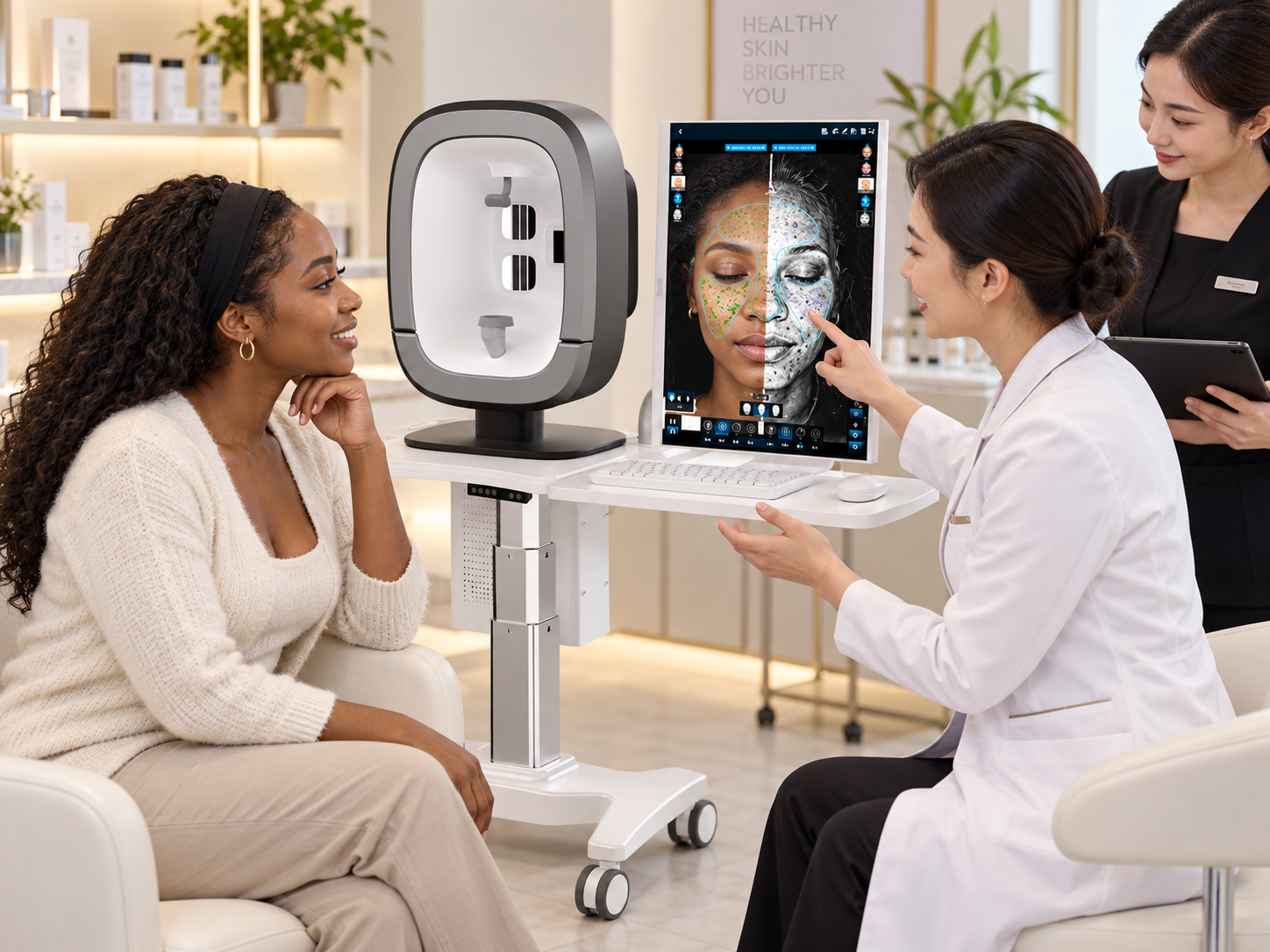
Developing and manufacturing a custom 3D skin analyzer takes 4 weeks to 18 months, determined almost entirely by customization depth rather than manufacturing speed. Logo and packaging changes on an existing platform like the MEICET 3D MD300 require 4–8 weeks for samples. Custom hardware extends to 8–16 weeks for samples, plus 4–6 weeks for production mold fabrication.
4–8 week project. Uses existing certified hardware and triggers no electrical safety re-testing.
Adds tooling and regulatory time. Custom molds require 4–6 weeks for production tooling.
Fast but conditional. Safety reports in 10 days to 2 weeks, but failed EMC tests add 2–4 weeks.
Can add 6–24 months of registration time depending on the market and device class.
A clinic chain or distributor requesting a custom 3D skin analyzer typically receives timeline quotes that vary by a factor of ten. The variance is not dishonesty—it reflects different assumptions about what “custom” means. A supplier quoting 6 weeks is describing logo printing on a finished MEICET 3D MD300. A supplier quoting 14 months is describing custom hardware development plus medical device registration for diagnostic claims.
Custom 3D skin analyzer development is not a single sequential process; it is four parallel workstreams with different minimum durations. The total project timeline is determined by the longest workstream, not the sum of all four.
Workstream 1: Design and engineering. Cosmetic and software-only changes require 2–4 weeks. Tooling-dependent changes require 8–16 weeks for samples. Injection mold production tooling takes 4–6 weeks.
Workstream 2: Hardware manufacturing preparation. Includes component sourcing and assembly line setup. Abbreviated for MD300 platform projects.
Workstream 3: Regulatory testing. IEC 60601-1 reports in 10 days to 2 weeks. Biocompatibility testing (ISO 10993) adds 4–8 weeks.
Workstream 4: Market registration. NMPA Class II (6–12 months), Class III (12–24+ months), EU MDR (~6 months).
| Customization Scope | Design & Engineering | Tooling | Regulatory Re-testing | Total Timeline |
|---|---|---|---|---|
| Logo + packaging on MD300 | 2–4 weeks | None | None | 4–8 weeks |
| Custom enclosure on platform | 8–16 weeks | 4–6 weeks | 10 days–2 weeks | 16–24 weeks |
| New device (Diagnostic) | 12–24+ months | Included | Full test battery | 18–36+ months |
The MEICET 3D MD300 has published specifications including 0.2mm 3D modeling accuracy and 32 million full-face pixels. A skin analyzer platform that already exists can compress the development cycle to 8–16 weeks for customized variants, avoiding the 12–24 month cycle required for a new device from scratch.
Warning: The single most common cause of timeline overrun is regulatory testing. If the modification touches the electrical enclosure, LED driver, or optical path, existing reports do not apply. EMC failure adds 2–4 weeks per remediation cycle.
Yes, but only for logo application and packaging on an existing, certified platform like the MD300, with no hardware or software changes.
Tooling fabrication usually wins. Production injection molds require 4–6 weeks from design lock to first parts.
Cosmetic changes typically do not invalidate reports. Hardware changes require full re-testing.
It adds 6–24+ months depending on the class (NMPA/EU MDR). This is regulatory processing time, not manufacturing time.
Yes, experienced manufacturers overlap these workstreams to compress the schedule to minimum lead times.
Post time: Nov-04-2026


