


Quick Answer
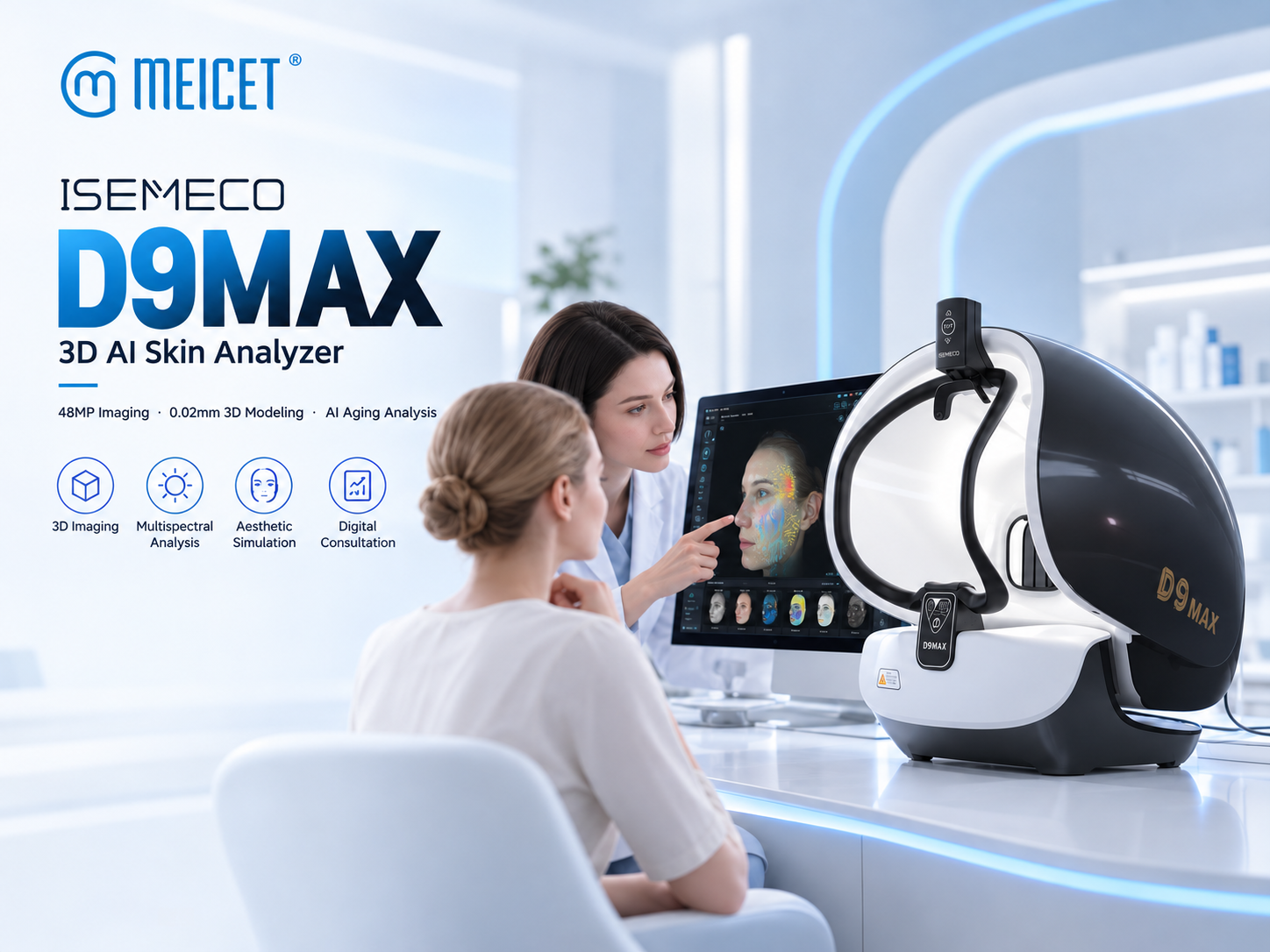
Payback speed for a skin analyzer depends almost entirely on utilization and conversion, not on the device’s feature list. For a salon integrating a professional 3D analyzer into every consultation, modeled payback ranges from roughly 3.5–5 months in an expected-case scenario to about 10 months in a conservative scenario, with best-case figures under two months achievable only at high scan volume and conversion. For a distributor, payback depends on inventory turnover and dealer margin rather than per-scan revenue, and typically requires selling through 3–5 units to recover the initial stocking investment. The ISEMECO D9MAX’s upgraded specifications—0.02mm modeling accuracy, 48-megapixel full-face capture, and 30-second AI report generation—strengthen the consultation-to-treatment conversion lever that drives salon payback.
Key Takeaways
Utilization is the strongest controllable variable: A scanner used in every consultation pays back far faster than one used occasionally.
Expected-case salon payback is 3.5–5 months: This assumes roughly 40 scans per month at 25% conversion.
Charging for the scan accelerates payback: A $25 scan fee credited toward treatment adds direct revenue and filters for serious clients.
D9MAX upgrades the conversion argument: The 10× improvement in structured-light camera precision and the 30-second AI report make the consultation demonstration faster and more visually compelling.
Distributor payback follows unit sell-through: The relevant metric is how many units must be sold to cover stocking costs, not per-scan revenue.
The Salon Payback Model: Utilization and Conversion Drive Everything
A salon’s skin analyzer payback period is determined by two variables: how many clients are scanned per month, and what percentage of those scans convert to booked treatments. The device’s technical specifications set the ceiling on what the consultation can demonstrate, but the operational discipline of using it consistently sets the floor on payback speed.
A published payback model for salon skin analyzers illustrates the range clearly. In the expected case, 40 scans per month at 25% conversion produces payback in roughly 3.5 to 5 months. In the conservative case, 25 scans per month at 15% conversion stretches payback to approximately 10 months.
| Scenario | Scans/Month | Conversion Rate | Modeled Payback | How to Use This Figure |
|---|---|---|---|---|
| Conservative | 25 | 15% | ~10 months | Budget against this number |
| Expected | 40 | 25% | ~3.5–5 months | Plan operations around this |
| Best case | 60 | 35% | ~6 weeks | Know it exists; do not bank on it |
The model assumes the scanner is embedded in the consultation workflow, not used as an occasional add-on. The failure pattern that destroys payback is the “month-three slump”: initial enthusiasm fades, the scanner migrates to a storage room, and the payback clock keeps running with zero contribution.
What the D9MAX Changes About the Payback Equation
The D9MAX’s hardware upgrades target the conversion lever directly. The base D9 platform already supports 3D aesthetic simulation and 0.1ml volume difference calculation, features that allow clinicians to show patients a visual preview of treatment outcomes. MEICET materials state that more than 90% of clients want to see a simulated result before proceeding with treatment.
Accuracy: Modeling accuracy improves from 0.2mm to 0.02mm. This 10× improvement means subtle contour changes and fine lines become measurable, supporting credible recommendations.
Resolution: Full-face pixel count increases to 48 megapixels. Higher resolution produces sharper before-after comparisons, critical for visual persuasion.
Speed: AI report generation time is 30 seconds. A report that generates in half a minute keeps the consultation momentum fresh.
The Distributor Payback Model: Unit Economics, Not Scans
A distributor’s payback calculation follows a different logic from a salon’s. The distributor does not generate revenue per scan; the distributor generates revenue per unit sold. Payback occurs when cumulative gross margin from unit sales covers the initial stocking investment, promotional costs, and working capital tied up in inventory.
The relevant variables for a distributor are:
- Dealer acquisition cost (DAC): the landed cost per unit from the manufacturer
- Selling price to sub-dealers or clinics
- Sell-through velocity: how many units per month the network absorbs
- Inventory carrying cost: the working capital tied up in unsold stock
Five Operational Levers That Cut Months Off Salon Payback
Make the scan step one of every consultation, documented in the SOP.
Charge a $25 scan fee credited toward treatment to filter for serious clients.
Connect data findings directly to treatment recommendations.
Keep the scanner where consultations happen, not in a closet.
Ensure features like 0.02mm accuracy match your high-value treatment menu.
What the Payback Model Does Not Capture
The payback model is a planning tool, not a guarantee. Three factors that affect real-world outcomes include:
Retention and repeat visits: Progress scans keep clients engaged long after the initial investment is recovered.
Conversion rate variability: The device enables conversion through features like 3D simulation, but staff training determines the final rate.
Traffic Bottlenecks: A scanner amplifies an existing business—it cannot create traffic where none exists.
FAQ
What is a realistic payback period for a salon skin analyzer?
Plan against the conservative case of roughly 10 months, with the expectation that disciplined utilization can bring it to 3.5–5 months.
How many scans per month does a salon need to break even?
25 scans per month supports a 10-month timeline. Below 15 scans per month, the investment becomes difficult to justify financially.
What is the D9MAX’s advantage over the base D9 for payback purposes?
The 10× improvement in modeling accuracy and 48MP resolution produce sharper simulations, strengthening the conversion lever.
How does a distributor calculate payback differently?
Based on unit sell-through. Breakeven occurs when cumulative gross margin covers the initial order and carrying costs.
What is the biggest risk to payback after purchase?
The “month-three slump” where the device stops being used. Mandatory SOP integration is the primary defense.
Post time: Nov-16-2026


