


Quick Answer
Choosing a reliable 3D skin analyzer manufacturer requires verifying four evidence-based dimensions: certification scope tied to the actual manufacturing entity (ISO 13485, not just a trading company’s certificate), documented 3D capture technology (structured light vs. simulated depth, with published precision like the ISEMECO D9′s 0.2mm to 0.1mm modeling accuracy), software governance and algorithm validation (training data composition, update policies, cybersecurity controls), and after-sales infrastructure with contactable references. The global skin analysis systems market continues to expand, driven by demand for personalized skincare and non-invasive diagnostics. But market growth does not guarantee supplier reliability. A manufacturer that cannot provide factory-level certification, live measurement demonstrations, and year-two support evidence should be disqualified before price negotiation begins.
Key Takeaways
- ✔ ISO 13485 certification must name the factory, not the trading office: a certificate for a parent entity or distributor does not qualify the production site.
- ✔ Structured light is the technical threshold: the D9 uses binocular grating structured light with 0.2mm precision (standard) or 0.1mm (advanced configuration), enabling true volumetric measurement.
- ✔ Algorithm validation must include skin type representation: the D9 includes Fitzpatrick I–VI adjustment; ask whether performance data is disaggregated by skin tone.
- ✔ After-sales response time and spare-parts availability determine device lifespan: a supplier without regional parts inventory leaves clinics with idle equipment.
- ✔ Contactable references from comparable markets are the only proof of year-two support quality.
1 Dimension 1: Certification and Quality System Integrity
The foundational verification is whether the manufacturer operates a certified quality management system for the specific factory producing your devices.
ISO 13485: The Baseline Requirement
ISO 13485:2016 specifies quality management system requirements for organizations involved in the design, development, production, storage, distribution, installation, or servicing of medical devices. For a skin analyzer marketed for clinical or aesthetic applications, this certification is the minimum threshold.
The U.S. FDA’s Quality Management System Regulation (QMSR), effective February 2026, explicitly incorporates ISO 13485 by reference, requiring manufacturers to document a quality management system that complies with ISO 13485. This harmonization means ISO 13485 certification is not merely a European requirement—it is increasingly the global standard for medical device quality systems.
- The certificate must name the actual manufacturing entity, not a trading affiliate or parent holding company.
- The scope must cover “design and manufacture of medical imaging equipment” or equivalent language.
- The certificate number should be verifiable through the issuing body’s database.
What a Trading Company Cannot Provide
A trading company may present an ISO certificate for its own sales operations, but that certificate does not cover the factory producing the devices. When calibration is needed, when software requires validation, when a component fails—the trading company has no quality system authority over the manufacturing process. The buyer inherits unmanaged risk.
2 Dimension 2: 3D Capture Technology and Published Precision
The technical threshold for a “3D” skin analyzer is true structured-light depth measurement, not stereo vision or software-simulated depth.
The ISEMECO D9 Technology Stack
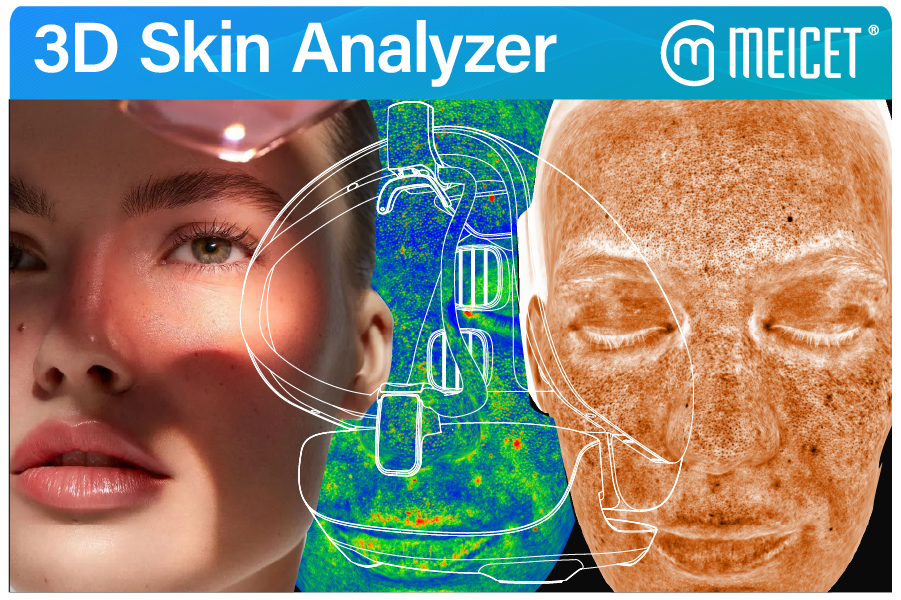
The ISEMECO D9 uses binocular grating structured light—projecting a known pattern and calculating depth from its deformation across two camera viewpoints. MEICET’s product documentation reports:
- Standard D9: 0.2mm modeling accuracy, 36 million full-face pixels, 180° full-face capture in a single scan.
- Advanced configuration: 0.1mm high-precision 3D modeling with fully automatic external scanning.
- Volume change tracking: 0.1ml precision for confirming filler or botulinum toxin efficacy.
What to Ask: “What is the exact capture method, and can you demonstrate a measurement on a reference object?” A manufacturer using structured light will welcome this demonstration. A supplier using simulated depth will deflect.
3 Dimension 3: Software Governance and Algorithm Validation
Software determines whether captured data becomes defensible clinical information—or an opaque score. The manufacturer’s software lifecycle process is as important as the hardware specifications.
Algorithm Training and Skin Type Representation
The D9′s aging model is described as using AI deep learning technology built on big data skin images to construct an 8-dimension aging index covering forehead lines, glabellar lines, crow’s feet, periorbital lines, laugh lines, marionette lines, corner of mouth lines, and brown spots.
The D9 includes Fitzpatrick I–VI skin type adjustment to avoid errors across different skin tones. The critical question is whether this adjustment is automatic (algorithm detects skin type) or manual (operator selects), and whether the manufacturer has performance data demonstrating consistent accuracy across types.
Software Update and Cybersecurity Governance
A device that stores patient images and may connect to clinic networks requires documented cybersecurity controls. Ask:
- How are algorithm updates validated before release?
- Can updates be rolled back if performance degrades?
- What data encryption and access controls are implemented?
4 Dimension 4: After-Sales Infrastructure and Reference Verification
The device’s useful life depends on support quality in year two and beyond.
Spare Parts & Response
Ask where critical components are stocked regionally and what the documented response time is for technical issues. A supplier without defined SLAs has not institutionalized service.
Contactable References
Request three references who have used the device for 12+ months. Testimonials are marketing; actual client feedback on year-two support is evidence.
Manufacturer Reliability Verification Checklist
| Verification Area | Critical Question | What a Good Answer Looks Like | Red Flag |
|---|---|---|---|
| Quality system | Does your ISO 13485 certificate name the manufacturing site? | Certificate entity matches factory | Certificate for trading company |
| 3D technology | What is the capture method? | Structured light; live measurement demo | “It’s 3D” without method detail |
| Precision | What is the modeling accuracy? | 0.2mm (standard) or 0.1mm (advanced) | Unspecified or “high precision” |
| Algorithm fairness | Do you have performance data by Fitzpatrick type? | Disaggregated data available | “Works on all skin types” without data |
| Software governance | How are updates validated and rolled back? | Documented change control | “Updates are automatic” |
| After-sales | What is your response time SLA? | Defined in hours | “We respond quickly” |
| References | Can you provide three contactable references? | References from comparable markets | No references or unreachable |
Frequently Asked Questions
What is the most important factor when choosing a 3D skin analyzer manufacturer?
ISO 13485 certification for the actual manufacturing entity. Without a certified quality system covering the factory, every other commitment rests on an unverified foundation.
How do I verify that the manufacturer’s 3D claims are real?
Request a live measurement demonstration on a known reference object. The ISEMECO D9′s 0.2mm or 0.1mm modeling accuracy is a verifiable geometric claim.
What algorithm validation data should I request?
Request performance data disaggregated by Fitzpatrick skin type (I–II, III–IV, V–VI). The D9 includes Fitzpatrick I–VI adjustment, but verification requires data demonstrating consistent accuracy across types.
How do I evaluate software governance?
Ask about validation processes before release, rollback capabilities, and implemented cybersecurity controls. A manufacturer without documented change control cannot credibly support the device long-term.
What after-sales commitments should be in writing?
Response time in hours, spare parts availability for 5–7 years, training scope, and software update policy (included or separately priced).
Does MEICET/ISEMECO support OEM/ODM for distributors?
MEICET’s company information states that it has the capability to offer OEM and ODM services and has been focused on the skin analyzer industry since 2008. Verification should include factory audit access and R&D staff confirmation.
Post time: Oct-23-2026


