


Quick Answer
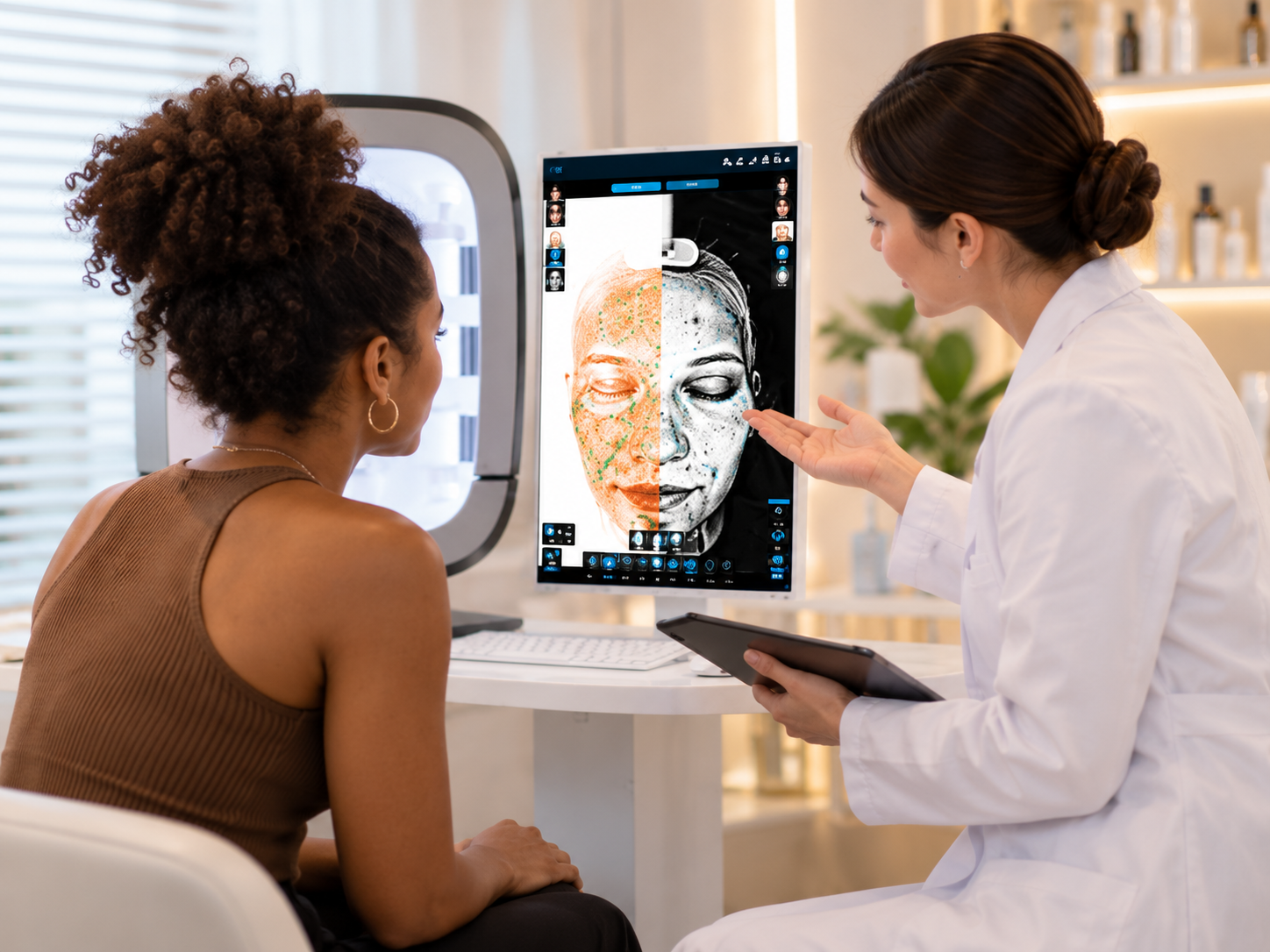
Beauty clinic chains can standardize skin assessment with 3D skin analyzers by treating the device as a data standardization infrastructure, not a collection of standalone cameras. The standardization requires three layers working together: a consistent capture protocol across all locations (same device model, same lighting, same positioning), a centralized cloud data platform that aggregates patient records from every device into one searchable archive, and a defined clinical interpretation framework that links device outputs to standardized treatment recommendations. MEICET/ISEMECO’s “Skin Cloud” platform directly addresses the multi-location fragmentation problem, consolidating customer profiles, scan images, analysis reports, and treatment histories from all connected devices into a single cloud-based system with role-based access controls.
Device Consistency: The foundation of standardization. A chain using different 3D analyzer models across locations cannot compare scan results longitudinally.
Cloud Assets: The cloud layer converts scattered devices into a unified data asset, creating a single customer profile accessible from any location.
Clinical Protocol: Standardization fails without a clinical interpretation protocol and documented grading thresholds.
Permission Management: Role-based access ensures privacy and operational hierarchy in larger organizations.
Skin type classification is a standardization variable that chains often overlook. The Fitzpatrick scale was developed for Caucasian skin and over-concentrates Chinese populations into Types II–IV, with Types I, V, and VI rarely represented. A chain serving diverse populations should verify how the device’s classification performs across its actual patient demographic.
A beauty clinic chain with five locations faces a problem that a single clinic does not: the patient who scanned at the downtown location last month and is now consulting at the suburban branch needs their history available at the suburban branch, not locked in a device at the downtown location. The ISEMECO 3D D9 and its ecosystem represent a clinical-grade device platform with published specifications including 0.2mm structured-light modeling, 42 million full-face pixels, and 0.1ml volume-difference precision. But the question of whether that device standardizes assessment across a chain depends less on the capture capability and more on the software architecture and operational protocol behind it.
Standardization begins with identical capture conditions, because a 3D scan is only comparable to another scan if the measurement system is the same. A chain that deploys the D9 at headquarters and a different model at a satellite clinic has created two incompatible datasets, regardless of whether both devices produce “3D” output.
The D9’s published specifications—binocular grating structured light, 0.2mm modeling accuracy, 650nm laser band, 40°×40° field of view—define a specific measurement architecture. The practical rule is: one device model, one calibration standard, one capture protocol across all locations that are expected to share patient data.
| Standardization Variable | Why It Matters for Chains | Verification Action |
|---|---|---|
| Device model | Different models produce non-comparable depth data | Deploy identical model at all locations sharing patient data |
| Calibration status | Drift between devices introduces measurement variance | Request per-device calibration certificates |
| Capture protocol | Operator-dependent variables affect repeatability | Document a written SOP and train all staff |
The Skin Cloud platform is the operational answer to the fragmentation problem. MEICET/ISEMECO launched the platform in August 2026 to solve the issue of scattered data and customer history loss during staff turnover.
- Unified customer archive: Data from all ISEMECO 3D devices aggregated into a single customer profile.
- Cross-location case library: Success cases can be authorized and retrieved across the entire chain.
- Operational data center: Dashboards show demographics and symptom rankings across all connected devices.
A standardized scan is only useful if two clinicians at two locations interpret it the same way. The clinical standardization protocol should address thresholds between grades, Fitzpatrick classification usage, and standard follow-up intervals for longitudinal comparison.
| Standardization Area | Specific Action | Owner |
|---|---|---|
| Device fleet | Procure identical model for all locations | Procurement |
| Calibration | Establish per-device calibration schedule | Operations |
| Cloud data | Deploy Skin Cloud; configure archive | IT/Operations |
Q1: Do all locations in a chain need the same 3D skin analyzer model?
Yes. For locations that share patient data and compare outcomes, different models with different measurement architectures produce data that cannot be directly compared without transformation.
Q2: What does the Skin Cloud actually do that the D9’s built-in software does not?
The Skin Cloud aggregates data from multiple devices and locations into a unified archive, supports cross-location case retrieval, and provides chain-wide operational dashboards.
Q3: How do I standardize interpretation when clinicians have different experience levels?
Define grade-to-action mappings: recommend specific treatment categories for “moderate” vs “severe” findings, and use documented protocols in staff training.
Q7: Can a chain start with one location and scale the standardization later?
Yes, but select the architecture with scaling in mind. It is more cost-effective to standardize on one platform before opening additional locations than migrating a mixed fleet later.
Post time: Nov-04-2026


