


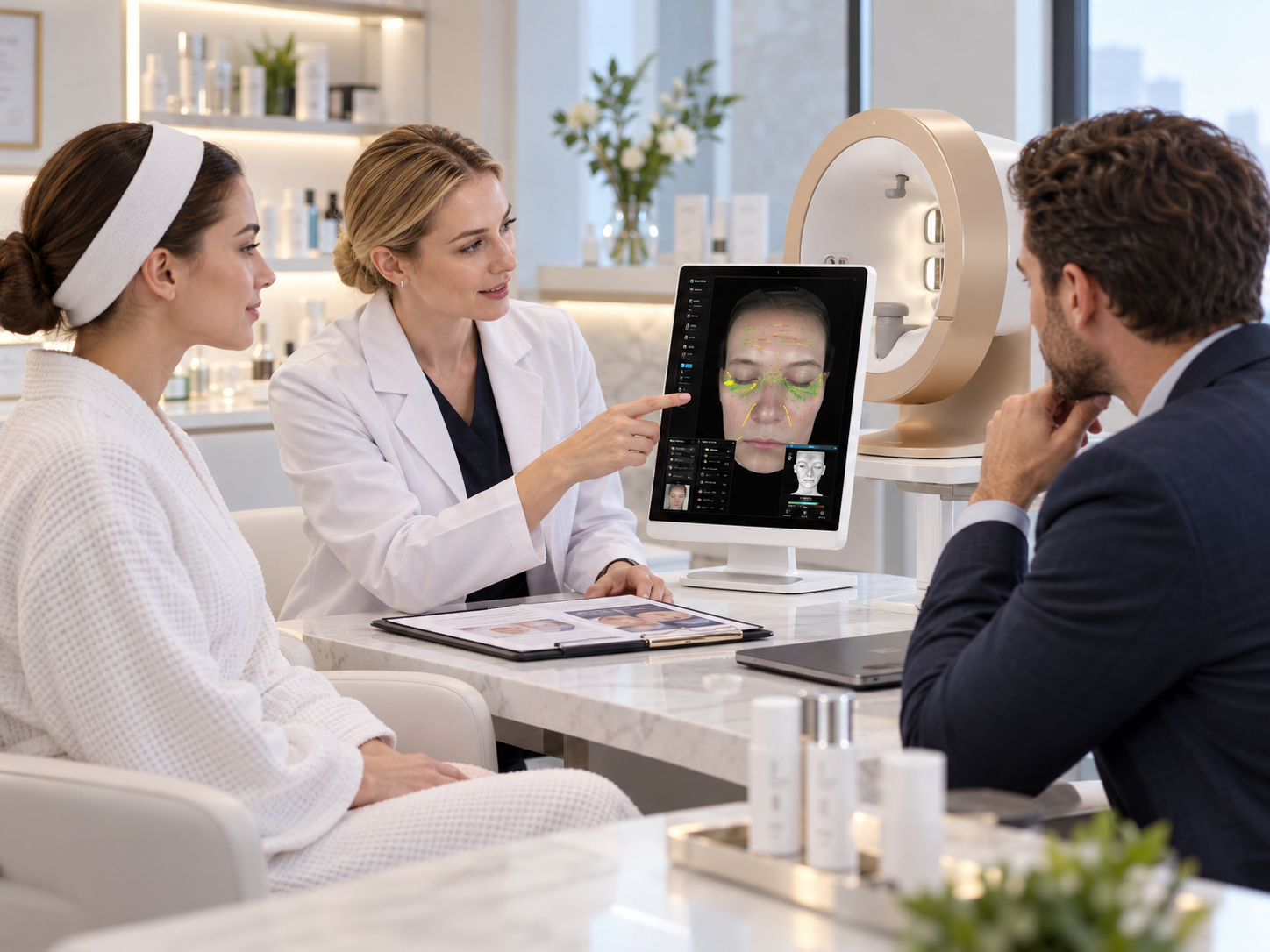
B2B buyers should verify a 3D skin analyzer through a four-layer framework: regulatory certification and quality management system credentials, hardware specification validation against clinical needs, software algorithm transparency and clinical evidence, and independent hands-on testing. For a device like the ISEMECO 3D D9, this means confirming CE/FDA claims with actual certificate numbers, requesting the Declaration of Conformity, verifying the 0.2mm modeling accuracy claim against a physical test, and demanding published or third-party clinical validation of the AI aging analysis. A 2025 FDA guidance on computer software assurance emphasizes that software testing alone is insufficient to establish fitness for intended use—buyers should apply the same risk-based scrutiny to vendor claims. The verification process typically takes 2–4 weeks and prevents costly post-purchase compliance and performance gaps.
Key Takeaways
Certification claims require document-level verification, not brochure logos; request certificate numbers and check issuing bodies.
Hardware specifications must be tested against clinical workflow; 0.2mm accuracy must be repeatable across skin tones.
AI algorithm claims need clinical evidence; absence of published validation studies is a material risk for diagnostic use.
Software updates and data security are critical; algorithm updates without documentation create regulatory exposure.
Certification Verification Must Go Beyond the Logo
A CE or FDA logo on a product page is a marketing statement until the underlying certificate and Declaration of Conformity are verified against the specific model being purchased. The 3D D9 product page lists extensive technical specifications but does not display certificate numbers or issuing bodies. MEICET’s exhibition materials claim CE and FDA certificates, but the buyer’s verification obligation is to obtain the actual documents.
For CE marking, the legally operative document is the EU Declaration of Conformity, which must name the manufacturer, identify the product by model, list applicable directives (likely Machinery Directive and possibly Medical Device Regulation if the device is intended for diagnostic purposes), and bear a signature and date. A CE “certificate” from a testing laboratory is not equivalent to a Declaration of Conformity. For FDA, a device intended for skin analysis may be classified as a Class I or Class II medical device depending on its intended use claims. If MEICET claims FDA clearance, request the 510(k) number (for Class II) or the establishment registration and device listing (for Class I exempt devices).
Quality management system certification is a related but distinct verification. ISO 13485 is the internationally recognized QMS standard for medical device manufacturers. If the 3D D9 is marketed for clinical use by dermatologists and cosmetic surgeons—as the product page states—the manufacturer should hold ISO 13485 certification. Request the certificate number and issuing body, and verify the certification body is accredited by a recognized national accreditation service.
H Hardware Specification Validation: What the Datasheet Does Not Tell You
The 3D D9 datasheet specifies 0.2mm modeling accuracy, 42 million full-face pixels, binocular grating structured light, and a 650nm laser band—but these numbers do not answer the buyer’s real question: will the device produce consistent, clinically useful measurements on my patient population? Verification requires testing the specifications against real-world conditions.
Modeling Accuracy and Repeatability
The 0.2mm modeling accuracy claim should be tested through repeated scans of a stationary reference object and through repeat scans of the same volunteer across multiple sessions. A device that achieves 0.2mm accuracy on a calibration target may perform differently on human skin with varying reflectance, moisture, and hair. Ask the vendor for the test protocol behind the accuracy specification.
Spectral Imaging Capability
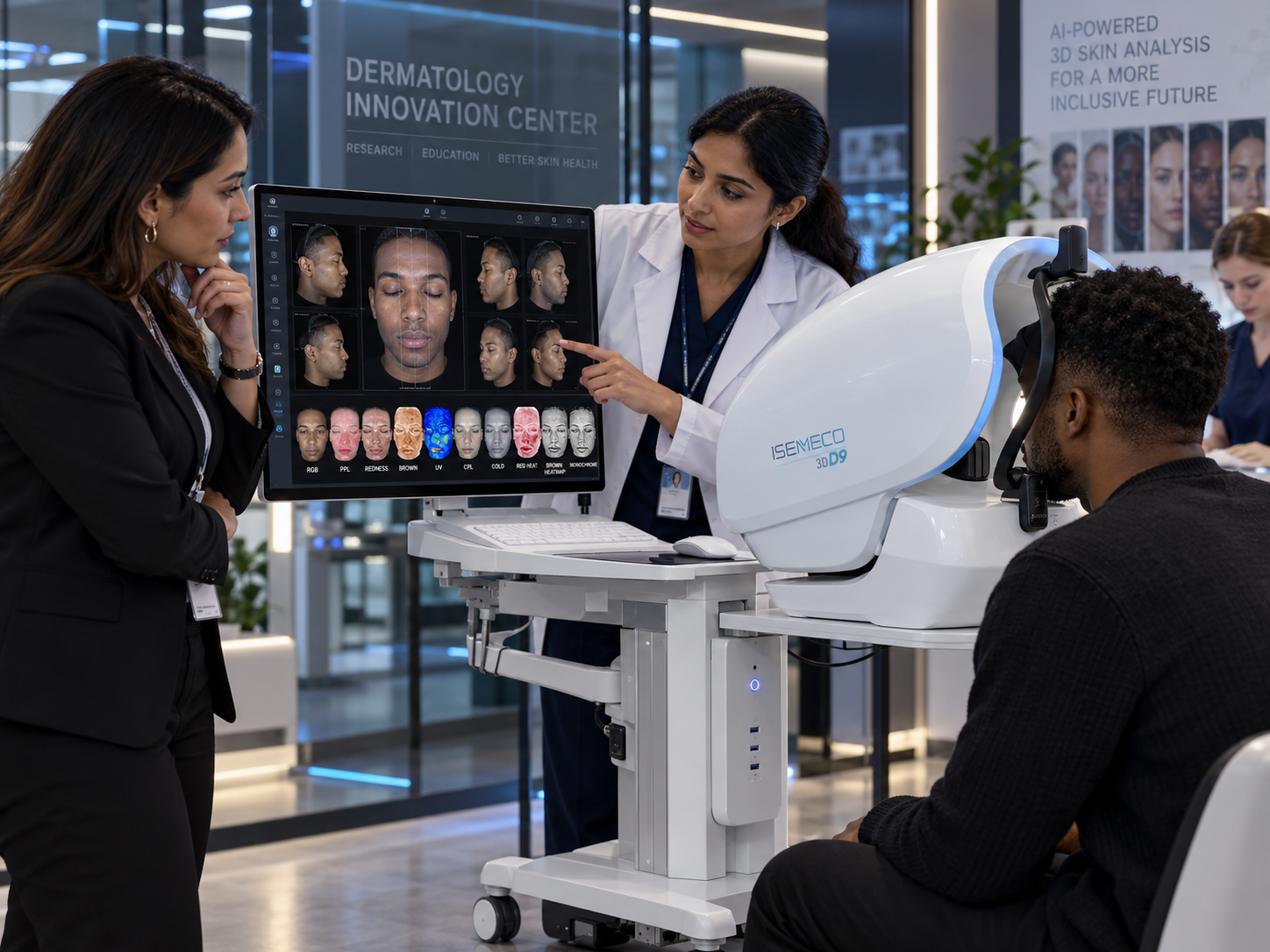
The D9 uses four spectral modes: RGB, cross-polarized, UV, and parallel-polarized light. Verification should confirm that the spectral modes produce images of sufficient resolution and contrast for clinical interpretation, not merely that the modes exist. A practical test: capture images of a volunteer with known features and compare against a dermatoscope reference.
Fitzpatrick Skin Type Coverage
The product page states Fitzpatrick Type I–VI support. Verification should include scanning volunteers across the skin tone spectrum, particularly Type IV–VI, where reflectance-based imaging and AI analysis are more prone to error. Ask the vendor for the demographic distribution of the training dataset.
S Software and AI Algorithm Verification: The Least Transparent Layer
The D9’s AI aging analysis—claiming eight dimensions of facial aging assessment and deep learning-based grading—is the device’s most distinctive feature and the hardest to verify. The product page provides no information on training data composition, validation methodology, or performance metrics.
This opacity is a verification problem. In dermatological imaging, AI performance is highly dependent on the training dataset’s representativeness. A model trained on a narrow demographic or a single imaging device may not generalize. A 2024 study found that volume measurements demonstrated the most variability across systems, while surface area was more consistent. This finding is directly relevant to the D9’s volume difference calculation claims.
Verification steps for the AI layer:
- Request the validation study protocol and results for the aging index model.
- Ask for the demographic and skin-type distribution of the training and validation datasets.
- Request information on how algorithm updates are controlled and whether updates require re-validation.
- Inquire whether the AI output is intended as a diagnostic aid or a visualization tool.
T Independent Testing and Hands-On Evaluation Protocol
A structured hands-on evaluation with your own clinical team and volunteers is the only way to verify usability, workflow fit, and real-world accuracy.
| Test Area | Procedure | Pass Criteria |
|---|---|---|
| Repeatability | Scan the same volunteer 5 times in one session without repositioning | Volume difference coefficient of variation < 5% |
| Reproducibility | Scan the same volunteer across 3 separate sessions on different days | Aging grade classification remains consistent |
| Skin tone coverage | Scan volunteers representing Fitzpatrick Types II, IV, and VI | No visible degradation in 3D model completeness |
| Workflow time | Measure time from patient positioning to completed report | Fits within consultation workflow (< 5 minutes) |
| Software usability | Have a clinician unfamiliar with the device operate it | Able to complete scan without vendor assistance |
What to Ask During the Demonstration:
- “Can you show me the raw 3D mesh, not just the rendered visualization?”
- “What happens when the patient moves during the scan?”
- “How does the system handle patients with facial hair, makeup, or moisturizer?”
- “Show me the comparison overlay between two scans of the same patient taken one month apart.”
After-Sales and Software Lifecycle Verification
A 3D skin analyzer is a software-driven device, and the vendor’s software lifecycle practices determine reliability and compliance over a multi-year service life. Buyers should verify how the vendor manages algorithm updates.
Key Questions for the Vendor:
- What is the software update cadence?
- Are updates accompanied by change control documentation?
- Does the system operate offline or require cloud connectivity?
- What is the spare parts availability commitment (typically 5–7 years)?
- Is on-site service available in your region?
Frequently Asked Questions
What certifications should a 3D skin analyzer have for clinical use?
At minimum, CE marking for European markets or FDA clearance/registration for the US. If marketed for diagnostic purposes, ISO 13485 QMS certification is the baseline expectation.
How can I verify the 0.2mm modeling accuracy claim?
Request the test protocol. If not provided, scan a calibration object with known dimensions and compare the measured output.
Does the D9’s AI aging analysis have published clinical validation?
The product page does not cite published studies for this specific model. Buyers should request the internal validation report and ask for reference standards used.
What is the difference between a CE certificate and a CE Declaration of Conformity?
A certificate from a lab is voluntary. The legally valid evidence is the manufacturer’s signed EU Declaration of Conformity naming the specific product.
How should I test the device on different skin tones?
Scan volunteers representing Fitzpatrick Types II, IV, and VI under consistent lighting. Compare 3D model completeness and AI analysis output across tones.
What software update practices should I verify?
Ask for the change control procedure: communication, re-validation requirements, and whether updates can be deferred.
Can I evaluate the device before committing to purchase?
Request a loaner unit or an on-site demonstration for 1–2 weeks. A structured evaluation protocol will reveal more than a sales demonstration.
Post time: Oct-26-2026


