


Quick Answer
An AI skin analyzer and a dermatologist are not directly comparable because they measure different things. AI skin analyzers quantify surface and subsurface parameters—pigmentation area, wrinkle grade, pore density, vascularity—with high repeatability on the specific metrics they are trained to measure. Dermatologists synthesize visual findings with patient history, palpation, and clinical reasoning to diagnose disease. In studies comparing AI to dermatologists on diagnostic classification tasks, AI sensitivity for malignant lesions ranges from 82% to 92%, with specificity of 78% to 83% . On skin parameter scoring (wrinkles, pigmentation, redness), AI agreement with dermatologist ratings ranges from 68% to 98% depending on the parameter and grading scale . Neither system replaces the other; they serve different functions in a clinical or aesthetic workflow.
Key Takeaways
AI excels at repeatable measurement; dermatologists excel at diagnosis. An AI skin analyzer like the ISEMECO 3D D9 produces consistent, quantified outputs (0.2 mm 3D modeling accuracy, 48-megapixel imaging) for tracking change over time.
Diagnostic AI performance varies by lesion type. In a 2025 real-world study, AI sensitivity was 92% for melanoma but only 85% for basal cell carcinoma.
Parameter scoring accuracy is parameter-dependent. AI-dermatologist agreement is highest for wrinkles (81–97%) and lowest for intermediate grades of redness.
Training data composition affects reliability across skin tones. Darker skin tones constitute only 5.8% of publicly available dermatology AI training images.
The Core Distinction: Measurement vs. Diagnosis
What an AI Skin Analyzer Does
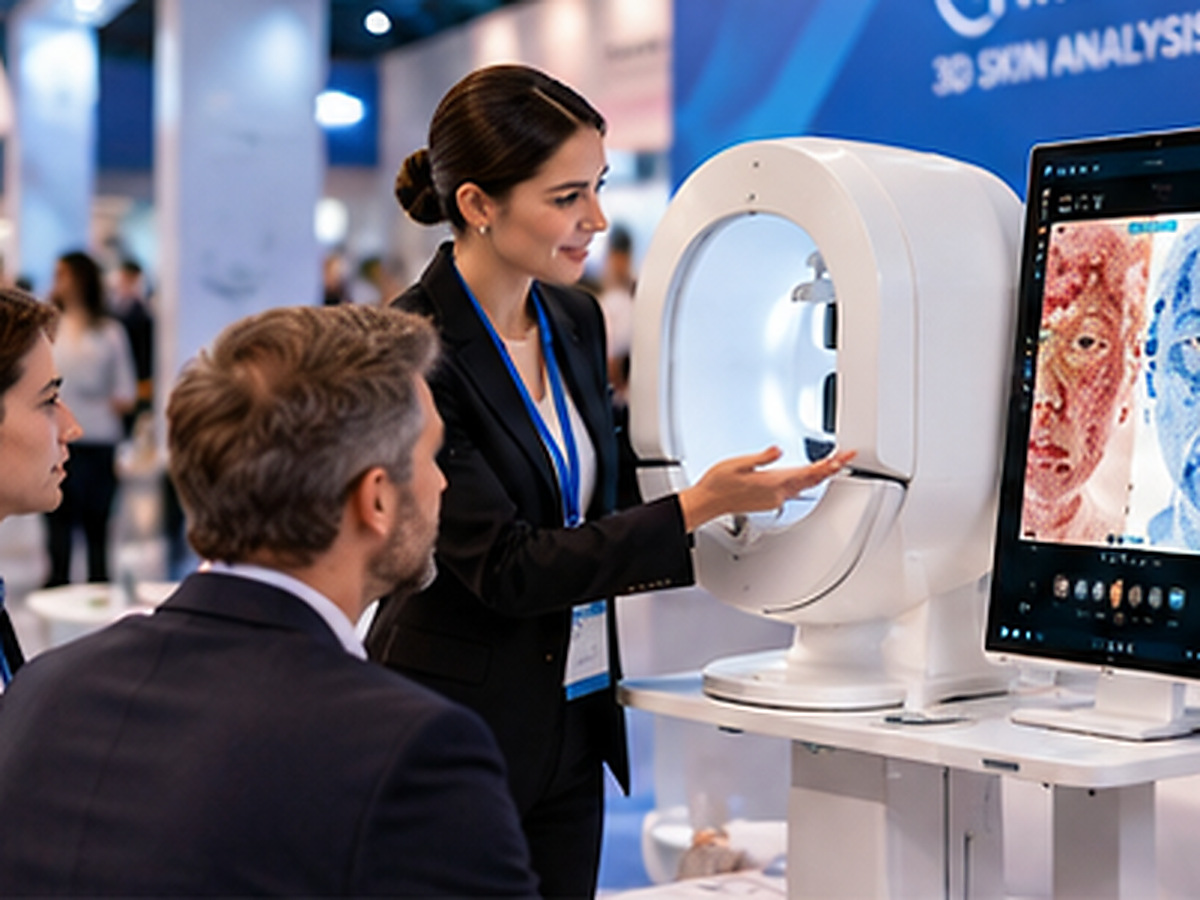
An AI skin analyzer performs quantitative parameter extraction. The ISEMECO 3D D9 captures full-face images under four spectral modes (RGB, cross-polarized, parallel-polarized, UV), builds a 3D model with 0.2 mm accuracy, and applies algorithms to grade features. Outputs include:
- Aging assessment: 8 dimensions graded into severity levels
- Pigmentation and sensitivity: Area percentage and severity classification
- 3D morphology: Volume change measurement accurate to 0.1 mL
What a Dermatologist Does
A dermatologist performs integrative diagnostic reasoning. The clinical assessment incorporates:
- History: onset, evolution, prior treatments
- Palpation: texture, induration, mobility
- Dermoscopy: subsurface structures at 10–20× magnification
- Contextual judgment: age, phototype, immunosuppression status
Quantified Performance: What the Data Shows
| Performance Metric | AI Tool 1 | AI Tool 2 | Study Context |
|---|---|---|---|
| Sensitivity (Malignant) | 88% | 82% | 180 lesions, 33.3% malignant |
| Specificity (Benign) | 78% | 83% | |
| Melanoma Detection | 92% | 84% | n=25 |
Where AI Outperforms
Repeatability: Fixed capture geometry produces identical measurements for identical conditions.
Quantitative Documentation: Shows 3D volume difference maps with color-coded change zones for treatment verification.
Where AI Falls Short
Training Gap: Only 5.8% of training data represents darker skin tones (Fitzpatrick V–VI).
Context Deficit: AI cannot recognize medical triggers like medication history or topical steroid use.
Frequently Asked Questions
Can an AI skin analyzer diagnose skin cancer as accurately as a dermatologist?
No. Diagnostic AI tools have shown sensitivity of 82–92% for malignant lesions. Dermatologists integrate history, palpation, and context that image-based AI does not capture.
Is the ISEMECO 3D D9 a medical device?
The D9 is described as a skin imaging and analysis system for aesthetic and morphological assessment, not disease diagnosis. Regulatory classification varies by jurisdiction.
Why does AI perform worse on darker skin tones?
Training datasets are heavily skewed toward lighter skin (Fitzpatrick V–VI images constitute only 5.8% of the total), leading to lower accuracy for underrepresented groups.
Post time: Nov-09-2026


