


Quick Answer
The accuracy of a professional face analysis machine varies by measurement domain and cannot be reduced to a single number. For 3D structural measurements—wrinkle depth, facial volume, contour—high-end systems achieve sub-millimeter precision (e.g., 0.02–0.1 mm resolution) under standardized conditions. For AI-based skin feature detection, laboratory studies report mean average precision (mAP) around 0.83 for wrinkles and pores, though real-world performance depends on skin tone diversity, lighting control, and operator technique. Independent validation studies on imaging-based facial aging detection show correlation with age ranging from 0.73 to 0.82 and repeatability scores up to 0.93, depending on the system. The critical caveat: accuracy claims without published methodology, diverse validation datasets, or live demonstration on real patients should be treated with skepticism.
Key Takeaways
Domain-Specific Accuracy
3D structural measurement accuracy (0.02–0.1 mm) is fundamentally different from AI skin-condition grading accuracy (mAP ~0.83); conflating the two misleads buyers.
Independent Validation Exists
Peer-reviewed research on imaging systems reports correlation with age of 0.73–0.82 and stability scores of 0.80–0.93, providing a benchmark for evaluating vendor claims.
Standardization Is the Multiplier
Even a precise device produces unreliable data without controlled capture conditions, operator training, and consistent landmark definitions.
Demonstration Beats Specification
The most reliable accuracy test is a live scan of a patient with a known condition, repeated twice to assess repeatability.
What Does “Accuracy” Mean for a Face Analysis Machine?
Accuracy for a face analysis machine means the degree to which the system’s measurements agree with a trusted reference standard—and that standard differs by measurement type. A buyer comparing specifications must first understand what kind of accuracy is being claimed.
Three distinct accuracy types apply to these systems:
- Geometric accuracy (3D structural): How closely the reconstructed 3D surface matches the true physical topography. This is measured in millimeters or micrometers against a reference object or direct anthropometry. The ISEMECO D9MAX specifies 0.02 mm 3D resolution, a geometric capability claim.
- Detectability accuracy (AI feature detection): How reliably the algorithm identifies and localizes features like wrinkles, pores, or pigmentation compared to human expert annotation. This is measured through metrics like sensitivity, specificity, and mean average precision (mAP).
- Longitudinal repeatability: How consistently the system produces the same measurement when the same subject is scanned multiple times under identical conditions. This is measured through intraclass correlation coefficients (ICC) or stability scores.
A system may excel at one type and underperform at another. A device with excellent 3D geometric accuracy may have a poorly validated AI detection model. A system with high AI detection mAP may produce inconsistent longitudinal measurements if capture conditions vary.
Table 1: Accuracy Types and How to Evaluate Them
| Accuracy Type | What It Measures | How It’s Reported | What to Ask the Vendor |
|---|---|---|---|
| Geometric (3D) | Surface reconstruction fidelity | Resolution (mm), point cloud density | “Can you demonstrate repeat scans of the same subject?” |
| AI Detection | Feature identification vs. expert | mAP, sensitivity, specificity | “What dataset was the model trained and validated on?” |
| Longitudinal | Measurement consistency over time | ICC, stability score | “What is the repeatability specification?” |
How Accurate Are 3D Structural Measurements?
3D structural measurements from professional face analysis machines are accurate to sub-millimeter levels under controlled conditions, but regional variation across the face affects reliability. A systematic review of 3D facial scanning modalities published in 2026 concluded that established stereophotogrammetry and structured-light systems “showed consistently strong performance” for soft-tissue landmark assessment, though accuracy was not uniform across all facial regions.
The review noted that scanner performance “should not be interpreted as a single uniform value across the entire face”. Midline landmarks generally show higher reproducibility than lateral facial regions. This matters for clinical use: a system may measure nasal tip position with high confidence but produce less reliable data for jawline contour in the lateral view.
For volume measurements, high-end systems like the ISEMECO D9MAX claim 0.1 mL difference calculation for treatment verification. Independent validation of this specific claim is not available in peer-reviewed literature, but the specification is consistent with the capabilities of structured-light 3D systems used in other clinical contexts. The practical test is repeatability: if the system reports a 0.1 mL difference between two scans of the same untreated subject, that variation represents the system’s measurement noise floor—and it should be well below the treatment effect the clinic intends to document.
How Accurate Is AI Detection of Skin Features?
AI detection of skin features is accurate enough for consultation support but should not be treated as diagnostic-grade. Independent research on imaging-based facial aging detection provides useful benchmarks. A 2025 study evaluating three imaging systems against human assessment as the gold standard reported accuracy adjustments of 0.75, 0.68, and 0.63 for the three systems tested. The highest-performing system achieved a correlation with age exceeding 0.82.
For AI feature detection specifically, a separate study reported mAP@0.5 of 0.833 for wrinkle and pore detection under optimized conditions. This indicates that algorithms can localize and classify subtle textural features with reasonable reliability on curated datasets.
The limitation is dataset diversity. A 2025 systematic review of AI dermatology diagnostics found that models achieved high accuracy (up to 99%) in some tasks, but noted that “underrepresented skin tones in datasets” and “limited clinical validation” remain significant barriers to equitable real-world performance. Most aesthetic AI models are trained predominantly on lighter skin tones; performance on Fitzpatrick IV–VI skin is less well documented.
Table 2: Independent Accuracy Benchmarks for Imaging Systems
| Metric | Reported Range | Context | Implication for Buyers |
|---|---|---|---|
| Correlation with age | 0.73–0.82 | 2,000-subject study | Higher correlation indicates better validity |
| Accuracy vs. human assessment | 0.63–0.75 | Same study | Best systems diverge from experts in ~25% of cases |
| Stability (repeatability) | 0.80–0.93 | Same study | Higher scores indicate consistent tracking |
| Wrinkle/pore detection mAP@0.5 | 0.833 | Optimized detector study | Indicates reliable localization |
What Factors Degrade Accuracy in Real Clinics?
Real-world accuracy degrades due to four factors: capture inconsistency, operator variation, skin tone and condition diversity, and AI training bias. A system validated in a controlled study may perform differently in a busy clinic.
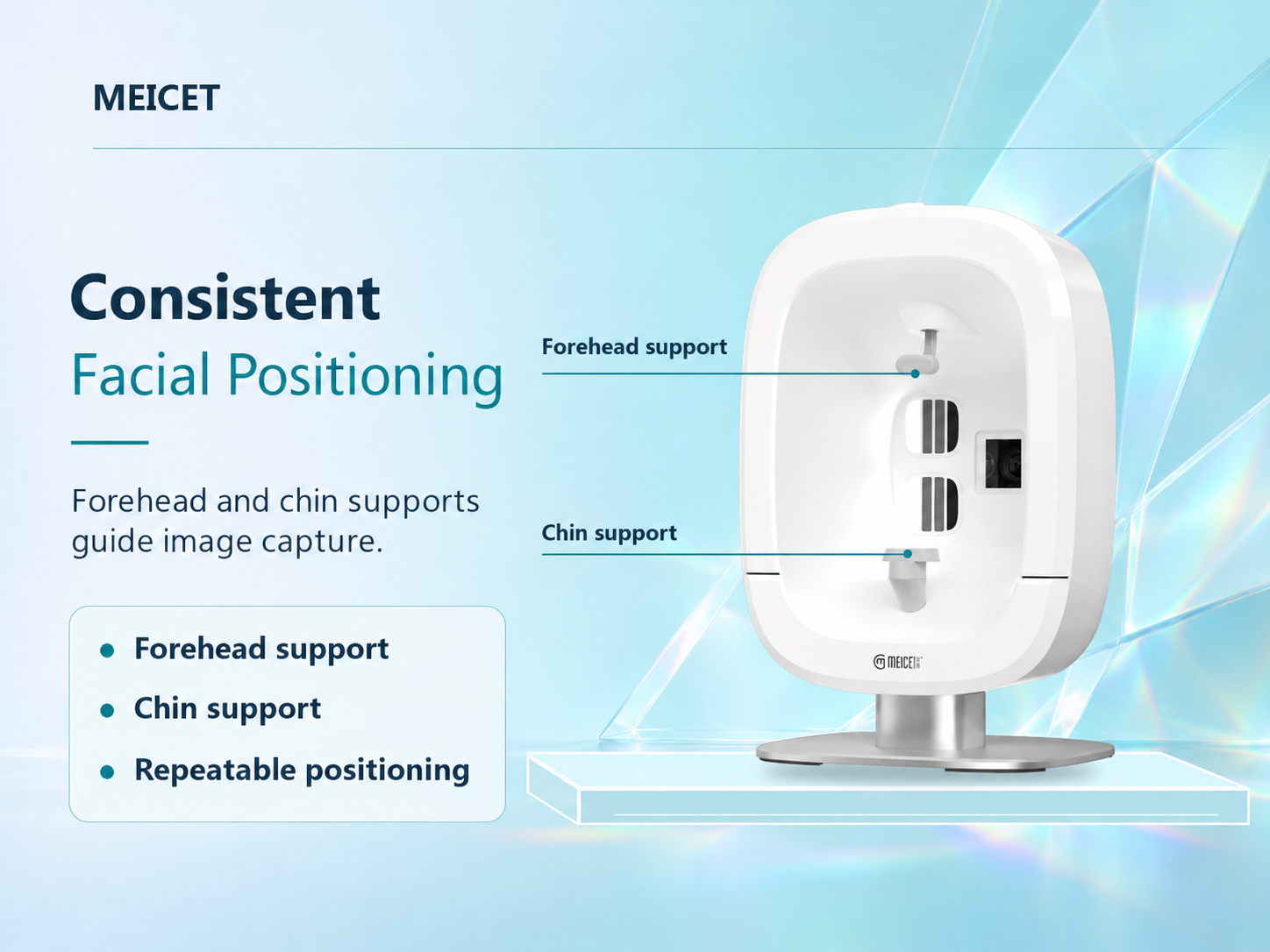
Capture inconsistency is the most common source. Patient positioning, facial expression (neutral vs. relaxed), hair coverage, and ambient light leakage all affect measurement reproducibility. Standardized capture protocols—head rests, fixed camera distance, expression guidelines—mitigate this factor, but only if staff follow them consistently.
Operator variation introduces another layer. The 2026 3D scanning review emphasized that “standardized capture conditions, operator training, and consistent landmark definitions remain essential regardless of device type”. Two technicians scanning the same patient may produce different results if their positioning technique differs.
Skin tone and condition diversity affects AI detection accuracy disproportionately. Models trained on narrow datasets may underperform on melasma, active acne, or darker skin tones where contrast patterns differ from the training data.
AI training bias is a structural limitation. The systematic review on dermatological AI noted that underrepresentation of diverse skin tones in training datasets remains a barrier to equitable performance. A clinic serving a predominantly Fitzpatrick IV–VI patient population should demand evidence of model performance on those skin types, not just overall accuracy metrics.
How Can Buyers Verify Accuracy Claims Before Purchase?
Buyers can verify accuracy claims through four practical tests: live demonstration on real patients, repeat-scan consistency testing, regional comparison against known features, and request for validation documentation. Vendor brochures are not validation.
- Live demonstration on real patients: Request a scan of a volunteer with a visible, quantifiable feature—a known asymmetric contour, a moderate-to-deep nasolabial fold, or visible melasma.
- Repeat-scan consistency testing: Scan the same subject twice in succession without changing position. Compare reported values. Variation represents the system’s inherent imprecision.
- Regional comparison: Ask to demonstrate measurement on both midline (forehead) and lateral (jawline) features to check for uniform accuracy.
- Validation documentation: Should include dataset size, skin tone distribution, reference standard used, and reported metrics.
Frequently Asked Questions
Is a professional face analysis machine accurate enough to replace a dermatologist’s visual assessment?
No. A face analysis machine detects and quantifies optical features; a dermatologist provides clinical interpretation, contextual judgment, and—critically—the ability to recognize when a lesion requires biopsy. The machine supports the consultation; it does not replace the clinician.
What is the accuracy of 3D wrinkle depth measurement?
High-end systems specify 3D resolution in the range of 0.02–0.1 mm. Independent validation of wrinkle depth measurement specifically is limited, but the 2026 systematic review concluded that structured-light and stereophotogrammetry systems provide clinically acceptable soft-tissue measurement under standardized conditions.
How does skin tone affect AI face analysis accuracy?
Darker skin tones (Fitzpatrick IV–VI) are underrepresented in many AI training datasets. A 2025 systematic review of dermatological AI identified this as a persistent limitation. Clinics serving diverse populations should request evidence of model performance across skin types.
Can I trust the accuracy metrics in a vendor’s brochure?
Treat brochure metrics as claims to be verified, not established facts. Ask for the dataset size, skin tone distribution, reference standard, and peer-reviewed publication (if any). Then conduct a live demonstration.
What is the difference between precision and accuracy for these machines?
Precision is the consistency of repeated measurements—does the system produce the same number when scanning the same subject twice? Accuracy is the agreement between the measurement and the true value. For clinical tracking, both matter.
How often does a face analysis machine need calibration?
Calibration requirements vary by device and manufacturer. Geometric 3D systems may require periodic calibration against a reference object; AI models are typically fixed at deployment unless the vendor provides software updates.
Does a higher pixel count mean better accuracy?
No. Pixel count determines image resolution but not measurement accuracy. 3D resolution (in millimeters) and validation methodology are more directly related to accuracy than camera pixel count.
Post time: Nov-17-2026


